Brand Architecture: Organizing Your Portfolio for Maximum Market Impact

When companies expand beyond a single offering, they face crucial decisions about how their various products and services should relate to one another. These choices form the essence of brand architecture—the strategic blueprint that organizes your brand portfolio. Far from being merely an administrative exercise, it profoundly shapes customer perceptions, operational efficiencies, and market opportunities.
This comprehensive guide explores the critical role of brand architecture in business growth. We delve into core models like Branded House and House of Brands, offer strategic advice on selecting the right framework, and provide actionable steps for implementation. By mastering these principles, you can clarify your market positioning, maximize brand equity, and drive sustainable success across your entire portfolio.
The Strategic Importance of Brand Architecture
Brand architecture serves as the organizational backbone that determines how brands within a portfolio connect to and differentiate from one another. It is the structural framework guiding decisions about naming, visual identity, messaging hierarchies, and the overall customer experience across different market segments. Well-designed architectures balance distinctiveness with efficiency, creating clear connections where beneficial while maintaining appropriate separation where necessary.
The significance of brand architecture has grown exponentially as companies increasingly expand through innovation, product line extension, and acquisition. Modern organizations frequently manage multiple brands serving various market segments across diverse geographies. Without coherent architectural principles, this complexity quickly becomes unmanageable—confusing customers, complicating operations, and undermining hard-earned brand equity.
At brandsdad.com, we’ve observed that companies who proactively design their brand architecture achieve better growth metrics than those who allow structures to evolve haphazardly. Strategic architecture decisions enable more effective resource allocation, clearer customer targeting, and greater marketplace impact from marketing investments.
Why It Matters for ROI
Investing in a solid branding strategy isn’t just about aesthetics; it’s about the bottom line. A disorganized portfolio leads to internal competition (cannibalization) where your own brands fight for the same customers. Conversely, a clear architecture allows for cross-selling, up-selling, and a more efficient use of marketing budget. When customers understand the relationship between your sub-brands and your master brand, trust transfers more easily, lowering the cost of customer acquisition.
Core Brand Architecture Models
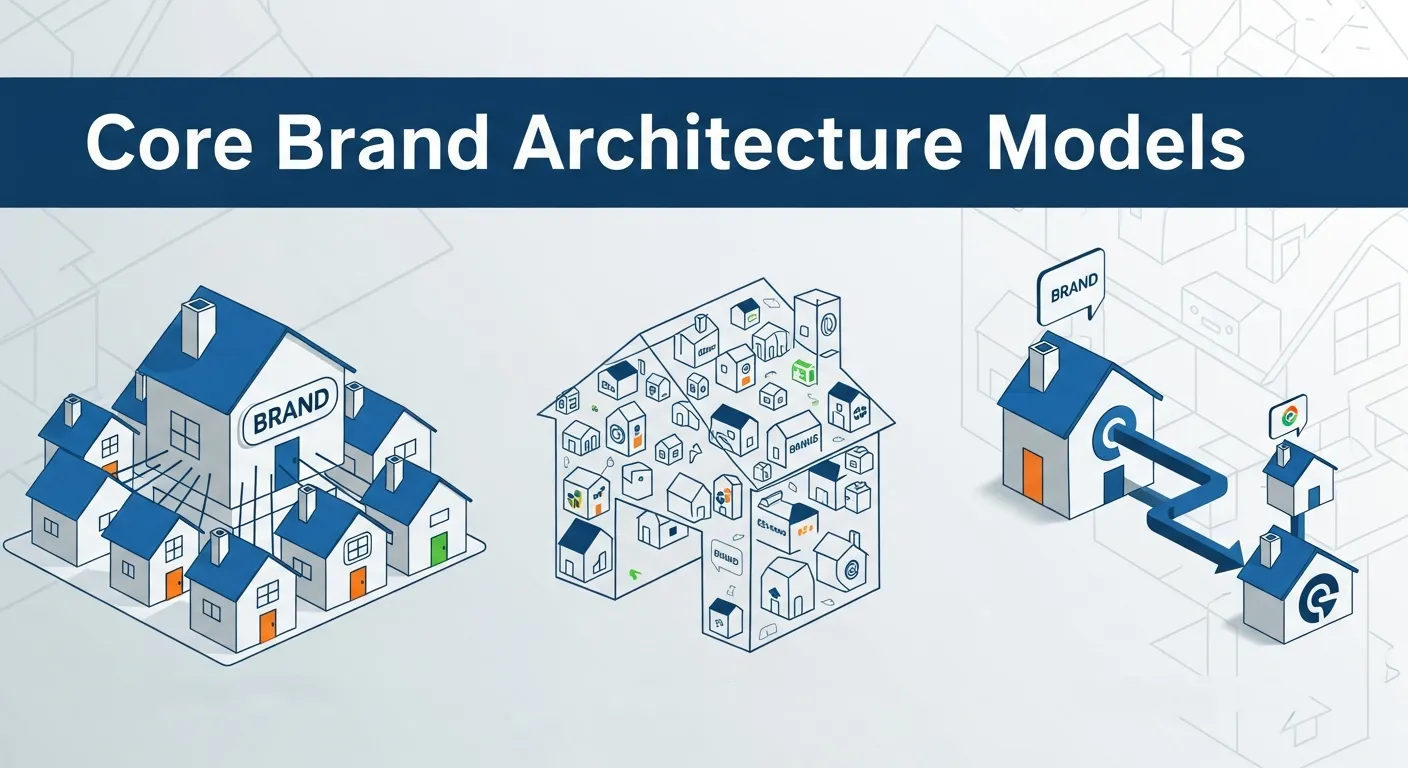
While brand architecture exists along a spectrum with numerous hybrid approaches, understanding three fundamental models provides essential context for portfolio decisions. These foundational structures—Branded House, House of Brands, and Endorsed Brands—represent distinct philosophical approaches to managing brand relationships.
1. The Branded House (Monolithic)
The Branded House model unifies all offerings under a single master brand, using descriptive sub-brands or product names for differentiation. This approach relies heavily on the strength of the parent brand to drive adoption.
- Example: FedEx. With offerings like FedEx Ground, FedEx Express, and FedEx Freight, the company maintains a consistent brand identity while communicating service differences.
- Example: Google. Offerings like Google Maps, Google Drive, and Google Photos create immediate familiarity while allowing each service to maintain functional differentiation.
Pros:
- Efficiency: Marketing investment in the master brand lifts all boats.
- Clarity: Customers instantly know who stands behind the product.
- New Product Launch: New offerings gain immediate credibility through brand awareness.
Cons:
- Risk: A PR crisis for the master brand affects every product in the portfolio.
- Inflexibility: It can be difficult to stretch the brand into unrelated categories (e.g., Google trying to sell shoes might feel disjointed).
2. The House of Brands (Pluralistic)
The House of Brands model maintains separate, distinct brand identities with minimal visible connection to their parent organization. Each brand stands on its own, with its own brand voice, visual style, and target audience.
- Example: Procter & Gamble (P&G). Brands like Tide, Pampers, and Gillette function as independent entities. Most consumers buy Tide without ever thinking about P&G.
- Example: Unilever. Dove, Axe, and Ben & Jerry’s operate independently, allowing Unilever to serve different needs without brand conflict.
Pros:
- Targeting: Allows for precise targeting of different niche markets or customer journey mapping without alienation.
- Risk Containment: A failure in one brand does not tarnish the others or the parent company.
- Market Coverage: You can own multiple positions in the same category (e.g., a luxury option and a budget option).
Cons:
- Cost: Maintaining separate brands requires distinct marketing budgets, teams, and strategies for each.
- No Synergy: There is little to no “halo effect” from the parent company.
3. The Endorsed Brand (Hybrid)
Between these extremes lies the Endorsed Brand model, where independent brands maintain their identity while receiving explicit endorsement from a parent brand. This creates a trust transfer while allowing each brand to maintain its unique positioning.
- Example: Marriott International. Properties like Courtyard by Marriott, Residence Inn by Marriott, and Fairfield by Marriott use the “by Marriott” endorsement.
- Example: Nestlé KitKat. The product has its own distinct brand, but the Nestlé endorsement provides quality assurance.
Pros:
- Credibility: The sub-brand borrows trust from the parent brand.
- Independence: The sub-brand can still have its own personality and specific value proposition.
Cons:
- Brand Dilution: If the sub-brand performs poorly, it can reflect negatively on the endorser.
- Complexity: Managing the visual hierarchy between the endorser and the endorsed brand can be tricky.
|
Model |
Primary Focus |
Best For |
Key Risk |
|---|---|---|---|
|
Branded House |
Master Brand |
maximizing efficiency and clarity |
Reputation contagion |
|
House of Brands |
Individual Brands |
diverse portfolios & distinct targets |
High marketing costs |
|
Endorsed Brand |
Shared Equity |
launching new products with credibility |
Brand dilution |
Selecting the Right Architectural Approach
Choosing an appropriate brand architecture requires balancing multiple strategic considerations rather than following prescriptive rules. Several key factors should guide this decision-making process, including customer perceptions, competitive landscape, business strategy, and operational realities.
Analyzing Customer Relationship Patterns
Customer relationship patterns significantly influence architectural choices. When customers typically engage with multiple offerings across a portfolio, stronger brand connections (Branded House or Endorsed) create coherence and cross-selling opportunities. Conversely, when different customer segments rarely overlap, distinct brand identities (House of Brands) often prove more effective in establishing relevant positioning for each audience.
Category Dynamics and Innovation
According to industry insights, companies must consider category dynamics when determining appropriate architecture. Categories with strong emotional engagement and personal identity associations often benefit from more distinct architectures that allow precise positioning. Meanwhile, offerings with primarily functional benefits frequently gain efficiency through more connected approaches.
Market expectations around innovation also shape architectural decisions. In categories where customers expect continuous innovation and new capabilities, Branded House approaches can efficiently transfer innovation credentials across products. However, in categories where specialized expertise creates credibility, more separated architectures often prove advantageous.
Impact of Mergers and Acquisitions (M&A)
Portfolio expansion plans should significantly influence architectural frameworks. Organizations anticipating growth through acquisition may benefit from flexible architectures that accommodate diverse brand cultures. Companies focused on organic innovation may prefer more unified approaches that efficiently extend existing brand equity into new areas.
Often, M&A activity forces a “re-architecture.” If you acquire a company with strong brand awareness, killing that brand to fold it into a Branded House might destroy value. In this case, an Endorsed model might serve as a transitional phase, eventually moving toward a unified brand once the customer base is migrated.
Implementing Effective Brand Architecture

Translating architectural concepts into market reality requires meticulous planning and consistent execution across multiple dimensions. This implementation process connects strategic intent with customer experience through the systematic application of naming conventions, visual identity systems, messaging frameworks, and experience design.
Naming Systems and Conventions
Naming systems require particular attention during implementation, as they create the most visible manifestation of architectural relationships.
- Descriptive Naming: Clearly communicates product functions and relationships (e.g., iPhone, iPhone Pro, iPad Air). This boosts clarity and SEO.
- Abstract Naming: Creates greater separation and allows for unique brand personalities (e.g., Lexus LS, Lexus RX vs. Toyota Camry).
These naming decisions should balance distinctiveness with logical connections appropriate to the chosen architecture. A confusing naming convention is the first step toward losing a potential customer.
Visual Identity Systems
Visual identity guidelines must translate architectural relationships into cohesive design systems. These guidelines establish how brand elements vary or remain consistent across the portfolio, determining the degree of visual connection between different offerings.
- Color Palette: Does the sub-brand share the master brand’s primary color?
- Logo Usage: Is the master brand logo dominant, secondary, or absent?
- Typography: Do all brands share the same font family to signal unity?
Thoughtful visual systems maintain appropriate distinctiveness while leveraging recognition efficiencies where beneficial. Tools like Canva or Adobe Express are often used to maintain these visual standards across distributed teams.
Operationalizing the Structure
Internal organizational structures often present significant challenges in architecture implementation. When internal divisions or business units maintain separate P&L responsibility for different brands, natural incentives emerge to maximize individual brand performance—potentially at the expense of portfolio coherence.
Effective governance mechanisms must align these internal incentives with the intended architectural vision. This might involve creating a “Brand Council” that oversees brand alignment and approves new naming or visual identity requests to prevent “brand sprawl.”
Managing Brand Architecture Through Change
Brand architectures inevitably evolve as organizations grow, markets transform, and competitive landscapes shift. Managing this evolution requires balancing stability with adaptability—maintaining valuable brand equity while accommodating necessary changes.
Adapting to Geographic Expansion
Geographic expansion challenges architectural frameworks, particularly when entering markets with different competitive dynamics or cultural contexts. A name that works in the US might have negative connotations in Japan. Organizations must determine whether existing architectural principles remain appropriate in new regions or require adaptation to local conditions (known as “glocalization”). These decisions balance global consistency against local relevance.
Navigating Digital Transformation
Category disruption through technological change or new business models often necessitates architectural evolution. When existing categories merge or fragment, traditional architectural boundaries may require reconsideration to reflect new market realities.
For example, the shift to SaaS (Software as a Service) often pushes companies toward a Branded House model to emphasize the integrated nature of the software suite (e.g., Adobe Creative Cloud vs. selling Photoshop and Illustrator as disparate boxed software). Organizations that proactively adapt architectural approaches during industry transformation maintain stronger market positions than those clinging to outdated structures.
Measuring Architecture Effectiveness
Evaluating brand architecture effectiveness requires assessing both market perception and business performance metrics. Comprehensive measurement frameworks combine customer research with commercial indicators to provide a holistic perspective on architectural impact.
Customer Perception Metrics
Customer perception metrics should evaluate architecture comprehension, examining whether target audiences understand intended brand relationships. Research methodologies like brand mapping exercises, association studies, and purchase journey analysis reveal how effectively the architecture translates to customer understanding. These studies identify confusion points requiring clarification or reinforcement.
- Brand Awareness: Does the target market know Brand B is part of Brand A?
- Trust Transfer: Does affection for the parent brand increase willingness to try the sub-brand?
Business Performance Metrics
Business performance metrics should examine both efficiency and effectiveness dimensions.
- Resource Allocation Efficiency: Are we spending less on marketing per unit of revenue because of shared brand assets?
- Cross-Sell Ratios: Are customers of one brand buying products from other brands in the portfolio?
- Market Share: Is the portfolio capturing a larger share of the total addressable market?
Regular architectural audits maintain alignment between strategic intent and market reality. These systematic reviews examine how portfolio elements relate to one another, identifying inconsistencies or missed opportunities for stronger connections. Such audits should occur at regular intervals and whenever significant portfolio changes occur through introduction or acquisition.
Evolving Architectural Considerations
Several emerging trends are reshaping brand architecture approaches across industries. Understanding these evolving considerations helps organizations develop forward-looking frameworks adapted to changing market realities.
The Rise of Ecosystem Brands
Subscription models and integrated ecosystems create new opportunities for connected architectures that emphasize portfolio relationships. When customers engage with multiple offerings simultaneously through bundled services (like Apple One or Amazon Prime), architectures that highlight complementary benefits and seamless integration create a competitive advantage. These connected experiences often benefit from more unified architectural approaches that emphasize portfolio membership over individual product identity.
Purpose-Driven Architecture
Purpose-driven positioning increasingly influences architectural decisions as organizations articulate social and environmental commitments. Brands sharing common purpose orientations (e.g., sustainability) often benefit from stronger architectural connections that reinforce these commitments across offerings. Conversely, brands with divergent purpose positions may require greater separation to maintain authentic relationships with different customer segments. This ties heavily into reputation management; a brand built on sustainability cannot easily house a product line known for pollution without damaging the entire architecture.
The Digital Shelf
Digital experience environments have transformed how customers encounter and interact with brand portfolios. Mobile interfaces, voice interaction, and app ecosystems create new contexts for brand relationships that may require architectural adaptation. On a small mobile screen, complex endorsed logos may be illegible. Organizations must consider how their architecture manifests in these digital environments where space constraints and interaction patterns differ from traditional channels.
Strategic Implementation Guidance
Organizations seeking to optimize their brand architecture should approach the process methodically rather than making isolated decisions for individual brands.
- Portfolio Assessment: Begin with a comprehensive portfolio assessment examining current and planned offerings across dimensions including target customers, value propositions, competitive positioning, and growth trajectories.
- Perceptual Mapping: Map existing customer perceptions through research that reveals how target audiences currently understand portfolio relationships. This perceptual baseline identifies areas where architectural reality diverges from strategic intent, highlighting opportunities for clarification or restructuring.
- Define Principles: Develop guiding principles that translate strategic objectives into architectural guidelines. These principles establish decision criteria for evaluating architectural options rather than prescribing specific structures.
- Transition Planning: Create transition plans that manage evolution rather than attempting immediate transformation. Brand architecture changes typically require phased implementation that respects existing equity while moving systematically toward the desired framework. These transitions should prioritize high-visibility touchpoints while managing change costs through scheduled updates rather than emergency replacements.
Conclusion
Brand architecture represents one of the most consequential strategic decisions organizations make regarding their market presence. By thoughtfully designing how brands within their portfolio relate to one another, companies create frameworks that maximize both individual brand strength and collective portfolio impact. The resulting clarity benefits customers through more intuitive choices while delivering organizational efficiency through more focused brand investments.
Whether you choose a Branded House, a House of Brands, or a hybrid solution, the key is intentionality. A haphazard architecture leaks value; a strategic one compounds it. As you look to the future, consider how your current structure supports your business goals. Is it a springboard for growth, or a hurdle to innovation? By organizing your portfolio for maximum market impact today, you safeguard your brand’s relevance for tomorrow.
Frequently Asked Questions (FAQs)
1. What is the difference between brand identity and brand architecture?
Brand identity refers to the visual and verbal elements (logo, color, tone) that distinguish a single brand. Brand architecture is the structural relationship between multiple brands within a single organization’s portfolio. Architecture dictates how the identities of different sub-brands relate to the master brand.
2. When should a company revisit its brand architecture?
You should conduct a review during major business shifts: mergers and acquisitions, launching a new product category, expanding into new international markets, or if market research indicates significant customer confusion about your offerings.
3. Is the “Branded House” model always the cheapest option?
Generally, yes. It is more cost-efficient because you focus your marketing spend on building one master brand. However, it carries higher risk; if the master brand suffers a reputation crisis, all sub-brands suffer.
4. Can a company switch from a House of Brands to a Branded House?
Yes, but it is a complex, multi-year process. It often involves rebranding popular products to carry the master brand name (e.g., changing “Product X” to “MasterBrand X”). This risks alienating loyal customers of the original product, so it requires careful change management.
5. How does brand architecture affect SEO?
It has a huge impact. A Branded House typically uses subdomains or subdirectories (brand.com/product) which consolidates domain authority and boosts SEO. A House of Brands usually relies on separate domains (product.com), which splits authority and requires separate SEO strategies for each site.
6. What is a “hybrid” brand architecture?
A hybrid architecture mixes elements of different models. For example, a company might operate as a Branded House for its core B2B services but use a House of Brands strategy for its consumer-facing products to avoid brand dilution.
7. How do I know if my brand architecture is broken?
Signs include: customers are confused about who owns which product; internal teams are fighting over which logo to use; marketing costs are spiraling because you are supporting too many weak brands; or cross-selling attempts are failing because customers don’t see the connection.
8. What role does the “Master Brand” play in a House of Brands?
In a pure House of Brands (like P&G), the master brand is largely invisible to the consumer and serves primarily as a holding company for investors and employees. However, recently, some House of Brands companies are making the parent brand more visible to leverage corporate social responsibility (CSR) reputation.
9. How does brand architecture impact company culture?
Architecture signals how the company is organized. A Branded House fosters a “one team” culture. A House of Brands can create siloed cultures where employees identify more with their specific brand than the parent company.
10. What tools can help manage brand architecture?
Brand Asset Management (BAM) software and Digital Asset Management (DAM) systems like Bynder or Frontify are essential. They ensure that teams across different brands and regions access the correct logos, guidelines, and templates, maintaining the architectural integrity you’ve defined.