Brand Cannibalization: How to Expand Your Portfolio Without Self-Competition

Every business leader dreams of growth. Yet, the path to expansion is often paved with good intentions that lead to unexpected consequences. When companies introduce new products or services alongside existing ones, they sometimes face a silent profit killer: their new offerings stealing market share from established products rather than expanding the total market. This phenomenon, known as brand cannibalization, requires careful navigation and strategic foresight.
This comprehensive guide explores the complexities of brand cannibalization, explaining how it occurs and why it matters. You will learn to identify potential risks before launching new products, discover strategies to minimize harmful self-competition, and understand when brand cannibalization can actually be a strategic advantage. We also cover how to measure impact using data from tools like Google Analytics and provide a detailed FAQ section to answer your most pressing questions.
Understanding Brand Cannibalization
At its core, brand cannibalization occurs when a company’s new product diverts sales from its existing products instead of generating genuinely new revenue. It is the business equivalent of robbing Peter to pay Paul. While sometimes intentional, unplanned brand cannibalization can damage profitability, dilute brand equity, and confuse customer perception.
Imagine you own a successful coffee shop known for its premium hot lattes. To capitalize on the summer heat, you introduce a line of iced coffees. Ideally, this new line brings in customers who wouldn’t have bought a hot drink anyway. However, if your loyal latte drinkers simply switch to the cheaper iced coffee, your total revenue might decrease even though you sold more units. That is the essence of negative brand cannibalization.
The Classic Case of Coca-Cola
Consider the classic example of Coca-Cola. When the company launched Diet Coke in 1982, executives were understandably worried. They feared the new zero-calorie soda would eat into the sales of their flagship product, Coca-Cola Classic.
Some brand cannibalization indeed happened. Die-hard Coke fans switched. However, Diet Coke also attracted an entirely new segment of consumers—those who were health-conscious or avoiding sugary drinks entirely. By accepting a degree of internal competition, Coca-Cola ultimately expanded its overall market presence and solidified its dominance in the beverage industry. This illustrates that not all brand cannibalization is bad; it depends entirely on the net result for the company’s bottom line.
Types of Cannibalization
To manage this phenomenon effectively, we must distinguish between its different forms:
- Planned Cannibalization: This is a strategic move. A company introduces a new product knowing it will replace an older one, often to stay ahead of technology trends or competitors. Apple’s iPhone replacing the iPod is the quintessential example.
- Unplanned Cannibalization: This is the dangerous variety. It happens when a new product launch fails to target a new segment effectively, resulting in accidental sales theft from existing lines.
- Discount Cannibalization: This occurs when a company runs frequent sales or promotions. Customers stop buying at full price, waiting instead for the inevitable discount, effectively cannibalizing future full-price sales.
Identifying Potential Cannibalization Risks
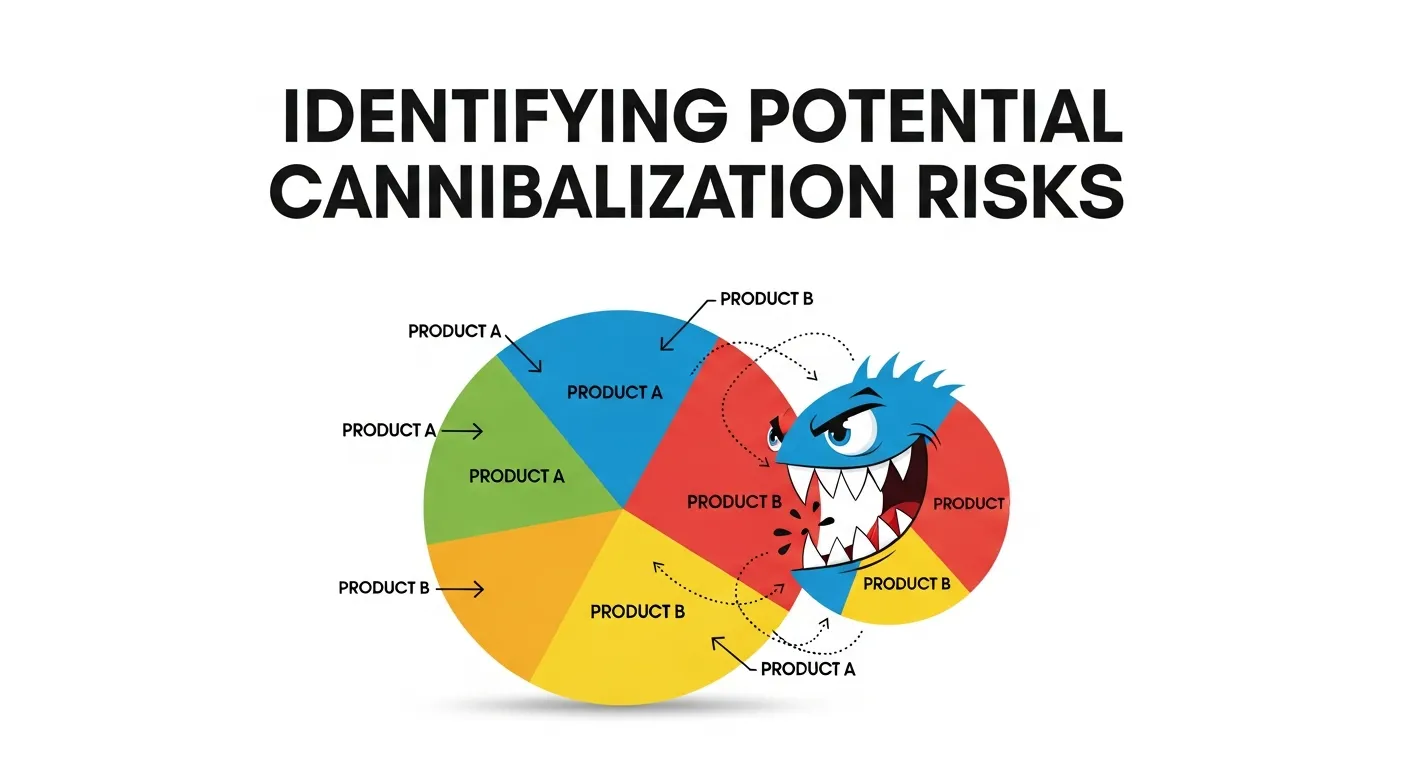
Before expanding your portfolio, you must assess potential internal competition. Ignoring this step is a common pitfall in brand marketing strategy. You can predict potential issues through several analytical approaches.
1. Market Analysis and Overlap
A thorough market analysis reveals where your products might overlap in solving customer problems. If two products solve the exact same pain point for the same user at a similar price, brand cannibalization is virtually guaranteed.
Use tools like SEMrush or Ahrefs to analyze keyword intent. If the search terms for your proposed product are identical to those of your existing best-seller, you are likely targeting the same audience. You need to ask: Does this new offering provide a distinct value proposition, or is it just a “flavor of the week”?
2. Customer Segmentation Deep Dive
Customer segmentation is your best defense against accidental self-competition. You need to identify whether your new offerings target distinct demographics or merely appeal to your existing customer base.
- Demographic Data: Are you targeting a different age group, income level, or geographic location?
- Psychographic Data: Does the new product appeal to a different lifestyle or set of values?
- Behavioral Data: Is the new product for a different usage occasion (e.g., on-the-go vs. at-home)?
If your new luxury watch targets the exact same affluent professional as your existing luxury watch, without a significant difference in design or function, you are setting the stage for cannibalization.
3. Examining Sales Patterns
Historical data is a goldmine. Sales pattern examination from previous launches can highlight whether earlier expansions affected established product performance. Look at your sales data in Google Analytics or your CRM. Did sales of Product A dip significantly the month Product B was launched? Did they recover, or did the dip become permanent?
Many businesses fail to recognize cannibalization until sales figures already reflect the damage. Marketing charts often demonstrate that consumer loyalty becomes increasingly fragmented in markets with excessive product options. When consumers are overwhelmed with choices from the same brand, they may experience decision paralysis or simply migrate to the cheapest option.
Strategies to Minimize Harmful Brand Cannibalization

Successful brand portfolio expansion requires deliberate positioning. You cannot simply throw products at the wall and hope they stick. Here are the most effective strategies to protect your revenue streams.
Clear Differentiation is Key
Differentiation ensures each product serves distinct purposes or customer segments. It is not enough for the products to be different; the customer must perceive them as different.
When Apple introduced the iPad, critics screamed that it was just a “big iPhone” and would eat into Mac sales. However, Apple carefully positioned it. The iPhone was for mobility and communication; the Mac was for productivity and creation; the iPad was for consumption and entertainment. This “third category” positioning minimized brand cannibalization while establishing a new massive revenue stream.
Price Tiering and Segmentation
Price tiering creates a natural separation between products aimed at different market segments. This is a staple of luxury brand marketing and the hospitality industry.
Consider Marriott Hotels. They maintain a vast portfolio of brands under one corporate umbrella:
- Fairfield Inn: Budget-conscious travelers.
- Courtyard: Business travelers needing reliability.
- JW Marriott: Luxury seekers wanting distinct service.
These brands rarely compete directly because the price points and service levels act as barriers. A customer looking for a $100/night room is unlikely to book a $500/night suite, and vice versa. This allows Marriott to capture share of wallet across the entire economic spectrum without their brands fighting each other.
Geographic Separation
Sometimes, the solution is physical. Geographic separation allows similar products to thrive in different markets without competition.
For example, a CPG brand marketing team might test a new flavor of chips in the West Coast market while keeping their traditional lineup in the East. If the test is successful and shows no cannibalization of the core product, they might expand. Regional exclusivity can also increase product longevity by creating a sense of scarcity and local relevance.
Temporal Spacing (Timing Your Launches)
Temporal spacing between product launches gives each offering time to establish its market position before introducing potentially competing items.
If you launch two similar smartphone models in the same month, the marketing messages will blur, and customers will be confused. By spacing them out—perhaps one in the spring and one in the fall—you allow the market to digest the first product. This also gives your marketing team distinct windows to focus on specific brand storytelling for each item.
Distinct Branding and Sub-Brands
Building a cannibalization-resistant brand architecture often involves creating distinct sub-brands. This allows you to target different audiences without diluting your core brand equity.
- Toyota and Lexus: Toyota created Lexus to enter the luxury market. If they had launched a $60,000 car under the Toyota name, it likely would have failed or confused customers. The distinct brand identity allowed them to capture a new segment without confusing the value proposition of their economy cars.
- Old Navy, Gap, Banana Republic: This trio targets different price points and style preferences, allowing the parent company to capture revenue from teenagers, families, and professionals simultaneously.
When Cannibalization Makes Strategic Sense
It is crucial to understand that cannibalization is not always the villain. Sometimes, calculated cannibalization serves legitimate business purposes and is a sign of a proactive brand strategy framework.
Defensive Cannibalization
Defensive cannibalization happens when companies introduce products that might cannibalize existing offerings—because if they don’t, competitors will.
The most famous example is Netflix. They built their empire on DVD-by-mail rentals. However, seeing the digital horizon, they pivoted aggressively to streaming. This move cannibalized their lucrative DVD business. If they had tried to protect the DVD revenue, a competitor like Blockbuster or a tech giant would have owned the streaming market, and Netflix might be a relic today. They chose to eat their own lunch before someone else did.
Planned Obsolescence and Lifecycle Management
Planned obsolescence involves deliberately introducing superior products to replace aging ones. This allows a company to control the transition on its terms rather than waiting for market forces to render products obsolete.
Tech companies excel at this. They launch a new version of software or hardware that makes the previous version less desirable. This encourages upgrades and keeps the customer within the ecosystem. It is a form of brand resilience strategy that ensures the company remains at the cutting edge of innovation.
Market Saturation Strategy
In highly competitive markets, a company might flood the shelf with variations of its own product to squeeze out competitors. If you walk down the detergent aisle, you will see Tide in liquid, powder, pods, with bleach, with Downy, for cold water, etc.
Procter & Gamble knows that Tide Pods might cannibalize Tide Liquid. However, by owning more shelf space, they reduce the physical room available for competitors. In this case, the goal is total market share dominance, and internal cannibalization is an acceptable cost of doing business.
Measuring Cannibalization Impact

You cannot manage what you do not measure. Tracking brand cannibalization requires disciplined metrics and regular auditing.
1. Sales Velocity Comparison
Compare the sales velocity of existing products post-launch. If Product A was selling 100 units a week and drops to 60 units a week immediately after Product B launches (selling 50 units), you have a cannibalization rate of 40%.
Formula:
(Lost Sales of Old Product / Sales of New Product) x 100 = Cannibalization Rate
However, remember to look at total revenue. If Product B has a higher profit margin, the total profit might still be up despite the volume loss.
2. Share of Wallet Measurement
Share of wallet tracks whether customers spend more overall or merely redistribute existing spending across your expanded portfolio.
If a customer typically spends $50 a month with you and, after a new launch, splits that $50 between two products, you have gained nothing. If they increase their spend to $70 to try the new item, you have successfully expanded their share of wallet. Loyalty program data is essential for this analysis.
3. Customer Acquisition Source Analysis
Where are the buyers of the new product coming from?
- New-to-Brand: These are net-new customers. This is the holy grail.
- Switchers: These are existing customers moving from your old product.
- Conquesting: These are customers switching from a competitor.
Use survey data or digital attribution models in Google Analytics to determine the source. If 90% of your new product sales are from “Switchers,” your cannibalization risk is high.
4. Brand Sentiment and Perception
Sometimes the damage isn’t in sales dollars but in brand perception. Use brand monitoring services and social listening tools to see if customers are confused. Are they asking “What’s the difference between X and Y?” on social media? Confusion leads to hesitation, which leads to lost sales.
Building a Cannibalization-Resistant Brand Architecture
Long-term protection against harmful cannibalization comes from thoughtful brand architecture. This is the structural blueprint of your brand portfolio.
Establish Clear Hierarchies
Create brand hierarchies where relationships between products make intuitive sense to consumers.
- Master Brand: The overarching entity (e.g., Google).
- Sub-Brands: Distinct offerings under the master (e.g., Google Maps, Google Drive).
- Endorsed Brands: Independent brands with a nod to the parent (e.g., Courtyard by Marriott).
When the hierarchy is clear, the consumer understands the value trade-offs instantly. They know why the “Pro” version costs more than the “Lite” version.
Focus on Complementary Functionalities
Focus on complementary rather than competing functionalities when expanding product lines. This is the essence of cross-selling and brand extension marketing.
If you sell high-end running shoes, don’t launch another nearly identical running shoe. Launch performance socks, moisture-wicking shirts, or hydration packs. These products complement the core offering rather than competing with it. They build a complete ecosystem around the customer’s need (running) without forcing a choice between two similar items.
The Role of Brand Voice Strategy
Your brand voice strategy plays a crucial role in differentiation. Even if two products are functionally similar, you can separate them with voice.
- Product A speaks with technical precision, targeting engineers and experts.
- Product B speaks with simple, friendly language, targeting beginners and hobbyists.
The language you use signals to the customer “This is for me” or “This is not for me,” effectively sorting them into the correct product funnel and minimizing overlap.
Conclusion
Brand cannibalization represents neither inherent success nor failure—it is simply a market dynamic requiring thoughtful management. It acts as a double-edged sword: wielded poorly, it slices into your own profits; wielded with precision, it carves out new market territory and keeps competitors at bay.
By intentionally designing your product portfolio with clear differentiation, purposeful brand positioning, and strategic timing, you can expand your offerings while minimizing destructive internal competition. The goal is not always to eliminate cannibalization entirely—defensive moves often require it—but to ensure that every instance of it is a calculated choice rather than an accidental casualty.
Remember that customer confusion typically precedes harmful cannibalization. When consumers cannot articulate the difference between your products, they default to price-based decisions or stick with familiar options. Clear, consistent communication about each product’s unique value prevents this confusion and preserves the integrity of your expanding brand portfolio. As you look to the future, use data, maintain distinct brand voices, and always keep the customer’s perspective at the center of your growth strategy.
Frequently Asked Questions (FAQs)
1. What is the difference between brand cannibalization and market expansion?
Market expansion involves attracting new customers who were not previously buying your products, thus increasing the total size of your pie. Brand cannibalization occurs when you simply slice the existing pie differently, moving current customers from one of your products to another without gaining net new revenue. Ideally, a new product should drive expansion, not just cannibalization.
2. Is brand cannibalization always bad for business?
No. Strategic or “planned” cannibalization can be beneficial. For example, if you introduce a lower-margin product to block a competitor from entering your market, the loss in margin might be worth the protection of market share. Similarly, cannibalizing an old technology with a new innovation (like streaming replacing DVDs) is essential for long-term survival.
3. How can I test for cannibalization before launching a product?
Conduct concept testing surveys with your current customers. Present the new product concept and ask, “If this product were available today, would you buy it in addition to what you currently buy, or instead of it?” High “instead of” rates indicate high cannibalization risk. You can also run limited market tests in specific geographic regions.
4. Can changing the price reduce cannibalization?
Yes, price tiering is a primary tool for differentiation. By setting a significant price gap between products, you signal that they are for different buyers. However, be careful not to just lower the price of the new item to differentiate it, as this might devalue your brand. The price difference must be justified by a clear difference in features or value.
5. How does brand loyalty impact cannibalization?
High brand loyalty can actually increase cannibalization risk in the short term because your loyal customers are the most likely to try your new offerings. However, loyal customers are also more likely to increase their total share of wallet if the new product complements their existing purchases. The key is to leverage loyalty for cross-selling rather than replacement selling.
6. What role does SEO play in brand cannibalization?
Keyword cannibalization is a digital form of this problem. If you have multiple pages or products optimizing for the exact same keyword (e.g., “best running shoes”), they compete against each other in search results. This splits your click-through rate and can hurt your overall ranking. Use Google Search Console to identify pages competing for the same queries and consolidate or differentiate them.
7. How do I fix unintentional cannibalization after it happens?
If you discover harmful cannibalization, you have a few options:
- Reposition: Change the marketing message to clearly target a different segment.
- Retire: Phase out the older product if the new one is superior and more profitable.
- Merge: Combine the features of both products into one strong offering.
- Price Adjust: Alter pricing to create a clearer distinction between the two.
8. Does adding more flavors or varieties always lead to cannibalization?
Often, yes. This is known as “variety-seeking behavior.” A customer who buys vanilla yogurt might switch to strawberry if it’s introduced. They are unlikely to eat two yogurts just because a new flavor exists. In CPG (Consumer Packaged Goods), line extensions often cannibalize existing flavors, but they are necessary to keep the brand fresh and maintain shelf space against competitors.
9. What metrics should I look at in Google Analytics to spot cannibalization?
Look at the Behavior Flow or Path Exploration reports. If users land on Product A’s page but navigate to Product B and convert there, it suggests migration. Also, monitor the Average Order Value (AOV). If AOV drops after a new launch, customers might be switching to a cheaper alternative within your portfolio.
10. How does brand architecture prevent cannibalization?
A strong brand architecture (like the “House of Brands” strategy used by P&G or Unilever) keeps brands distinct. By giving products different names, visual identities, and personalities (e.g., Dove vs. Axe), the parent company minimizes the perceived overlap. Even though both sell body wash, the distinct branding ensures they appeal to completely different psychological needs, reducing direct competition.