Brand Refresh: How and Why To Update Your Brand

Does your logo still look as sharp as it did five years ago? Or does it feel like a relic from a different era? Every business evolves, but sometimes, the visual identity gets left behind. A brand refresh isn’t just about a new coat of paint; it’s a strategic move to realign your outside look with your inside growth. If your market position has shifted but your branding hasn’t, you might be leaving money on the table. Strong Branding Strategies, Digital Marketing choices, and Content Marketing play critical roles along this journey.
This comprehensive guide explores the critical process of a brand refresh. We will cover the clear signs that indicate it’s time for an update, differentiate between a refresh and a full rebrand, and provide a step-by-step roadmap for execution. You will learn how to modernize your visual assets, maintain brand equity, and communicate changes effectively to stakeholders. Whether you are a startup maturing into an enterprise or a legacy company facing digital disruption, this article provides the actionable insights needed to revitalize your presence—especially if you’re interested in Brand Awareness, improving Customer Experience, or enhancing your E-commerce Growth Strategies.
What Is a Brand Refresh vs. a Rebrand?
Before diving into the “how,” it is crucial to understand exactly what we are talking about. Many business owners confuse a brand refresh with a full rebrand, but they are distinct strategies with different scopes and risks. Both offer opportunities for improving Brand Storytelling and employing AI and Automation in your branding strategies.
The Brand Refresh: Evolution
A brand refresh is like a makeover. You are still you, but you got a better haircut, sharper clothes, and maybe started hitting the gym. The core DNA of the company remains the same. You are keeping the fundamental elements—perhaps the name, the primary values, and the general color palette—but tweaking them to look modern, cleaner, and more relevant.
Think of Mastercard. They didn’t change their name or their iconic red and yellow circles. They simply removed the comb-teeth detailing from the circles and moved the text outside the graphic. It was a subtle yet powerful move that optimized their logo for mobile screens and digital wallets—key in an era of Mobile Marketing and Omnichannel Strategies.
The Rebrand: Revolution
A rebrand is a complete overhaul. It’s identity protection witness protection. You are changing the name, the core message, the entire visual system, and often the business model itself. This is usually reserved for companies trying to escape a PR crisis, merging with another entity, or radically pivoting their product offering. Such dramatic moves may be prompted by Crisis Management, a push for Brand Resilience, or shifting toward Sustainability Marketing goals.
Key Differences at a Glance:
|
Feature |
Brand Refresh |
Full Rebrand |
|---|---|---|
|
Scope |
Visual tweaks, tone adjustments, updated assets |
New name, new logo, new strategy, total overhaul |
|
Risk |
Low to Medium |
High |
|
Goal |
Modernization, relevance, alignment |
dissociated from past, new market entry |
|
Cost |
Moderate |
High |
|
Timeline |
Weeks to Months |
Months to Years |
Why Consider a Brand Refresh Now?
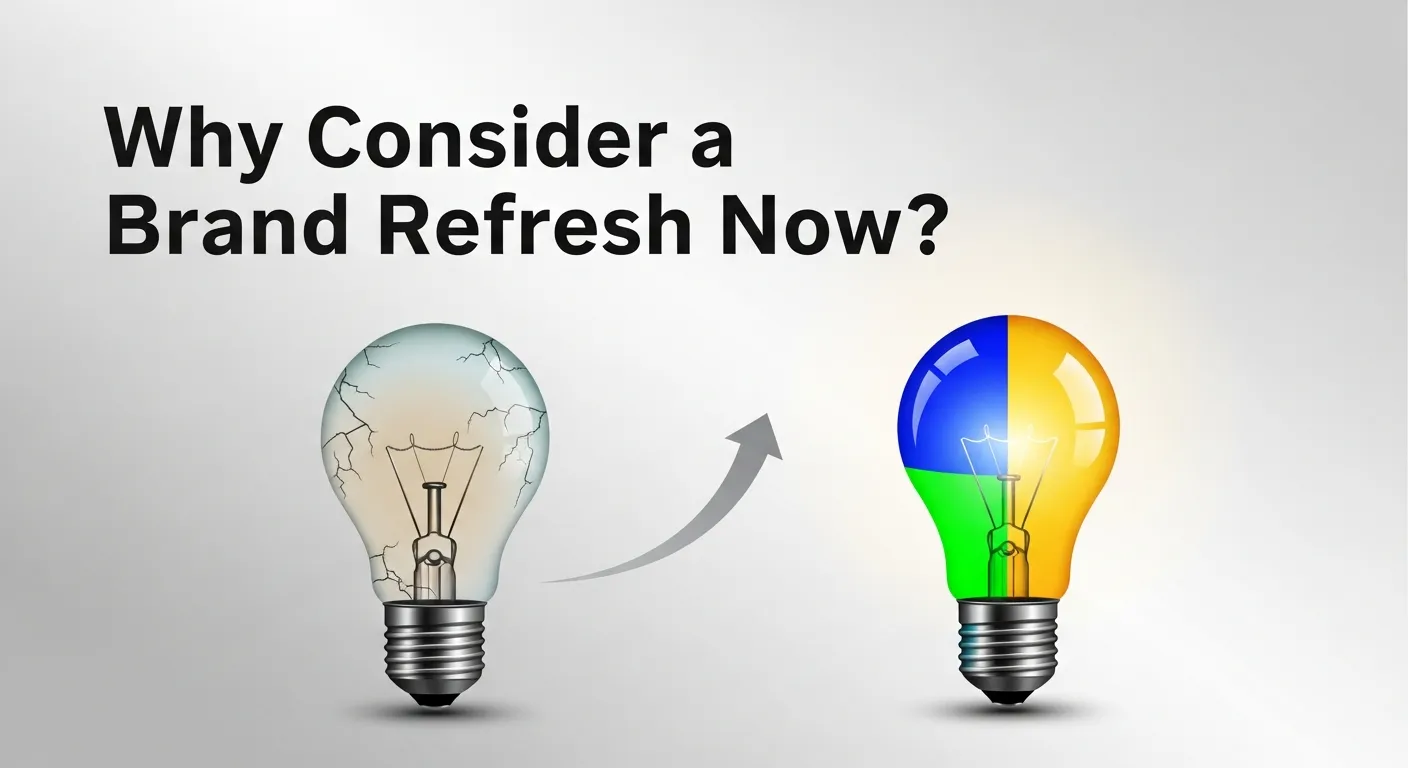
Markets are not static. Consumer preferences shift, design trends evolve, and new competitors emerge constantly. A visual identity that looked cutting-edge in 2015 might look tired today. Here are the primary drivers that push companies toward a refresh—including a need to keep up with Social Media Management, Influencer Marketing, and Programmatic Ads trends.
1. Your Business Has Outgrown Its Look
Startups often launch with “good enough” branding. You might have used a crowdsourced logo or a DIY website to get off the ground. But as you scale, land enterprise clients, and increase your pricing, that initial identity can become a liability. If your service is premium but your logo screams “budget,” you have a misalignment that hurts conversion. Consider leveraging Brand Development Consultant services or investing in Creative Marketing Services to bring your visual identity up to par.
2. The Competitive Landscape Has Shifted
Take a look at your top five competitors. Do they all look the same? In many industries, especially SaaS and FinTech, there is a tendency toward homogenization—everyone uses the same safe blues, the same sans-serif fonts, and the same abstract geometric icons. A brand refresh is a powerful tool for differentiation. If everyone zigs, you can use design to zag. Incorporating elements like Gamification Strategies or Metaverse Branding can make your brand stand out.
3. Digital-First Adaptation
Many established brands were built in an era of print. Their logos were designed for letterheads and billboards. Today, your logo needs to work as a tiny 16×16 pixel favicon on a browser tab or an app icon on a smartphone. Complex crests and detailed illustrations often turn into illegible smudges at small sizes. Simplifying your visual assets for digital clarity is one of the most common reasons for a refresh, especially in a world of Zero Click results and Mobile Marketing.
4. Audience Expansion
Perhaps you started targeting Gen X, but now your growth lies with Gen Z. Or maybe you were B2C and are pivoting to B2B. Different audiences respond to different visual cues. A brand refresh allows you to tune your aesthetic frequency to resonate with the people you actually want to reach now, not the ones you targeted five years ago. Consider the impact of Diversity, Equity, and Inclusion (DEI) or cultural trends in Emotional Branding.
The Strategic Roadmap to a Successful Brand Refresh

Executing a brand refresh requires more than just hiring a graphic designer. It demands a strategic foundation to ensure the new look supports business goals such as enhancing Customer Retention, boosting Brand Advocacy, or excelling with Account-Based Marketing.
Phase 1: The Audit
Before you change anything, you must understand what you currently have. Conduct a comprehensive brand audit.
- Inventory Assets: List every touchpoint where your brand appears (website, social profiles, email signatures, packaging, slide decks, office signage)—all of which play into your Cross-Channel Marketing.
- Gather Feedback: Don’t guess. Use tools like Google Analytics to see how users interact with your site. Survey employees and loyal customers. Ask them: “What words come to mind when you see our logo?” This feedback loop is crucial for accurate Brand Equity KPI assessment.
- Analyze Competitors: Use tools like SEMrush or Ahrefs to look at competitor traffic and positioning. Visually map their identities to find the “white space” in the market. Stay ahead on Brand Longevity Challenges and Competitive Brand Analysis.
Phase 2: The Strategy
Define the “Why.”
- Positioning Statement: Has your value proposition changed? Write a new statement that clarifies exactly what you do and who it is for—essential for effective Brand Purpose Development.
- Visual Strategy: Decide on the degree of change. Are you just cleaning up the typography? Or are you introducing a completely new secondary color palette? Don’t forget about the impact of Color Psychology and Sensory Branding.
- Keywords & SEO: A refresh often involves a website update. This is the perfect time to revisit your SEO strategy. Ensure your Brand Refresh doesn’t tank your rankings. Map 301 redirects carefully if URL structures change—a best practice in SEO Optimization.
Phase 3: The Design
This is where the magic happens.
- Logo Refinement: Simplify. Remove unnecessary strokes, gradients, or shadows. Aim for “flat design” which renders better on screens, supporting efforts like Video Advertising and Instagram presence.
- Typography: Typography trends move fast. Switching from a dated serif to a modern geometric sans-serif can instantly take ten years off your brand’s age. Consistency in fonts is crucial for Brand Voice.
- Color Palette: You don’t have to ditch your brand colors, but you might adjust the saturation or add accent colors to meet accessibility standards (WCAG compliance) for web readability. This supports your Brand Accessibility.
- Photography & Imagery: Move away from generic stock photos. Invest in custom photography or a unique illustration style that competitors can’t copy—consider Interactive Content and Augmented Reality assets for further engagement.
Phase 4: Implementation and Rollout
This is where most companies stumble. A great design that isn’t deployed consistently is wasted.
- Brand Guidelines: Create a “Brand Bible.” This document dictates exactly how the logo can be used, what fonts are allowed, and the hex codes for colors. It prevents your sales team from stretching the logo on their PowerPoint slides. Solid Brand Alignment prevents inconsistencies.
- The internal Launch: Your employees are your biggest brand ambassadors. Launch the brand refresh internally first. Explain the why behind the change so they can champion it. Encourage Brand Rituals to build advocacy.
- The External Launch: Don’t just flip a switch. Create a campaign around it. Write a blog post explaining the evolution. Update all social media profiles simultaneously, and consider Influencer Strategy and Webinar Promotion Strategies for broader reach.
Measuring the Success of Your Refresh
How do you know if it worked? You need data.
- Brand Sentiment: Monitor social mentions and customer feedback. Are people reacting positively to the new look? Track progress in Reputation Management.
- Engagement Metrics: Check Google Analytics. Did the bounce rate decrease on your homepage? Are visitors spending more time on the site? A cleaner design often improves UX, leading to better metrics—including Conversion Optimization.
- Conversion Rates: Ultimately, the refresh should drive business. Monitor lead generation and sales figures in the months following the update. Review alongside other Data-Driven Insights and Referral Marketing efforts.
Case Studies: Brand Refreshes Done Right (and Wrong)
The Good: Burger King
Burger King’s recent refresh was a masterclass in retro-modernism. They ditched the shiny, plastic-looking logo introduced in 1999 and went back to a flat, minimal version of their 1969 logo. The result? A warm, appetizing, and nostalgic identity that looks fantastic on an app screen and a wrapper. It leveraged their heritage while feeling entirely contemporary—a clear win in Brand Storytelling and E-commerce Growth Strategies.
The Warning: Gap
In 2010, Gap attempted a refresh that lasted only one week. They replaced their iconic blue box and serif font with a generic Helvetica font and a small gradient square. The public outcry was immediate and vicious. The issue? It was a change without a reason, and it discarded immense brand equity for a generic look. They reverted to the old logo within days. The lesson: Don’t change just for the sake of change. Ensure you have a Successful Branding Strategy before pivoting.
Maintaining Brand Equity During a Refresh
One of the biggest fears executives have regarding a brand refresh is losing the recognition they have built over years. This is valid. To mitigate this:
- Keep the distinctive assets: If you are known for a specific shade of purple, keep it, or a variation of it. This is vital for your Brand Archetype and future Brand Community.
- Evolution, not elimination: Ensure there is a visual through-line connecting the old and the new, supporting healthy Brand Advocacy.
- Communication is key: Tell your story. When customers understand that the visual change represents improved service or new products, they embrace it—helping reinforce your Awareness Building and Customer-Centric Brand Development.
Conclusion
A brand refresh is a powerful signal to the market that your company is vibrant, evolving, and ready for the future. It is not about vanity; it is about performance. By aligning your visual identity with your strategic goals, you remove friction from the customer journey and build a stronger emotional connection with your audience.
Don’t let the fear of change hold you back. If your branding feels like it is dragging you down rather than lifting you up, it is time to act. Audit your assets, plan your strategy, and execute with precision. Your brand is your most valuable intangible asset—invest in it wisely, and consider leveraging Gamified Marketing, Hyper-Personalization, or Voice Branding for added impact.
FAQs: Common Questions About Brand Refresh
1. How much does a brand refresh cost?
The cost varies wildly depending on the size of your company and the agency you hire. A freelancer might charge a few thousand dollars for a visual tune-up, while a top-tier branding agency could charge $50,000 to $150,000+ for a comprehensive strategy, visual system, and rollout plan. View it as an investment, not an expense—especially if you’re upgrading for High-Ticket Sales Webinars or venturing into NFT Marketing.
2. How often should we refresh our brand?
There is no hard rule, but generally, companies look at a refresh every 3-5 years. However, this shouldn’t be based on a calendar. It should be based on business triggers: major growth, new product lines, or a noticeable disconnect between your look and your reality. Tie your refresh into new Webinar Marketing Goals or Market Share expansion.
3. Will a brand refresh hurt my SEO?
It can if you change your domain name or mess up your site structure. However, if you keep your domain and simply update the content and design, it often helps SEO. A better user experience (UX) and faster load times (from optimized graphics) are ranking signals for Google. Monitor your brand with Google Search Console.
4. How long does the process take?
A proper brand refresh takes anywhere from 6 weeks to 6 months. Rushing the process often leads to mistakes like the Gap disaster mentioned earlier. Allow time for stakeholder interviews, design iterations, and asset production, and schedule webinars on Trending Webinar Topics to keep your audience engaged during the process.
5. Do we need to change our logo?
Not necessarily. A refresh can sometimes just be an update to typography, photography style, and color palette. However, the logo is the anchor of your identity, so it usually gets at least a minor cleanup to match the new system, much like updating Webinar Landing Page templates.
6. Who should be involved in the process?
You need a core team. This usually includes the CMO or Marketing Director, the CEO (for final approval), a creative lead, and key stakeholders from sales or product who understand the customer best. Keep the decision-making group small to avoid “design by committee.” You may also consult experts in Social Media Management, Influence Marketing, or Brand Crisis Management.
7. How do I announce a brand refresh?
Don’t hide it! Make it a celebration. Send an email to your subscriber list, write a press release if you are large enough, and create a “making of” video or blog post. Show your customers that this change is for them—to make their experience better. Leverage Webinar Promotion Strategies and Affiliate Marketing for extra reach.
8. What is the difference between brand identity and brand image?
Brand identity is what you design and put out into the world (your logo, colors, voice). Brand image is how the market actually perceives you. A refresh is your attempt to bring the two closer together—maximizing Customer Perception.
9. Can we just do it in-house?
If you have a talented internal creative team, yes. However, internal teams often suffer from “brand blindness”—they are too close to the product to see it objectively. Hiring an external agency or consultant often brings a fresh, unbiased perspective that is crucial for a successful refresh, especially when pursuing High-Converting Webinar Titles or Interactive Content Marketing.
10. What is the first step I should take today?
Start with a brand audit. Gather all your materials—business cards, brochures, website screenshots, social posts—and spread them out on a table (physical or digital). Does it look like it all comes from the same company? Does it look like a company you would trust in 2024? If the answer is no, start planning your refresh. Don’t forget to evaluate your Webinar Marketing, Email Campaigns, and Influence Marketing Services at this stage.