Brand Simplification: The Power of Focused Brand Promises

In a noisy marketplace, clarity is your strongest weapon. Simplicity cuts through the chaos, building trust and loyalty faster than complex messaging ever could.
This comprehensive guide explores the strategic imperative of brand simplification. We delve into the psychology behind why simple brands win, the dangers of brand sprawl, and actionable frameworks for pruning complexity. Learn how to craft focused brand promises, align your brand voice strategy, and measure the tangible business impact of clarity.
The Strategic Imperative of Brand Simplification
In a world drowning in complexity, simplicity has become the ultimate sophistication. Nowhere is this more evident than in brand strategy, where companies increasingly recognize that attempting to be everything to everyone often results in meaning nothing to anyone. The most memorable brands share a common characteristic: clarity of purpose expressed through focused brand promises. This is the essence of brand simplification.
It is not merely an aesthetic choice about minimalist logos or clean web design. It is a fundamental business strategy that aligns internal culture, operational processes, and external communications around a singular, powerful idea. When a brand achieves this level of focus, it becomes easier for customers to understand, easier for employees to deliver, and easier for the market to value.
The Rise of Brand Complexity
Brand complexity didn’t happen overnight. It evolved gradually—a phenomenon often called “entropy.” As companies expanded product lines, entered new markets, and attempted to satisfy increasingly diverse consumer segments, they naturally accreted layers of messaging. With each expansion came additional visual elements, sub-brands, and value propositions.
Eventually, many organizations found themselves communicating a muddled mix of claims rather than a coherent identity. This complexity accelerated during the digital revolution. Suddenly, brands needed consistent expression across websites, mobile apps, social platforms, email campaigns, and traditional channels. Without disciplined simplification, many companies created fragmented brand experiences where touchpoints contradicted rather than reinforced each other.
The consequences became increasingly apparent. According to Siegel+Gale’s Global Brand Simplicity Index, 64% of consumers are willing to pay more for simpler experiences, while 61% are more likely to recommend brands delivering simplicity. Perhaps most tellingly, a portfolio of the world’s simplest brands has outperformed major stock indexes by 679% since 2009. This data underscores that brand simplification is not just a marketing tactic; it is a driver of shareholder value.
The Psychology Behind Brand Simplification
Why does simplicity work so well? The answer lies in human biology. The brain naturally gravitates toward simplicity to conserve energy. Cognitive science reveals we can typically hold only 5-7 pieces of information in working memory simultaneously. When brands bombard consumers with complex messaging, detailed specs, and nuanced value propositions, most details simply disappear into cognitive overflow.
By contrast, simplified brands create what psychologists call “processing fluency”—the ease with which our brains can process information. This fluency generates positive emotional responses. We tend to trust things that are easy to understand. Complicated explanations often trigger skepticism (“What are they hiding?”), whereas simple explanations feel honest and transparent.
The classic example remains Apple. Their famous “Think Different” era represented radical simplification compared to competitors. While other technology companies listed technical specifications (RAM, processor speed, ports), Apple communicated emotional benefits through stark, minimalist marketing. This approach created immediate cognitive fluency in a category notorious for complexity, effectively leveraging emotional branding to bypass technical barriers.
From Brand Sprawl to Focused Promises
Effective brand simplification begins with focused promises—clear statements of value that companies can consistently deliver. Unlike the expansive mission statements or lengthy value propositions that characterized earlier branding approaches, focused promises distill brand essence into remarkably concise expressions.
Consider how Southwest Airlines simplified air travel’s typical complexity into “low fares, lots of flights, and lots of fun.” This isn’t just a tagline; it’s a strategic filter.
- Low fares: Dictates operational efficiency and cost control.
- Lots of flights: Dictates route planning and turnaround times.
- Lots of fun: Dictates hiring practices and company culture.
This straightforward promise guided everything from operational decisions to marketing communications, creating remarkable consistency across customer touchpoints. The promise proved both memorable to consumers and actionable for employees—essential characteristics of effective simplification.
The Three Phases of Simplification

At its core, the journey to a simpler brand usually involves three distinct phases:
1. Auditing Current Complexity
You cannot simplify what you do not understand. Complexity auditing requires an honest assessment of all brand communications. This involves collecting every piece of marketing material, sales deck, email signature, and web page.
- Identify Inconsistencies: Are you promising “innovation” on LinkedIn but “tradition” on your website?
- Spot Contradictions: Does your sales team pitch a low-cost solution while your marketing team pitches premium quality?
- Flag Unnecessary Elaboration: Where are you using 50 words when 5 would do?
Companies often discover they’re communicating wildly different value propositions across channels, creating customer confusion rather than clarity. Tools like SEMrush can help analyze your content footprint to identify disparate messaging themes.
2. Identifying Core Value
Once the clutter is visible, the next step is determining what to keep. This involves identifying the intersection between what your company does best and what your customers care about most.
- Customer Research: Use surveys and interviews to find out why customers really buy from you. It might not be the feature you think it is.
- Competitor Analysis: Where is the “white space” in the market? If everyone is shouting about “speed,” maybe your opportunity is “reliability.”
- Internal Soul Searching: What is the one thing your team is most proud of?
Effective simplification rarely means adding new claims; it typically means pruning everything except what truly differentiates the brand. This requires a deep understanding of brand equity—knowing what assets (visual or verbal) hold real value.
3. Disciplined Expression
The final phase is execution. This ensures the simplified promise appears consistently across all touchpoints. This consistency requires remarkable organizational discipline, as departments naturally push for exceptions and additions reflecting their specific priorities.
- Brand Guidelines: Create rigid (but simple) rules for visuals and voice.
- Templates: Provide teams with pre-approved templates that force simplicity.
- Governance: Empower a brand manager to say “no” to complexity.
The Courage to Subtract
Perhaps the greatest challenge in brand simplification lies not in determining what to communicate, but what to eliminate. Innovation is often additive; simplification is subtractive. Most brands grow complicated because nobody has the authority or courage to say “no” to additional messages, features, or exceptions.
The most successful simplifiers demonstrate unwavering commitment to subtraction. They recognize that every additional claim dilutes core messaging, every product extension potentially confuses customers, and every visual variation weakens recognition.
Case Study: Procter & Gamble
When Procter & Gamble simplified their sprawling product portfolio under CEO A.G. Lafley, they divested nearly 100 brands to focus on 65 core offerings. This seemingly radical pruning improved both profitability and brand clarity by eliminating products and messages that distracted from their strongest market positions. They realized that maintaining a “long tail” of weak brands was costing them focus on their winners.
Case Study: Target
Similarly, when retail giant Target simplified their brand promise to “Expect More. Pay Less,” they committed to removing anything contradicting this focused positioning. Products, store environments, and marketing communications all required alignment with this straightforward promise. This necessitated frequent subtraction of initiatives that didn’t clearly support the simplified brand direction. It meant saying no to cheap, low-quality goods (which violated “Expect More”) and saying no to overpriced luxury items (which violated “Pay Less”).
Simplification Across Touchpoints
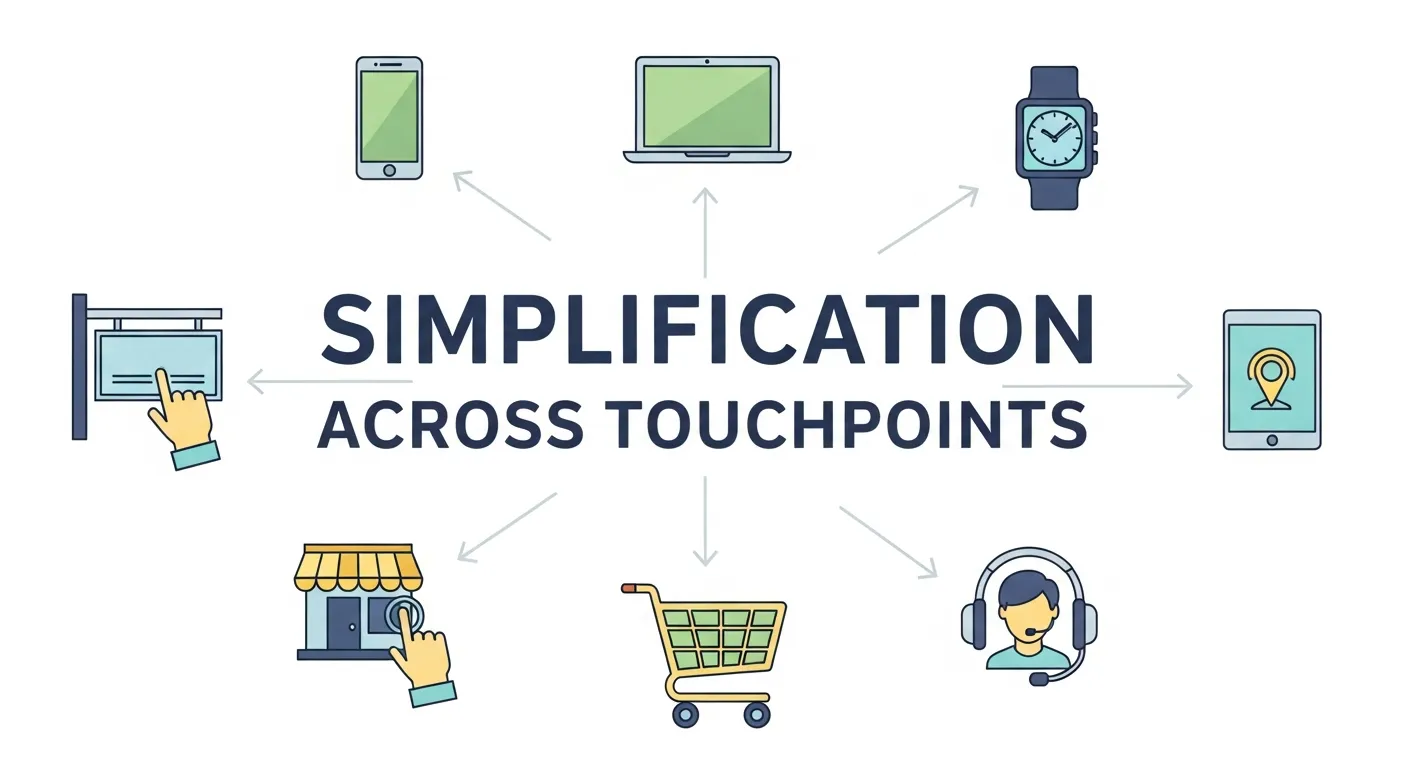
Effective brand simplification extends beyond marketing communications to influence every customer experience. The most successful practitioners apply simplification principles across four key dimensions.
1. Visual Simplification
Visual clutter creates cognitive load. Visual simplification creates immediate recognition through restrained design systems.
- Logo Design: Flat, scalable logos work better on small mobile screens.
- Color Palettes: Reducing the number of brand colors helps own a specific hue in the consumer’s mind (think Tiffany Blue or Coke Red).
- Typography: Using fewer fonts creates a more cohesive reading experience.
Mastercard’s 2016 rebrand exemplifies this approach, removing unnecessary elements from their iconic interlocking circles while maintaining instant identifiability. This simplified visual system works more effectively across digital platforms while retaining the brand’s visual heritage.
2. Verbal Simplification
Words matter. Verbal simplification ensures consistent language that customers immediately understand. It involves stripping away corporate jargon, buzzwords, and passive voice.
- Plain Language: Speak like a human, not a corporation.
- Consistency: Call your product features by the same name every time.
- Brevity: Respect the reader’s time.
Insurance company Oscar Health revolutionized their category by replacing incomprehensible industry jargon with straightforward explanations of coverage and benefits. Their simplified communications significantly outperformed traditional insurance messaging in both comprehension and trust metrics, proving that brand voice strategy is a competitive advantage.
3. Experiential Simplification
This focuses on removing friction from customer interactions. How many clicks does it take to buy? How many steps to return an item?
- UX/UI Design: Streamlining navigation menus and reducing form fields.
- Customer Service: Empowering agents to solve problems without transfers.
- Processes: Eliminating unnecessary bureaucracy for the customer.
When banking giant USAA simplified their digital customer experience by reducing their mobile app’s functions from 800+ to approximately 120 core features, customer satisfaction scores increased by 18% while support calls decreased by 15%. By eliminating rarely-used options that created visual clutter and cognitive overload, USAA delivered significantly improved customer experiences.
4. Product Simplification
Analysis paralysis is real. Product simplification reduces overwhelming choice while maintaining meaningful options.
- SKU Rationalization: Cutting low-performing variations.
- Bundling: creating simple packages that solve specific needs.
- Curating: guiding the customer to the best choice rather than offering every choice.
When grocery chain Trader Joe’s limits product selection to approximately 4,000 items (compared to 50,000+ at traditional supermarkets), they create both operational efficiency and customer relief. Their simplified selection eliminates decision fatigue while maintaining carefully curated options that meet core customer needs.
Measuring Simplification Success
Unlike many branding initiatives with ambiguous outcomes, simplification efforts can be measured through specific metrics revealing their business impact. Using tools like Google Analytics and qualitative surveys can help track these KPIs.
Decision Velocity
This indicates how quickly customers move from awareness to purchase. Simplified brands typically generate faster decision-making as customers easily understand the value proposition without extensive research or comparison. If your brand storytelling is clear, the path to purchase is shorter.
Employee Understanding
This reveals whether staff can accurately articulate brand promises. When employees are confused, customers will be too. When telecommunications provider T-Mobile simplified their “Un-carrier” positioning, internal measurements showed employee message consistency improved from 59% to 91%, creating significantly more coherent customer experiences.
Meaningful Differentiation
According to research from Millward Brown, the world’s most valuable brands score 124% higher on “meaningful differentiation” metrics than average brands. This meaningfulness correlates strongly with simplification—brands communicating focused promises achieve substantially higher differentiation scores than those with complex or inconsistent messaging.
Customer Effort Score (CES)
This metric asks a simple question: “How easy was it to interact with [Brand]?” High effort correlates with disloyalty; low effort correlates with retention. Brand simplification directly targets this metric by removing friction.
Maintaining Simplicity in Complex Organizations
Perhaps the greatest challenge in brand simplification comes not from developing focused promises but maintaining them against organizational complexity. As companies grow, departments naturally push for exceptions, additions, and special cases that gradually erode simplicity. “Just one more slide,” “just one more dropdown menu,” “just one more sub-brand.”
Successful simplifiers establish governance structures maintaining focus despite these pressures. Four approaches prove particularly effective.
1. Simplicity Champions
Simplicity champions with organizational authority ensure brand focus remains paramount in decision-making. These individuals have explicit responsibility for questioning additions and complications, serving as organizational counterweights to the natural tendency toward complexity. They are the guardians of the brand archetype.
2. Regular Simplification Audits
Just as you audit finances, you must audit simplicity. Regular audits assess whether brand expressions remain focused or have accumulated unnecessary elements. These systematic reviews identify “complexity creep” before it significantly damages brand coherence.
3. Decision Filters
Provide clear criteria for evaluating new initiatives against simplified brand promises. Rather than subjective judgments about whether something “fits the brand,” these structured assessments measure specific impacts on brand clarity and focus.
- Does this add value or just noise?
- Does this align with our core promise?
- Can this be explained in one sentence?
4. Reward Systems
Incentivize simplification rather than addition. Corporate cultures often reward people who launch new things. When organizations explicitly recognize and reward simplification efforts—sunsetting old products, streamlining processes, condensing reports—employees become significantly more likely to pursue focus rather than complexity.
Table: The Complexity vs. Simplicity Mindset
|
Feature |
Complexity Mindset |
Simplicity Mindset |
|---|---|---|
|
Focus |
Internal structures & silos |
Customer needs & ease |
|
Messaging |
Comprehensive & Detailed |
Focused & Emotional |
|
Visuals |
Decorative & Additive |
Functional & Subtractive |
|
Product |
“More is better” |
“Less but better” |
|
Goal |
Appease all stakeholders |
Delight the user |
Integrating Simplification into Digital Marketing
In the realm of digital marketing, simplification is critical for conversion optimization.
- Website Design: A cluttered homepage increases bounce rates. A simple, clear value proposition keeps users engaged.
- SEO Optimization: Focusing on a core set of keywords (like Brand Simplification) creates stronger topical authority than trying to rank for everything.
- Email Campaigns: Short, text-based emails often outperform highly designed, image-heavy newsletters because they feel personal and are easier to read.
- Social Media: Consistent visual templates and a unified voice help cut through the algorithmic noise.
Chatbot marketing and AI and Automation can also aid simplification by providing instant, simple answers to complex user queries, reducing the effort required to find information.
Conclusion
In today’s overwhelming information environment, brand simplification represents not merely an aesthetic choice but a strategic imperative. Companies delivering focused, coherent promises significantly outperform those presenting complicated or inconsistent brand experiences.
The journey toward simplification requires both strategic clarity and organizational courage—the clarity to identify what truly matters and the courage to eliminate everything else. Brands achieving this discipline create what neuroscientists call “cognitive ease,” making their promises feel instinctively right to customers navigating an increasingly complex world.
As Leonardo da Vinci observed centuries ago, “Simplicity is the ultimate sophistication.” In branding, this principle has never been more relevant than today, when the scarcest consumer resource isn’t money but attention. Brands that respect this reality by delivering focused promises win not just market share but something far more valuable: mental space in their customers’ increasingly crowded lives.
FAQs
1. What is the difference between brand simplification and rebranding?
Brand simplification is a strategic process of focusing messaging and removing friction. It can lead to a rebrand (new logo, etc.), but it doesn’t have to. You can simplify a brand without changing its name or logo by simply clarifying its voice and streamlining its product offers. Rebranding is often a visual overhaul; simplification is a structural and strategic overhaul.
2. Does simplifying a brand mean “dumbing it down”?
No. Simplicity is about clarity, not stupidity. It means communicating complex ideas in a way that is easy to understand. As Einstein said, “If you can’t explain it simply, you don’t understand it well enough.” Sophisticated B2B brands often benefit most from simplification because their products are inherently complex.
3. How long does a brand simplification process take?
It varies by company size, but typically takes 6-18 months. The audit phase alone can take months for a large enterprise. However, the mindset shift should be permanent. It is an ongoing discipline, not a one-time project.
4. Can a brand be too simple?
Yes, if it becomes generic. If you strip away so much that you lose your unique personality or brand voice, you have gone too far. The goal is “meaningful simplicity”—simple enough to understand, but distinctive enough to remember.
5. How does brand simplification impact SEO?
Positively. Search engines favor clear, structured content that answers user queries quickly. A simplified site architecture helps crawlers index pages, and clear, focused content improves user engagement signals (like dwell time), which boosts rankings. Using tools like Ahrefs can help you identify which complex pages are underperforming.
6. Is brand simplification expensive?
The process incurs costs (consultants, design, internal time), but the outcome saves money. Complexity is expensive—it requires more staff to manage, more money to market, and creates more customer support tickets. Simplification reduces operational drag and improves marketing efficiency.
7. How do I convince stakeholders to delete content or products?
Use data. Show them the “long tail” of products that generate 1% of revenue but take up 20% of resources. Show them heatmaps of websites where users ignore complex navigation menus. Frame subtraction as a way to liberate resources for the high-performing areas.
8. What role does Design Thinking play in simplification?
Design Thinking is central to the process because it starts with empathy for the user. By mapping the customer journey and identifying pain points (complexity), you can design solutions that remove barriers. It shifts the focus from “what do we want to say?” to “what does the user need to know?”
9. Can AI help with brand simplification?
Yes. AI marketing tools can analyze vast amounts of content to identify inconsistencies in tone and messaging. They can also help rewrite complex technical jargon into plain language, ensuring a consistent brand voice strategy.
10. What is the first step I should take today?
Start with a “content audit” of your homepage and your primary sales deck. Look at them side-by-side. do they say the same thing? If you gave them to a stranger, would they understand exactly what you do in 5 seconds? If not, you have a complexity problem.