Brand Strategy vs Marketing Strategy: Understanding the Critical Differences
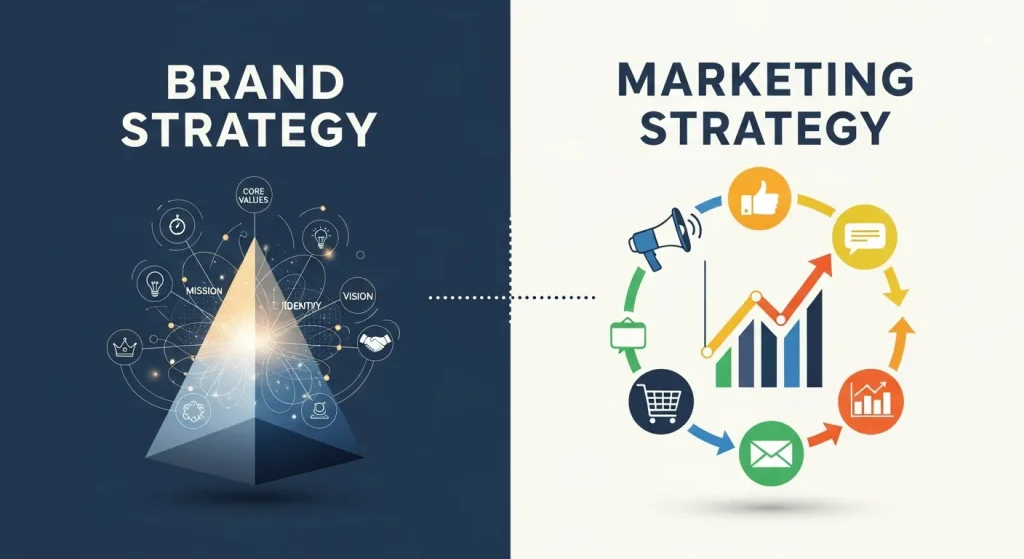
Confusing brand strategy with marketing strategy is a common but costly mistake. This guide clarifies their distinct roles, helping you build an enduring brand while driving measurable growth.
We will dissect the core differences between brand strategy vs marketing strategy, defining brand as your “why” and marketing as your “how.” This article explores how to align these disciplines to build lasting brand equity, enhance marketing ROI, and create a resilient, resonant business identity.
The Common Point of Confusion
In the complex world of business development, two terms are often used interchangeably: brand strategy and marketing strategy. For many, they blend into a single concept focused on attracting customers. However, treating these distinct disciplines as synonymous can lead to misaligned efforts, wasted resources, and underwhelming results. Understanding their fundamental differences, and more importantly, their symbiotic relationship, is crucial for any business leader aiming to build an enduring market presence while driving measurable growth.
The debate of brand strategy vs marketing strategy is not just academic; it has profound practical implications. A business that focuses solely on short-term marketing tactics without a solid brand foundation is like a ship without a rudder—it may move quickly, but it lacks direction and is easily thrown off course by market shifts. Conversely, a company with a brilliant brand strategy but no effective marketing to communicate it is like a powerful engine that’s never turned on.
This guide will provide a comprehensive breakdown of each concept, illustrate how they work together, and offer actionable frameworks for harmonizing them within your organization.
The Foundation: What Is Brand Strategy?
Brand strategy is the North Star of your business identity. It is the long-term, high-level plan for how you want your company to be perceived by the public. It’s not about what you sell, but what you stand for. Brand strategy answers the most fundamental questions about your business:
- Who are you? (Your mission, vision, and core values)
- What makes you different? (Your unique value proposition and competitive positioning)
- Why should anyone care? (The emotional connection and brand purpose development you aim to foster)
Think of your brand strategy as the architectural blueprint for your company. It defines the structure, the core principles, and the overall aesthetic before a single marketing brick is laid. This blueprint should remain relatively constant, evolving slowly and deliberately as your business matures, rather than shifting with every new market trend. It is your business’s DNA.
Core Components of a Robust Brand Strategy
A comprehensive brand strategy is built upon several key pillars:
- Purpose: This is your “why.” As famously articulated by Simon Sinek, people don’t buy what you do; they buy why you do it. Patagonia’s purpose is to “save our home planet.” This purpose guides everything, from product design using recycled materials to their environmental activism.
- Vision: This is the future you are trying to create. Where do you see your company and its impact in 5, 10, or 20 years?
- Values: These are the non-negotiable principles that guide your company’s behavior, both internally and externally. They dictate how you treat employees, customers, and partners.
- Positioning: This is the specific niche you occupy in the minds of your target audience relative to your competitors. Volvo owns the “safety” position in the automotive industry. This clarity informs every decision.
- Brand Voice and Personality: How does your brand sound and behave? Is it authoritative and professional, or playful and irreverent? Defining your brand archetype can be a powerful tool here.
- Target Audience: A brand cannot be everything to everyone. A deep understanding of your ideal customer—their needs, desires, and pain points—is essential. This goes beyond demographics into psychographics and behavior.
A well-crafted brand strategy, as defined on platforms like Wikipedia, is an intangible asset that creates significant brand equity. This equity translates into tangible financial benefits, such as the ability to command premium prices and foster deep customer loyalty that transcends individual marketing campaigns.
The Activator: What Is Marketing Strategy?
If brand strategy is the “why,” marketing strategy is the “how,” “what,” “where,” and “when.” It is the tactical, action-oriented plan designed to activate your brand in the marketplace. Marketing strategy focuses on specific, measurable objectives to reach target customers and drive desired actions, such as lead generation, sales, or brand awareness.
According to a comprehensive McKinsey study, companies that integrate creativity, analytics, and purpose in their marketing approaches achieve significantly higher revenue growth than their peers. This highlights the importance of a well-executed marketing strategy that brings your brand to life through tactical implementation.
Marketing strategies typically operate on shorter timeframes—quarters or annual cycles—and are designed to be agile, adjusting to market conditions, consumer behavior shifts, and campaign performance data from tools like Google Analytics.
Core Components of a Modern Marketing Strategy
A marketing strategy involves detailed planning around numerous elements, often encompassed by frameworks like the 4Ps (Product, Price, Place, Promotion) or the 7Ps. Key components include:
- Marketing Goals: What do you want to achieve? Increase market share by 10%? Reduce customer acquisition cost (CAC) by 15%? These goals must be SMART (Specific, Measurable, Achievable, Relevant, Time-bound).
- Target Audience Segmentation: While brand strategy defines the broad audience, marketing strategy breaks it down into specific segments for targeted campaigns. This is where account-based marketing or hyper-personalization tactics come into play.
- Channel Plan: Where will you reach your audience? This involves a mix of channels like content marketing (blogs, whitepapers), social media (Instagram, TikTok, LinkedIn), email campaigns, SEO, paid advertising (programmatic ads), and influencer marketing.
- Messaging and Content: What specific messages will you use for each campaign and channel? This includes creating ad copy, blog posts, videos, and social media content that aligns with the overarching brand voice but is tailored to the channel’s context.
- Budget and Resource Allocation: How much will you spend on each channel and initiative? This requires careful planning and continuous optimization based on performance.
- Metrics and KPIs: How will you measure success? This involves tracking metrics like conversion rates, click-through rates (CTR), ROI, customer lifetime value (LTV), and brand equity KPIs. Using tools like Ahrefs or SEMrush can help track SEO and competitive performance.
Marketing is the active process of pushing your brand’s message out to the world and pulling customers in. It’s the engine that drives short-to-mid-term results.
Brand Strategy vs Marketing Strategy: A Head-to-Head Comparison
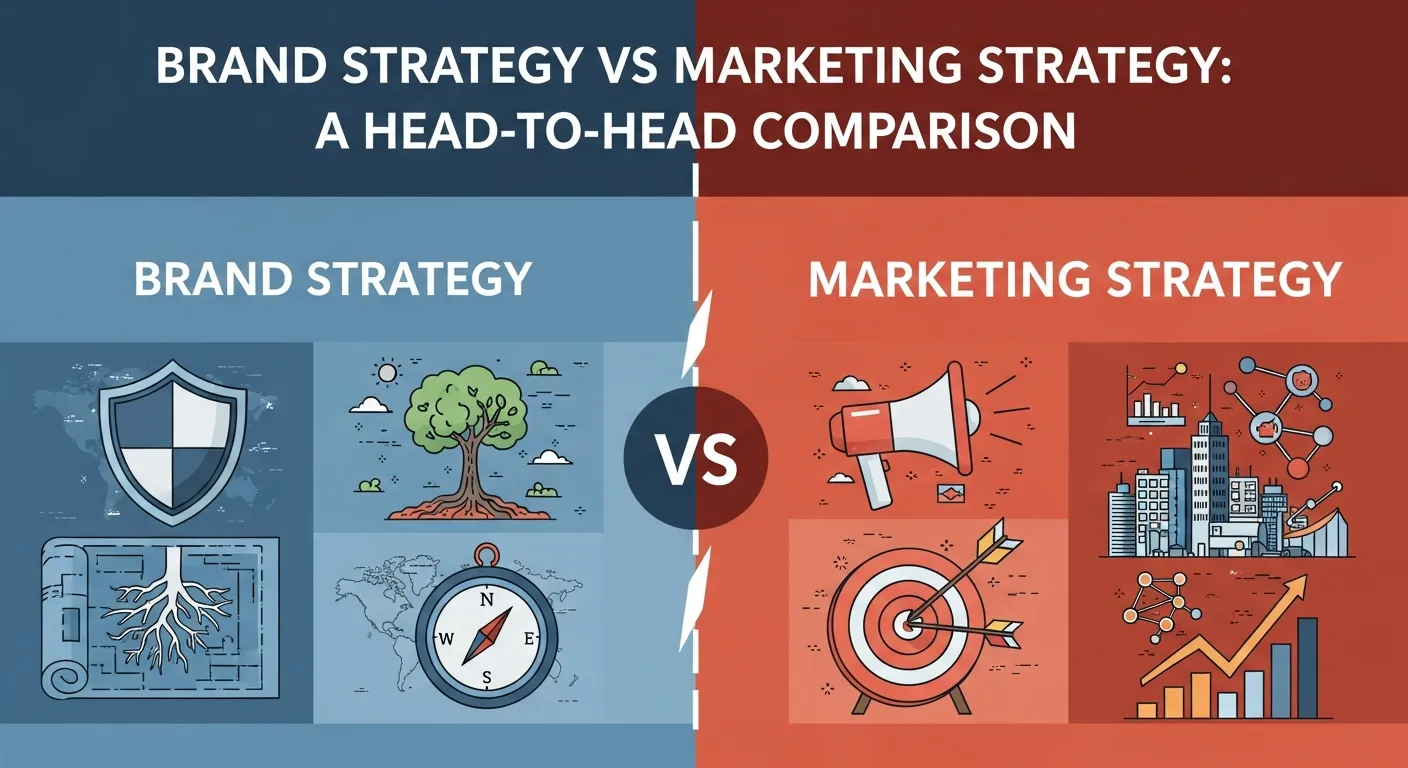
To truly grasp the distinction, a side-by-side comparison is invaluable.
|
Aspect |
Brand Strategy |
Marketing Strategy |
|---|---|---|
|
Core Question |
Who are we? (Why we exist) |
How do we reach them? (How we grow) |
|
Time Horizon |
Long-term (5+ years) |
Short-to-mid-term (Quarters/Years) |
|
Primary Goal |
Build loyalty, trust, and recognition. |
Generate leads, sales, and awareness. |
|
Focus |
Internal & External Perception |
External Action & Engagement |
|
Nature |
Foundational, Guiding |
Tactical, Action-Oriented |
|
Pace of Change |
Slow, Deliberate Evolution |
Fast, Agile Adaptation |
|
Measurement |
Brand equity, loyalty, perception. |
ROI, CAC, conversion rates, traffic. |
|
Output |
Brand guidelines, purpose statement. |
Marketing plan, ad campaigns, content calendar. |
|
Ownership |
C-Suite, Leadership |
Marketing Department, Agencies |
Understanding this table is the first step in resolving the internal conflict of brand strategy vs marketing strategy. They are not opponents; they are partners in a relay race. Brand strategy runs the first, foundational leg, and then passes the baton to marketing strategy to run the next, faster-paced legs.
How They Work Together in Harmony: A Symbiotic Relationship
Your brand strategy must serve as the foundation upon which all marketing initiatives are built. When these elements align correctly, marketing becomes exponentially more efficient and effective because it draws from a consistent wellspring of identity and purpose.
Nike exemplifies this harmony beautifully.
- Brand Strategy: Centers on athletic excellence, overcoming adversity, innovation, and empowerment. The core brand promise is to bring inspiration and innovation to every athlete in the world.
- Marketing Strategy: Activates these principles through various campaigns. The iconic “Just Do It” slogan is a marketing execution of the brand’s core value of empowerment. Their partnerships with athletes like Michael Jordan and Serena Williams (an influencer strategy) embody the brand’s focus on excellence. Each marketing effort feels authentic because it stems from that clear, unwavering brand identity.
When brand alignment is successful, marketing benefits in several ways:
- Efficiency: You don’t have to reinvent the wheel for every campaign. The brand guidelines provide a clear framework for messaging and visuals.
- Trust Establishment: Consistent marketing that reinforces the brand promise builds trust over time. Customers know what to expect.
- Differentiation: In a crowded market, marketing campaigns rooted in a unique brand strategy stand out more effectively than generic “buy now” ads. This is a core benefit of branding.
The Dangers of Misalignment
Many organizations struggle when marketing tactics become disconnected from the brand’s foundation. This misalignment, often driven by a relentless focus on short-term metrics, can create customer confusion and erode trust.
This happens when:
- A luxury brand known for exclusivity runs a deep-discount promotion that cheapens its image.
- A company with a brand voice that is “fun and friendly” sends out legalistic, jargon-filled customer service emails.
- A B2B brand built on “trust and reliability” uses clickbait headlines in its content marketing.
When short-term marketing wins take precedence over brand consistency, businesses may see an immediate sales bump but suffer longer-term identity erosion. Successful companies recognize that marketing campaigns may come and go, but brand equity builds or diminishes with every single interaction. Each marketing initiative must be a deposit into the brand bank, not a withdrawal.
Building Your Integrated Strategy: An Action Plan
To harmonize these critical elements in your business, follow this step-by-step process:
- Start with “Why”: Articulate Your Brand Strategy. Before you even think about a marketing campaign, gather your leadership team and solidify your brand strategy. Document your purpose, vision, values, positioning, and personality. This document is your constitution.
- Conduct a Brand Audit. Before moving forward, look at your existing assets. Do your current marketing materials, website, and social media presence reflect your newly articulated brand strategy? Identify the gaps.
- Develop Your Marketing Strategy from the Brand Blueprint. Use your brand strategy as a creative brief for your marketing plan.
-
- How can our marketing express our core value of “simplicity”? (e.g., clean ad design, easy checkout process).
-
- Which channels are most authentic to our “eco-conscious” brand personality? (e.g., partnerships with environmental blogs, not just generic banner ads).
- Create a System of Governance. Establish a “brand council” or a lead brand manager who ensures that marketing materials are on-brand before they go live. This isn’t about stifling creativity; it’s about ensuring coherence.
- Measure Both Sets of Metrics. Create a dashboard that tracks both brand metrics (e.g., brand sentiment, share of voice) and marketing metrics (e.g., conversion rates, ROI). Use tools like Google Search Console to track branded vs. non-branded search traffic as an indicator of brand strength.
Conclusion
The debate over brand strategy vs marketing strategy is settled when you realize they are two sides of the same coin. Brand strategy provides the meaning and direction, while marketing strategy provides the visibility and action. One builds long-term value and loyalty; the other drives short-term results and growth. Neglecting either one will cripple your business’s potential. By respecting their distinct roles while ensuring they work in concert, you can build a business that not only captures attention but also earns lasting customer commitment and a powerful competitive advantage.
Frequently Asked Questions (FAQs)
1. Which comes first, brand strategy or marketing strategy?
Brand strategy always comes first. It is the foundation and the guiding light for all subsequent marketing efforts. You cannot effectively market something if you don’t know what it is or what it stands for.
2. Can a small business have a brand strategy, or is it just for large corporations?
Absolutely. A brand strategy is arguably more important for a small business because it’s your primary way to differentiate yourself without a massive marketing budget. It could be as simple as defining your commitment to local sourcing or exceptional, personal customer service.
3. How often should you change your brand strategy vs marketing strategy?
Your brand strategy should be stable, reviewed every 3-5 years or during a major business pivot. Your marketing strategy should be agile, with campaigns and tactics that might change quarterly or even monthly based on performance data and market trends.
4. Is social media part of brand strategy or marketing strategy?
It’s both. The overall tone of voice, the visual aesthetic, and the type of content you post are defined by your brand strategy. The specific campaigns you run, your posting schedule, your ad spend, and the KPIs you track are part of your marketing strategy.
5. How do you measure the ROI of brand strategy?
It’s more challenging than measuring marketing ROI. You measure it through long-term indicators like brand equity valuation, customer lifetime value (LTV), price elasticity (ability to command a premium), and inbound metrics like branded search volume and direct traffic.
6. What’s the difference between a brand and a logo?
A logo is a visual symbol that represents the brand. The brand is the entire collection of perceptions, emotions, and experiences that people have with your company. Your logo is a tool; your brand is the reputation you’ve built.
7. If my marketing campaign is failing, should I change my brand strategy?
Not necessarily. First, analyze the marketing execution. Is it the wrong channel, wrong message, or wrong audience? A failing marketing campaign is rarely a sign that your entire brand foundation is wrong, unless many different marketing approaches consistently fail to resonate.
8. Who should be involved in creating a brand strategy?
Brand strategy creation should be led by the C-suite and should involve input from across the organization—including marketing, sales, product, and HR. It’s a foundational business decision, not just a marketing exercise.
9. Can strong marketing save a weak brand?
In the short term, maybe. A clever campaign can generate a temporary spike in sales. But in the long run, no. If the product or experience doesn’t live up to the marketing hype, customers will leave, and the brand’s reputation will suffer. Strong marketing cannot fix a fundamentally flawed brand promise.
10. What is “brand alignment”?
Brand alignment is the process of ensuring that every single touchpoint a customer has with your company—from your website and advertising to your customer service and packaging—is consistent with your core brand strategy. It’s the practical application of your brand strategy across the entire organization.