Customer Journey Mapping as a Brand Strategy Tool: A Complete Guide
Great brands aren’t just seen; they are experienced. By mastering the art of mapping customer journeys, you transform passive interactions into a powerful, cohesive strategy that drives lasting loyalty.
This comprehensive guide explores customer journey mapping beyond basic service improvements, positioning it as a vital strategic asset. We delve into emotional trajectories, expectation gaps, and cross-channel coherence. You will learn actionable methodologies to align your organization, innovate experiences, and secure a competitive advantage in a crowded marketplace.
The Strategic Imperative of Customer Journey Mapping
The most enduring brands aren’t built through clever advertising alone—they’re created through carefully orchestrated experiences that connect emotionally with customers at every interaction. Behind these seemingly effortless experiences often lies a powerful strategic tool: the customer journey map.
While many organizations view journey mapping merely as a customer service improvement exercise or a task for the UX design team, forward-thinking brands recognize it as something far more valuable. It is a strategic compass that can reveal opportunities for meaningful differentiation, guide resource allocation, and align organizational efforts around genuine customer needs. In the realm of digital marketing, where competition is fierce and attention spans are short, understanding the nuance of the customer path is the difference between being a commodity and being a beloved brand.
Moving Beyond Touchpoint Inventories
Many initial attempts at journey mapping produce glorified touchpoint lists—sequential inventories of where and how customers interact with the brand. These surface-level maps certainly have value; they identify technical bugs or process failures. However, they miss the deeper strategic insights that emerge when customer journey mapping adopts a more sophisticated approach.
Truly transformative journey maps delve beneath transactions to illuminate motivations, emotions, and unspoken expectations. They reveal not just what happens, but why it happens and how it matters to customers throughout their relationship with your brand. Think of traditional journey maps as roadmaps showing only highways and major cities. Strategic journey maps include terrain features, weather patterns, and alternative routes—the contextual elements that explain why travelers make certain choices and how they feel about their journey.
By integrating data-driven insights from platforms like Google Analytics with qualitative feedback, brands can move from simple observation to predictive strategy.
The Strategic Lens: Four Dimensions of Customer Journey Mapping
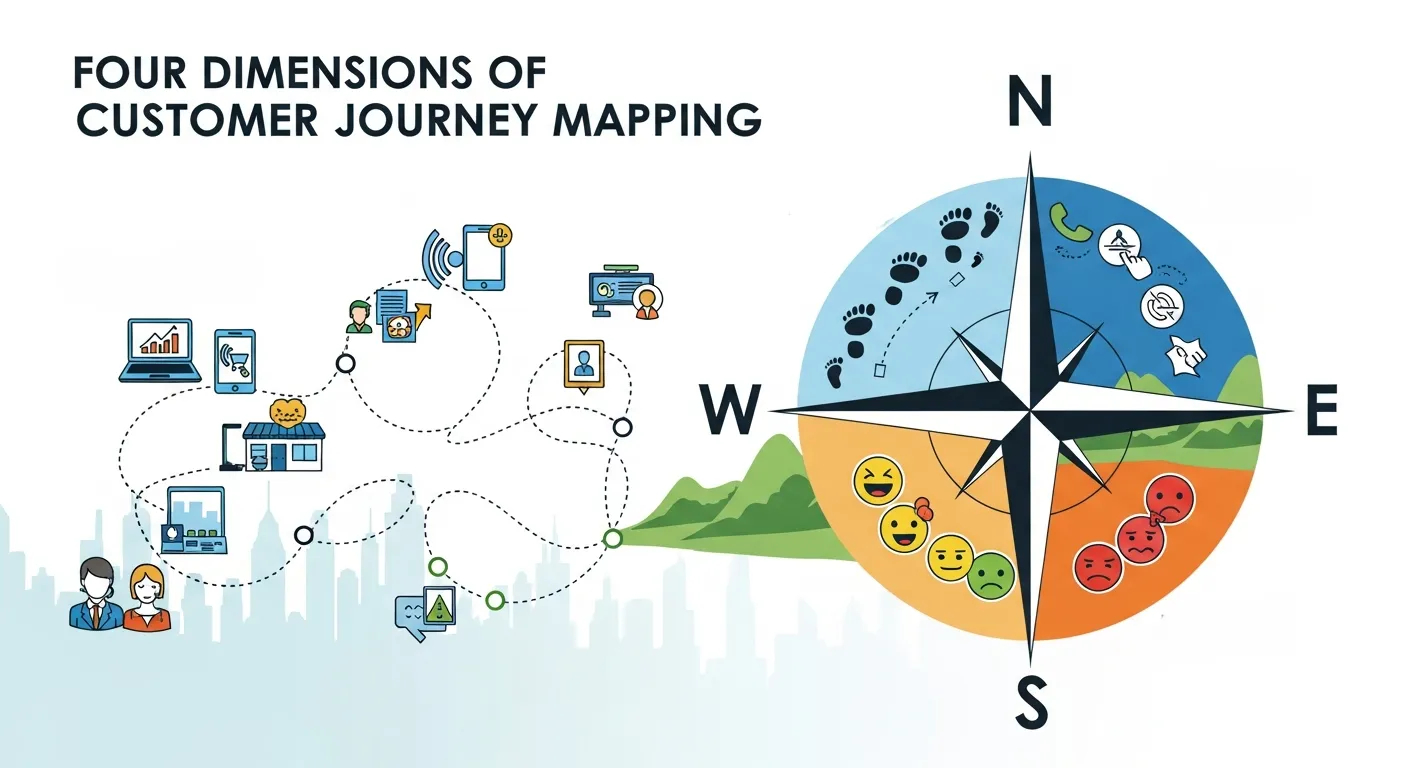
When approaching customer journey mapping as a brand strategy tool rather than merely a service improvement exercise, four critical dimensions emerge. These dimensions transform a static map into a dynamic engine for brand resilience and growth.
1. Emotional Trajectory: Engineering Memories
The emotional dimension of customer experience often receives superficial treatment—happy faces at some touchpoints, sad faces at others. Strategic journey mapping goes deeper by recognizing that emotions create memories, and memories create brand associations.
Research from the Journal of Consumer Research demonstrates that emotional peaks and endpoints disproportionately influence how experiences are remembered and subsequently shared. This is known as the “peak-end rule.” When customers recall their experiences with your brand, they don’t remember everything equally—their memories form around emotional highs, lows, and final impressions.
Strategic Application:
Consider how hotel brand Ritz-Carlton deliberately engineers emotional moments. Staff members are empowered to resolve issues or create memorable moments without seeking manager approval. This isn’t merely good service; it’s strategic emotional engineering. By using emotional branding, they create peaks that customers remember and share, thereby strengthening brand advocacy far beyond the immediate transaction.
For digital marketing teams, this means analyzing the emotional state of a user during a conversion optimization flow. Are they frustrated by a complex form? Relieved by a quick confirmation? Mapping these emotions helps in crafting personalization tactics that resonate.
2. Expectation Gaps: The Source of Delight and Disappointment
Perhaps the most strategically valuable insight from customer journey mapping comes from identifying gaps between customer expectations and actual experiences. These gaps represent both immediate risks and long-term opportunities.
- Negative Gap: When expectations exceed experience, disappointment erodes brand equity.
- Positive Gap: When experiences exceed expectations, positive brand associations strengthen.
- Neutral Gap: When expectations and experiences align perfectly, customers often feel merely satisfied rather than delighted.
This suggests that strategic surprise can be a powerful differentiator. Consider how Zappos transformed online shoe shopping. When they launched overnight shipping upgrades for free without announcing them, customers experienced delightful surprise that converted many into vocal brand advocates. This expectation gap became a cornerstone of their branding strategies, not merely a service tactic.
3. Cross-Channel Coherence: The Omnichannel Challenge
Modern customer journeys rarely progress neatly through a single channel. People research products on smartphones via mobile marketing while standing in physical stores. They see television advertisements that prompt online searches via voice search. They receive email campaigns that lead to social media conversations.
Strategic customer journey mapping examines how these channel-switching moments affect brand perception. The most revealing insights often emerge at these transition points, where disconnects between channels create confusion or frustration.
McKinsey & Company research indicates that brands delivering consistent experiences across channels can increase revenue by 10-15% while reducing service costs by 15-20%. This isn’t merely operational efficiency—it’s strategic advantage through coherence. Achieving this requires robust omnichannel strategies that integrate social media, web, and physical data.
4. Competitor Comparison: Benchmarking Strategy
Perhaps most critically for brand strategy, journey mapping should include competitive context. How do customer experiences with your brand compare to alternatives? Where are you meaningfully different, and where are you merely meeting category expectations?
Competitive brand analysis is essential here. When Apple mapped the traditional retail shopping journey, they identified numerous pain points: confusing layouts, commission-driven salespeople, and cumbersome checkout processes. Their revolutionary store concept systematically addressed each pain point, creating a retail experience so distinctive it became a powerful brand asset.
By using tools like SEMrush or Ahrefs to analyze competitor traffic sources and content strategies, you can overlay competitor data onto your own maps to see where they might be intercepting your customers.
From Insight to Strategic Action
The strategic value of customer journey mapping emerges when insights drive meaningful action across the organization. It is not enough to draw the map; you must navigate the territory.
Experience Innovation Through Jobs-to-be-Done
The most powerful journey maps look beyond what customers are doing to understand what they’re trying to accomplish—their “jobs-to-be-done.” This perspective reveals opportunities to innovate around unstated needs rather than simply improving existing processes.
When Netflix mapped the movie rental journey, they looked beyond the obvious steps of selection, payment, and return. By understanding the deeper job—enjoying entertaining content with minimal friction—they recognized that physical disc returns represented an unnecessary burden. This insight eventually led to their streaming model, fundamentally changing the entertainment landscape and redefining content marketing in the process.
Prioritizing Experience Investment
Not all touchpoints create equal value. Strategic customer journey mapping helps identify which moments disproportionately influence customer perception and loyalty, allowing more focused resource allocation.
Financial services provider USAA discovered through journey mapping that the insurance claims process—though relatively infrequent—had an extraordinary impact on customer loyalty. Their subsequent investment in streamlining and humanizing this experience, including pioneering mobile photo claims submission, yielded substantial competitive advantage. In a sector driven by reputation management, this single touchpoint became a defining feature of their brand.
Aligning Internal Teams
Perhaps the most underappreciated strategic benefit of journey mapping is its power to align diverse organizational functions around the customer perspective. When marketing, product development, operations, and customer service share a common understanding of the customer journey, they can collaborate more effectively toward consistent brand delivery.
Outdoor retailer REI uses journey maps as communication tools between departments. This ensures that seasonal campaigns planned by marketing align with inventory management by operations and staff training by human resources. This coordination creates a coherent customer experience that strengthens brand perception across all touchpoints.
Journey Mapping Methodology: Beyond the Workshop
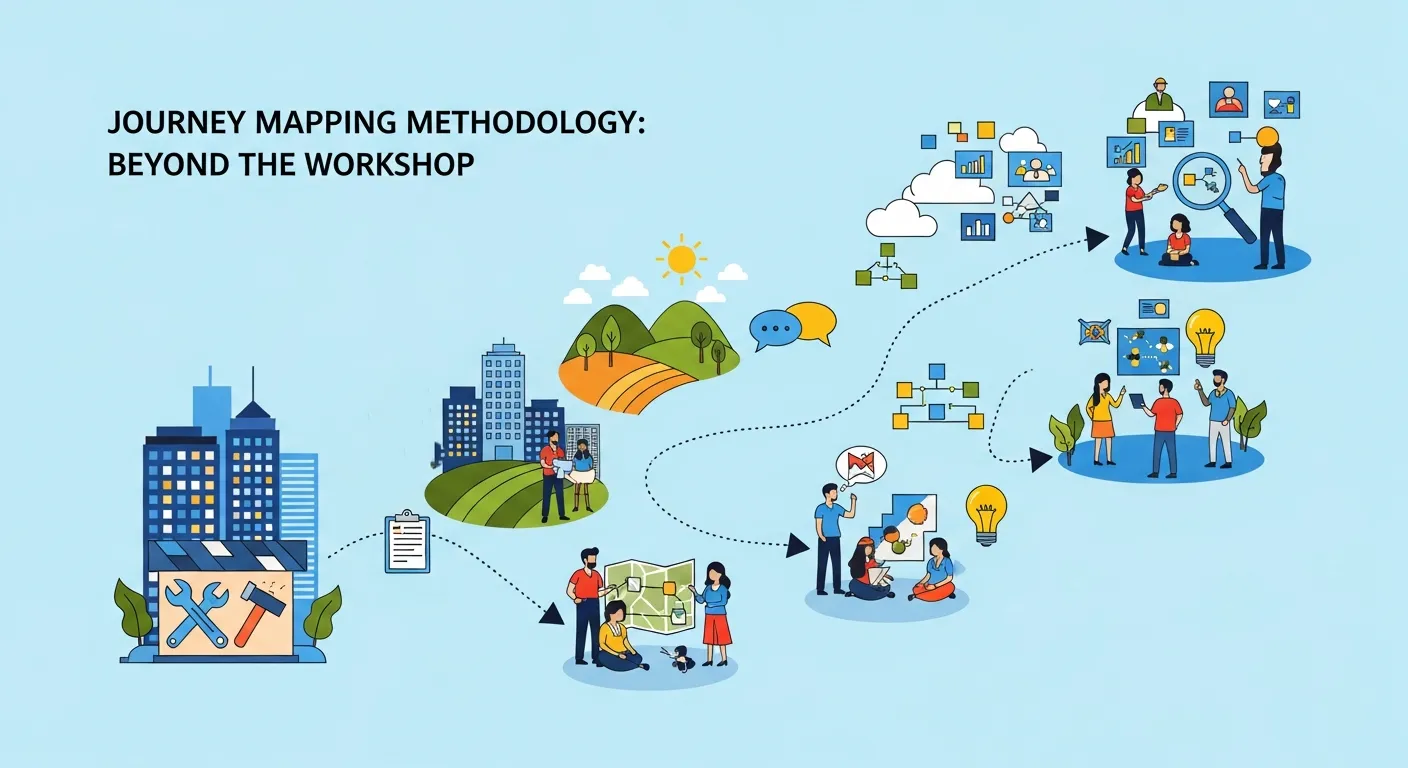
While many organizations treat journey mapping as a one-time workshop exercise, strategic applications require more rigorous approaches. Three methodological principles separate strategic journey mapping from superficial exercises.
Empirical Foundation
The most valuable journey maps blend qualitative insight with quantitative validation. Initial maps might emerge from customer interviews, ethnographic observation, and internal workshops. However, these hypotheses should then be validated through behavioral data, customer feedback, data analytics, and field testing.
Using data from Google Search Console helps validate what users are actually searching for before they even arrive at your site, providing empirical evidence of their initial intent.
Longitudinal Perspective
Customer relationships evolve over time. Strategic customer journey mapping examines not just immediate purchase pathways but entire relationship lifecycles—from initial awareness through repeat purchase, recommendation, and potentially, departure and return.
This extended timeframe reveals how brand perceptions form, strengthen, or erode through accumulated experience rather than isolated transactions. It also highlights critical relationship moments where small investments might yield significant loyalty dividends, impacting customer retention metrics directly.
Segmentation Sensitivity
Different customer segments often experience fundamentally different journeys with the same brand. Strategic journey mapping acknowledges these variations rather than averaging experiences into a misleading composite.
For example, a first-time customer navigating unfamiliar territory has substantially different needs and expectations than a loyal repeat customer. A journey map that doesn’t distinguish between these experiences misses critical strategic insights about how to move customers from initial trial to lasting loyalty. This is where account-based marketing (ABM) principles can be applied to map specific high-value client journeys distinct from general consumers.
Implementing Journey-Driven Brand Strategy
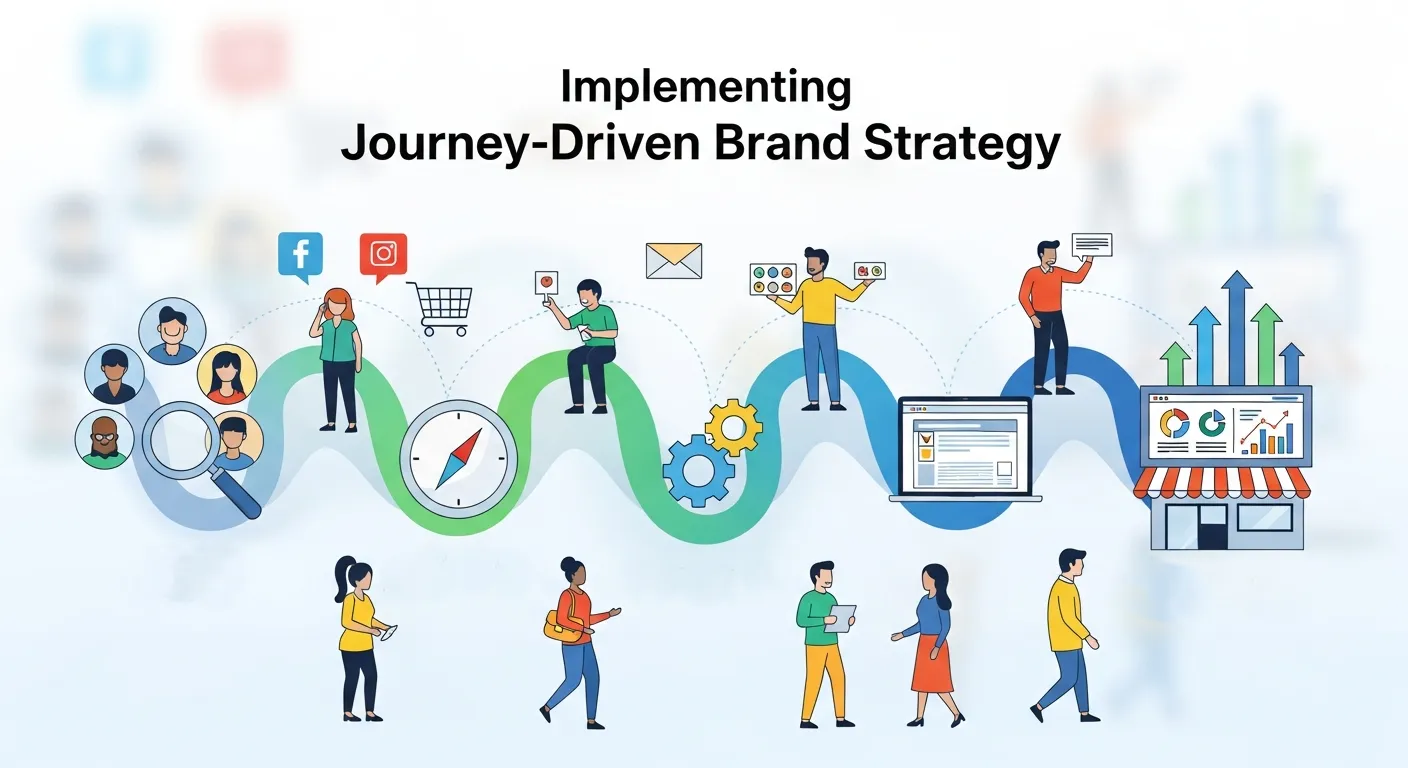
Translating journey insights into strategic advantage requires systematic implementation across the organization.
Experience Signature Development
The most distinctive brands identify “signature moments” where they consistently deliver experiences that differentiate them from competitors. Journey mapping reveals where these signature opportunities exist.
Southwest Airlines identified the in-flight safety announcement—a universally ignored moment in air travel—as an opportunity for brand distinctiveness. By encouraging flight attendants to inject personality and humor, they transformed a regulatory requirement into a brand-building moment that passengers actually anticipate. This is a prime example of brand storytelling in action.
Friction Elimination
Sometimes the most powerful brand strategy involves removing negative experiences rather than adding positive ones. Customer journey mapping excels at identifying unnecessary friction points that damage brand perception.
When Amazon introduced one-click purchasing, they eliminated multiple steps from the standard e-commerce growth journey, creating both immediate convenience and lasting brand association with shopping simplicity. This friction reduction became so strategically valuable they patented the concept. This is the essence of zero click optimization—reducing the effort required to achieve value.
Cross-Functional Governance
Sustaining journey-driven strategy requires governance structures that maintain focus on customer experience rather than departmental metrics. Many organizations establish customer journey teams with representation across functions, regular reporting of journey-based metrics, and explicit authority to address cross-departmental issues.
|
Strategic Action |
Objective |
Example Outcome |
|---|---|---|
|
Experience Innovation |
Solve core “Jobs-to-be-Done” |
Netflix moving from DVD to Streaming |
|
Friction Elimination |
Remove barriers to purchase |
Amazon’s 1-Click Ordering |
|
Signature Moments |
Create emotional brand peaks |
Southwest’s Safety Announcements |
|
Internal Alignment |
Unify departmental goals |
REI’s Cross-departmental coordination |
Leveraging Technology in Journey Mapping
In the modern era, AI marketing and machine learning play a pivotal role in dynamic journey mapping.
- Predictive Analytics: AI can predict the next best action for a customer based on their past journey data.
- Chatbot Marketing: Automated assistants can smooth out friction points in customer service, providing 24/7 support.
- Personalization Tactics: Using hyper-personalization, brands can tailor the website experience in real-time based on where the user is in their journey.
Conclusion
In markets where functional differentiation becomes increasingly difficult, customer experience emerges as the final frontier of meaningful differentiation. Customer journey mapping, when elevated from a tactical exercise to a strategic discipline, provides the insights needed to create these distinctive experiences. The most successful brands do not view this as a one-time project but as an ongoing strategic practice. By mapping these journeys with strategic intent, brands discover opportunities to deliver experiences so distinctive and valuable that customers not only return but eagerly share their experiences. In today’s experience economy, perhaps no strategic tool offers greater potential for sustainable differentiation and brand resilience.
Frequently Asked Questions (FAQs)
1. What is the difference between a touchpoint map and a customer journey map?
A touchpoint map is a simple inventory of every place a customer interacts with your brand (e.g., website, store, email). A customer journey map is a narrative tool that includes those touchpoints but layers on the customer’s emotions, motivations, pain points, and thought processes at each stage. It tells the story of the experience, not just the interaction.
2. How does customer journey mapping improve SEO optimization?
By understanding the questions and problems customers have at the “Awareness” and “Consideration” stages of their journey, you can create targeted content that answers those specific queries. This aligns your content marketing with user intent, which is a primary ranking factor for search engines like Google.
3. Can journey mapping help with B2B marketing?
Absolutely. In fact, it is often more critical in B2B due to longer sales cycles and multiple decision-makers. Mapping the journey helps identify when to deploy specific assets like white papers, webinars, or account-based marketing outreach to move the prospect to the next stage.
4. What tools are best for creating customer journey maps?
There are many tools available, ranging from simple digital whiteboards like Miro or Mural to specialized CX platforms like Smaply or UXPressia. However, data integration tools like Google Analytics and CRM platforms (Salesforce, HubSpot) are essential for feeding real data into those visual maps.
5. How often should we update our customer journey map?
Customer behaviors change rapidly, driven by technology and market trends. Ideally, you should review your high-level maps annually. However, for fast-moving industries like e-commerce, quarterly reviews of specific micro-journeys (like checkout or onboarding) are recommended to ensure conversion optimization.
6. What is the role of “personas” in journey mapping?
Personas are the characters in the story of your map. You cannot map a journey without knowing who is taking it. A “Price-Sensitive Student” will have a radically different journey and emotional trajectory than a “Premium Enterprise Buyer.” Effective mapping requires distinct maps for distinct personas.
7. How do we measure the success of journey mapping initiatives?
Success isn’t the map itself; it’s the metric it improves. Common KPIs include higher Net Promoter Score (NPS), increased customer retention rates, reduced customer acquisition costs (CAC), and higher Customer Lifetime Value (CLV). If the map leads to changes that improve these numbers, it was successful.
8. Why is “negative” feedback crucial for journey mapping?
Negative feedback highlights the “friction points” in the journey. These are your biggest opportunities for improvement. According to Bill Gates, “Your most unhappy customers are your greatest source of learning.” Mapping these pain points allows you to prioritize fixes that will have the biggest impact on brand loyalty.
9. Can journey mapping help with social media strategy?
Yes. By mapping where social media fits into the journey (e.g., brand discovery vs. customer support), you can tailor your content. Instagram might be for inspiration (Awareness), while Twitter/X is for real-time problem resolution (Support). This ensures channel-appropriate social media management.
10. What is “Service Blueprinting” and how does it relate?
While a customer journey map focuses on the customer’s experience (front-stage), a Service Blueprint maps the internal processes (back-stage) required to deliver that experience. It connects the customer actions to the employee actions and support systems needed to make the journey happen. It is the operational counterpart to the strategic journey map.