How to Conduct a Comprehensive Brand Audit (And What to Do With the Results)
Every successful brand eventually reaches a crossroads where evaluation becomes necessary. A thorough brand audit provides the clarity needed to make strategic decisions rather than reactive ones.
This guide details how to perform a comprehensive brand audit, covering both internal assessments of your brand identity and external analysis of market perception. You will learn how to synthesize findings and translate those insights into a clear, actionable strategic roadmap for sustainable growth.
Why Brand Audits Matter Now More Than Ever
In today’s marketplace, brands face unprecedented challenges. Consumer expectations shift constantly, digital landscapes transform overnight, and competitors emerge from unexpected directions. Brands that fail to periodically reassess their position often discover their market relevance quietly eroding. A brand audit isn’t merely a diagnostic tool; it’s a forward-looking compass that reveals both your current position and potential future direction. It is the foundation of any successful branding strategy.
The purpose of a brand audit is to provide an objective, 360-degree view of your brand’s health. It helps you identify strengths to build upon, weaknesses to correct, opportunities to seize, and threats to mitigate. Without this data-driven clarity, any attempt at rebranding, marketing campaigns, or strategic pivots is based on guesswork.
The Anatomy of an Effective Brand Audit
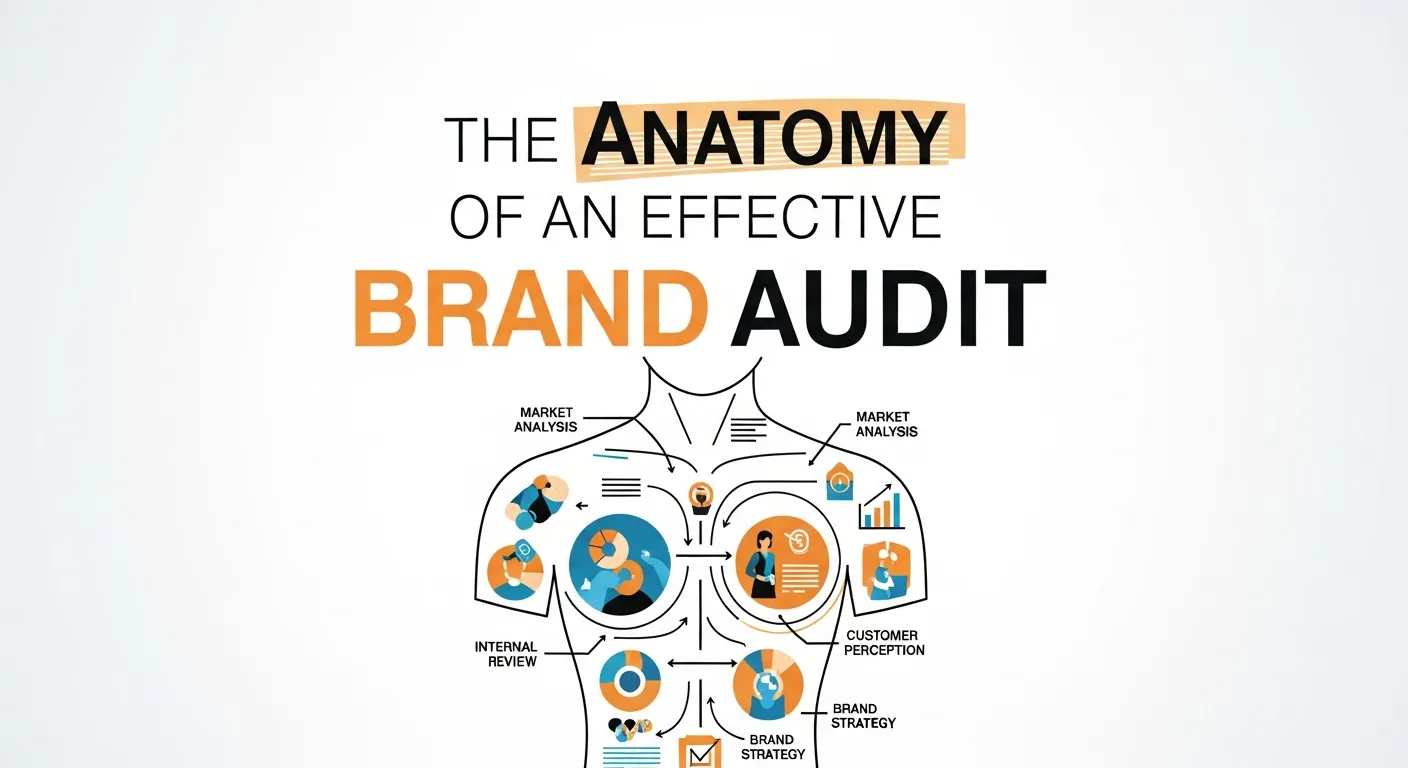
A truly comprehensive brand audit examines your brand from two critical perspectives: how you see yourself (internal) and how the world sees you (external). The most powerful insights often lie in the gap between these two views. This process involves a deep dive into your company’s communication, visual identity, market position, and customer sentiment.
Phase 1: The Internal Brand Audit
Start by looking in the mirror. The internal brand audit examines how your organization defines, communicates, and lives its brand. This internal perspective forms the foundation of your brand identity but often contains blind spots that only objective analysis can reveal.
Mission, Vision, and Values Alignment
The first step is to review your foundational documents.
- Mission Statement: Does it still accurately reflect your organization’s core purpose?
- Vision Statement: Does it still represent your long-term aspirations?
- Company Values: Are these values actively demonstrated in your company culture and business practices?
The gap between intention and reality often reveals crucial insights. If your mission is to be “customer-centric” but your internal processes prioritize cost-cutting over customer experience, you have a significant misalignment that a brand audit will uncover. This lack of brand alignment can be toxic to long-term growth.
Visual Identity Evaluation
Your visual elements—logo, typography, color palette, imagery—should work in harmony to convey your brand’s essence. Examine each element critically:
- Cohesion: Does your visual system feel cohesive or fragmented across different platforms (website, social media, print)?
- Timeliness: Does it reflect current design standards without appearing overly trendy or dated?
- Clarity: Would someone unfamiliar with your industry recognize what sector you operate in based solely on visual cues?
- Consistency: Is the same logo, color palette, and font used consistently everywhere?
Many brands discover that their visual systems have evolved haphazardly over time, creating inconsistencies that subtly undermine brand recognition. According to the Harvard Business Review, consistent presentation of a brand increases revenue by an average of 23%, highlighting the financial impact of visual coherence. A brand audit often reveals the need for updated brand guidelines.
Content and Messaging Analysis
Examine your communication across all channels. Does your brand maintain a consistent brand voice? Are key messages reinforced or contradicted? This part of the brand audit requires a detailed inventory of:
- Website Content: Is the copy on your homepage, about page, and product pages aligned in tone and message?
- Social Media: Does your Instagram presence have the same personality as your LinkedIn profile?
- Marketing Materials: Review advertisements, brochures, and sales presentations for consistency.
- Customer Service Communications: Analyze email templates, chatbot scripts, and call center guidelines.
- Product Descriptions & Packaging: Does the language on your packaging reinforce your brand’s core promises?
This analysis often reveals surprising inconsistencies. A brand might project a fun, casual tone on social media but use formal, corporate language in its customer service emails, creating a jarring customer experience.
Phase 2: The External Brand Audit
While the internal assessment reveals how you view your brand, the external analysis shows how others perceive it—which is often the more critical perspective. This part of the brand audit moves from introspection to market-facing research.
Competitive Landscape Mapping
You cannot understand your brand’s position without understanding the landscape it occupies. A competitive brand analysis is a core component of any brand audit.
- Identify Competitors: List both direct competitors (offering similar products) and indirect competitors (solving the same customer problem with a different solution).
- Analyze Their Positioning: How do your competitors position themselves in the market? Are they the low-cost option, the premium choice, or the innovative disruptor?
- Evaluate Their Marketing: Review their advertising, content marketing, and social media strategies. What channels are they using? What messages are they pushing? Tools like SEMrush and Ahrefs can provide powerful insights into their digital footprint.
- Assess Their Strengths & Weaknesses: What do they do well? Where are their vulnerabilities? This SWOT (Strengths, Weaknesses, Opportunities, Threats) analysis can reveal gaps in the market that your brand might be able to exploit.
Customer Perception Research
Nothing matters more than how your customers actually perceive your brand. The goal here is to measure the gap between your intended brand identity and the reality of customer perception. Gather qualitative and quantitative data through a variety of methods:
- Customer Surveys: Use tools like SurveyMonkey or Typeform to ask direct questions about brand awareness, associations, and satisfaction. The Net Promoter Score (NPS) is a simple but powerful metric to include.
- Interviews and Focus Groups: Conduct one-on-one interviews or small group discussions with customers to gather deep, qualitative insights into their feelings and experiences with your brand.
- Social Listening: Use tools to monitor mentions of your brand across social media, forums, and blogs. What are people saying when they don’t think you’re listening? This provides unfiltered feedback.
- Online Review Analysis: Scour reviews on Google, Yelp, Amazon, and other relevant platforms. Look for recurring themes in both positive and negative feedback.
- Sales Team Insights: Your sales and customer service teams are on the front lines. Interview them to understand common customer objections, questions, and preferences.
Pay special attention to the alignment—or misalignment—between your intended brand attributes and actual customer perception. When customers describe your brand, do they use the terms you would hope for?
Market Trends and Future Projections
A forward-looking brand audit considers not just current conditions but emerging trends. The world is not static, and your brand shouldn’t be either.
- Industry Reports: Analyze reports from market research firms like Gartner, Forrester, or Nielsen to understand where your industry is headed.
- Consumer Behavior Studies: Look for shifts in consumer values and behaviors. Is there a growing demand for sustainability marketing or ethical sourcing in your category?
- Technological Developments: Consider how emerging technologies like AI marketing, augmented reality, or the metaverse could impact your industry and your brand.
The goal is to identify how your brand positioning might need to evolve to remain relevant as market conditions change. A brand that is strong today could be obsolete tomorrow if it fails to adapt.
Phase 3: Synthesizing Brand Audit Findings
After collecting a mountain of data, the crucial work begins: synthesis and interpretation. This is where you connect the dots and transform raw information into actionable insights. Look for patterns, themes, and contradictions across all elements of your brand audit.
|
Audit Area |
Potential Finding |
What It Means |
|---|---|---|
|
Internal vs. External |
You see your brand as “innovative,” but customers see it as “reliable but boring.” |
There is a major disconnect between your brand promise and customer perception. Your marketing is not communicating innovation effectively, or your products aren’t delivering it. |
|
Competitive Analysis |
A new competitor is rapidly gaining market share by targeting a niche audience you’ve ignored. |
There is an untapped market opportunity, but also a new threat. You need to decide whether to compete for this niche or double down on your core audience. |
|
Content & Messaging |
Your social media voice is playful and modern, but your website copy is formal and technical. |
Your brand has a split personality, which can confuse customers and undermine trust. You need to establish a consistent brand voice. |
|
Visual Identity |
Your logo and color palette look very similar to three of your main competitors. |
Your visual identity is not distinctive and is failing to differentiate you in the marketplace, leading to low brand awareness. |
The most valuable insights often emerge from these contradictions—the places where your internal perception and the external reality diverge significantly. These gaps represent your biggest risks and your greatest opportunities.
Phase 4: Translating Audit Insights into Strategic Action
A brand audit without action is merely an expensive academic exercise. The final, and most important, phase is to create a clear, prioritized strategic roadmap. Group your recommendations across three time horizons.
Immediate Corrections (The Next 1-3 Months)
These are the “quick wins” and critical fixes identified in your brand audit. They often involve addressing obvious inconsistencies and low-hanging fruit.
- Messaging Fixes: Correcting glaring messaging contradictions across your website and social media profiles.
- Visual Inconsistencies: Ensuring the correct logo and brand colors are used on all platforms.
- Customer Experience Pain Points: Addressing common complaints that surfaced in customer feedback, such as a confusing checkout process or slow customer service response times.
Medium-Term Initiatives (The Next 3-12 Months)
These changes require more substantial planning and resources. They often involve refreshing brand assets and strategies based on your brand audit findings.
- Brand Refresh: Updating visual identity elements that have become outdated, such as modernizing your logo or refreshing your color palette.
- Content Strategy Overhaul: Developing a new content marketing plan based on audience insights, focusing on topics and formats that resonate with your target customers.
- Positioning Adjustments: Refining your brand positioning statement to better differentiate yourself from competitors who have shifted their strategies.
Strategic Repositioning (The Next 1-3 Years)
Sometimes, a brand audit reveals the need for fundamental, transformative change. These are major strategic decisions that will shape the future of your business.
- Complete Rebranding: If your current brand identity no longer serves your business goals or is tied to negative connotations, a full rebrand may be necessary.
- Audience Pivot: If your traditional customer segment is declining, you may need to strategically pivot to target a new, growing audience.
- Product/Service Innovation: If the audit reveals unmet customer needs or disruptive market trends, it may trigger the development of new products or services.
Case Study: How a Brand Audit Drove REI’s Transformation
Consider outdoor retailer REI’s evolution following their comprehensive brand audit in 2015. The audit revealed that while customers valued their products, the deeper emotional connection came from the experiences that REI’s gear facilitated. This powerful insight drove their strategic shift from being a retailer of things to an enabler of outdoor life.
This new positioning culminated in the groundbreaking #OptOutside campaign, where the company announced it would close its stores on Black Friday—one of the biggest retail days of the year—and pay its employees to spend the day outside.
- The campaign was a tangible expression of the repositioned brand values uncovered through the brand audit.
- The results were remarkable: social engagement rose by 7,000%, and the brand secured a powerfully differentiated position in a crowded retail sector.
This case perfectly illustrates how a brand audit can lead to insights that inspire bold, brand-defining actions.
Conclusion
A comprehensive brand audit is not about correction—it’s about connection. It bridges the gap between how you see your brand and how the world actually experiences it. In that space between perception and reality lies the opportunity for authentic growth and renewed relevance. The most adaptive organizations embrace a continuous audit mindset, constantly evaluating the alignment between brand intention and market reality.
Frequently Asked Questions (FAQs)
1. What is a brand audit?
A brand audit is a detailed analysis of your brand’s current position in the market compared to its strategic goals. It involves a comprehensive examination of both internal factors (like company culture and visual identity) and external factors (like customer perception and competitive landscape) to assess the overall health of the brand.
2. How often should a company conduct a brand audit?
A full, comprehensive brand audit is typically recommended every 2-3 years. However, businesses should conduct smaller, more frequent “health checks” on an annual basis. In fast-moving industries, a more frequent audit schedule may be necessary.
3. What is the difference between a brand audit and a marketing audit?
A marketing audit focuses on the effectiveness of your marketing tactics, channels, and campaigns (the “how”). A brand audit is more strategic and holistic; it assesses the strength and consistency of the brand itself (the “what” and “why”) and its position in the market.
4. Can I conduct a brand audit myself, or do I need to hire an agency?
While you can conduct a basic internal brand audit yourself, an external agency or brand development consultant can provide a crucial objective perspective. They are not influenced by internal politics or emotional attachments to the brand, which often leads to more honest and actionable insights, particularly for the external perception part of the audit.
5. What are the key components of a brand audit checklist?
A good checklist includes:
- Internal Branding (Mission, Vision, Values, Culture)
- External Branding (Brand Awareness, Customer Perception, Reputation)
- Brand Identity (Logo, Voice, Messaging, Visuals)
- Competitive Analysis (Positioning, Strengths, Weaknesses)
- Customer Experience (Journey Mapping, Touchpoint Analysis)
- Digital Presence (Website, SEO, Social Media)
6. How do I measure customer perception in a brand audit?
You can measure customer perception through a mix of qualitative and quantitative methods: surveys (to measure metrics like NPS), customer interviews, focus groups, social media listening (to track sentiment), and analysis of online reviews and customer feedback.
7. What is the most common mistake companies make when conducting a brand audit?
The most common mistake is approaching the audit defensively. A brand audit is meant to uncover weaknesses and inconsistencies. If leadership is not open to hearing critical feedback, the process will fail. The goal is not to confirm that everything is perfect but to find opportunities for improvement.
8. What should be the final output of a brand audit?
The final output should be a detailed report that includes:
- An executive summary of key findings.
- A detailed analysis of all areas covered in the audit.
- A clear SWOT (Strengths, Weaknesses, Opportunities, Threats) analysis.
- A prioritized list of actionable recommendations with a clear timeline (short-term, medium-term, and long-term).
9. How does a brand audit help with SEO?
A brand audit can significantly inform your SEO optimization strategy. By understanding how customers search for solutions in your category (customer perception research) and what keywords your competitors are ranking for (competitive analysis), you can refine your keyword strategy to better align with your desired brand positioning and capture more relevant traffic.
10. What is the first step to take after completing a brand audit?
The first step is to present the findings to key stakeholders and gain alignment on the strategic priorities. Then, focus on implementing the “quick wins” or immediate corrections identified in the audit. Building momentum by addressing low-hanging fruit can help secure buy-in for the larger, more resource-intensive initiatives to come.