What Does Brand Promotion Mean on Amazon: A Complete Guide
Unlock the potential of the world’s largest marketplace. We dive deep into what does brand promotion mean on Amazon to help you scale visibility, drive sales, and build loyalty.
In this guide, we explore what does brand promotion mean on Amazon, covering essential tools like Sponsored Brands, Stores, and Posts. You will learn actionable strategies to increase visibility, optimize ad spend, and leverage Amazon’s ecosystem to create a lasting brand identity that converts browsers into loyal buyers.
What Does Brand Promotion Mean on Amazon?
When sellers ask, “what does brand promotion mean on Amazon?” they are often looking for a simple definition of a complex ecosystem. At its core, brand promotion on Amazon refers to a suite of marketing strategies and advertising tools designed specifically for brand owners enrolled in the Amazon Brand Registry. Unlike standard product listings that focus solely on selling a single SKU, brand promotion focuses on telling a cohesive brand story, increasing portfolio visibility, and fostering customer loyalty.
It is not just about getting a click; it is about creating a brand experience within a platform traditionally known for commoditized shopping.
The Evolution of Branding on Amazon
Years ago, Amazon was strictly a transactional platform. You searched for “batteries,” bought the cheapest or highest-rated option, and moved on. Today, the landscape has shifted. Amazon now prioritizes brands that can engage customers.
Understanding what does brand promotion mean on Amazon requires looking at how the platform rewards engagement. Tools like Amazon Stores, A+ Content, and Sponsored Brands allow you to differentiate your products from generic competitors. According to data from Statista, Amazon’s ad revenue has grown exponentially, proving that brands are investing heavily in these promotional avenues to stand out.
Key Components of Brand Promotion
To fully grasp what does brand promotion mean on Amazon, you must understand the specific tools available:
- Sponsored Brands: These are banner ads that appear at the very top of search results, featuring your logo, a custom headline, and a selection of products.
- Amazon Stores: A dedicated, multi-page storefront that acts as a mini-website within Amazon, allowing for a curated brand experience free from competitor ads.
- Amazon Posts: A social media-style feed that allows brands to share lifestyle images and product updates, driving discovery.
- Amazon Live: Livestreaming capabilities that allow brands to demonstrate products in real-time, similar to QVC or social commerce.
Benefits of Brand Promotion on Amazon
Why should you care about what does brand promotion mean on Amazon? The benefits go far beyond simple vanity metrics. Implementing a robust promotion strategy directly impacts your bottom line and long-term viability on the platform.
1. Increased Visibility and Brand Awareness
The most immediate benefit is visibility. With millions of products vying for attention, standard organic search results are often crowded. Amazon Brand Promotion tools, particularly Sponsored Brands, place your logo and products in prime real estate—often the very first thing a shopper sees. This is crucial for How to Increase Brand Awareness Through Digital Marketing strategies within the marketplace.
2. Enhanced Credibility and Trust
Shoppers are more likely to purchase from recognized entities. When you utilize high-quality A+ Content and a professional Brand Store, you signal to the customer that you are a legitimate business, not a fly-by-night operation. This builds Brand Equity in Marketing, leading to higher conversion rates.
3. Protection Against Competitors
One often overlooked aspect of what does brand promotion mean on Amazon is defense. If you aren’t bidding on your own brand keywords or utilizing your Brand Store, competitors can target your audience. Brand promotion allows you to “own” your digital shelf space, preventing others from poaching your customers.
4. Cross-Selling and Upselling Opportunities
Standard Sponsored Products ads promote one item. In contrast, Sponsored Brands and Stores allow you to showcase your entire catalog. If a customer is looking for a coffee maker, brand promotion tools allow you to also show them your coffee beans, filters, and mugs, increasing the average order value.
5. Data-Driven Insights
Amazon provides robust analytics for brand tools. You can see how many people visited your Store, which pages they looked at, and how new-to-brand customers are interacting with your ads. This data is invaluable for refining your broader Digital Marketing Strategies.
|
Benefit |
Description |
Impact on ROI |
|---|---|---|
|
Visibility |
Top-of-search placement |
High |
|
Trust |
Professional A+ Content & Stores |
Medium/High |
|
Defense |
Owning brand keywords |
High |
|
Cross-Selling |
Showcasing full catalog |
Medium |
|
Analytics |
Data on new-to-brand shoppers |
High |
How Amazon’s Brand Promotion Works
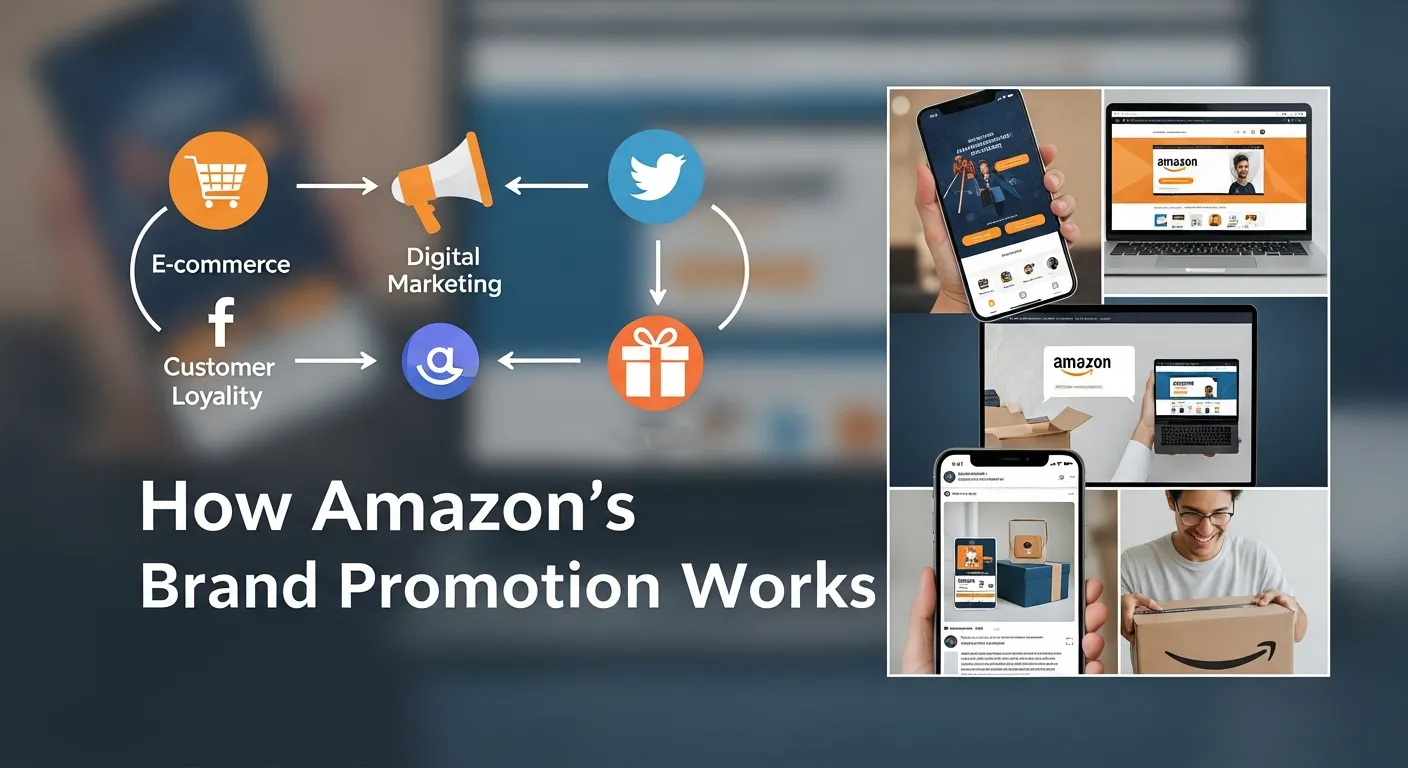
To truly master what does brand promotion mean on Amazon, you need to understand the mechanics behind the tools. It acts as a funnel, moving customers from awareness to consideration and finally to purchase.
The Role of Amazon Brand Registry
Before accessing these advanced tools, you must be enrolled in the Amazon Brand Registry. This requires a registered trademark. Once enrolled, you unlock the full suite of promotional tools. This is the foundational step in Amazon Brand Promotion.
Sponsored Brands: The Headliners
Sponsored Brands (formerly Headline Search Ads) are keyword-targeted ads.
- Targeting: You select keywords relevant to your products (e.g., “running shoes”).
- Creative: You design an ad creative featuring your logo, a custom headline, and three distinct products.
- Destination: When clicked, you can direct the shopper to a custom landing page or your Amazon Store.
This mechanism is vital for capturing high-intent traffic. When someone asks what does brand promotion mean on Amazon in the context of PPC (Pay-Per-Click), Sponsored Brands are often the answer.
Sponsored Display: Retargeting Mastery
Sponsored Display ads allow you to reach audiences both on and off Amazon. This works by:
- Retargeting: Showing ads to people who viewed your product but didn’t buy.
- Audience Interests: Targeting shoppers who have shown interest in categories related to your brand.
This is similar to Integrated Brand Promotion across other web platforms but contained within the Amazon ecosystem and its partner sites.
Amazon Stores: Your Brand HQ
Think of this as your website inside Amazon. You use a drag-and-drop builder to create pages.
- Home Page: Highlights best sellers and brand story.
- Category Pages: Organizes products (e.g., “Mens,” “Womens,” “Accessories”).
- Deals Page: specific page for active promotions.
The “Follow” button on Stores also allows you to build a subscriber base, alerting customers when you launch new products—a key tactic in Brand Building and Performance Marketing.
Strategies for Effective Brand Promotion
Knowing what does brand promotion mean on Amazon is different from executing it effectively. Here are detailed strategies to maximize your results.
1. Leverage Video in Sponsored Brands
Video has a higher engagement rate than static images. Amazon allows you to use video in Sponsored Brands ads.
- Strategy: Create a 15-30 second clip showing the product in use.
- Why it works: It stops the scroll. In a sea of white-background thumbnails, a moving image grabs attention immediately. This taps into Sensory Branding principles, even on a digital screen.
2. Optimize Your Brand Store for UX
Don’t just dump products into your store. Design it with the user experience (UX) in mind.
- Navigation: Ensure menus are intuitive.
- Imagery: Use high-resolution lifestyle images that evoke Emotional Branding.
- Mobile Optimization: Ensure the store looks good on mobile devices, where a significant portion of traffic originates.
3. Use A+ Content to Tell a Story
A+ Content (formerly EBC) replaces the text-only product description with rich images and text overlays.
- Comparison Charts: Help users choose the right model, reducing returns.
- Brand Story Module: A dedicated section to explain your company’s mission and values. This is excellent for Sustainable Branding Strategies if your brand is eco-conscious.
4. Implement a “New-To-Brand” Focus
Amazon provides metrics on “New-to-Brand” orders.
- Strategy: Allocate a specific portion of your budget to generic, high-volume keywords rather than just branded keywords.
- Goal: Acquire new customers rather than just retargeting existing ones. This is crucial for expanding market share and understanding What is Brand Awareness in Marketing? on the platform.
5. Utilize Amazon Posts
Posts are free to use.
- Strategy: Repurpose your Instagram and Facebook content for Amazon Posts.
- Placement: These appear on your product pages, competitor pages, and category feeds.
- Benefit: It adds a layer of Social Media Marketing directly onto the sales platform.
6. Seasonal Promotions and Deals
Align your Amazon strategy with the calendar.
- Events: Prime Day, Black Friday, Cyber Monday, and “Turkey 5”.
- Tactics: Use “Coupons” (green badges) and “Lightning Deals” to increase click-through rates (CTR).
- Context: Understanding Seasonal Marketing Strategies is vital. For example, during Q4, cost-per-click (CPC) rises, so your strategy must adjust to protect margins while capturing volume.
The Intersection of SEO and Brand Promotion
Many sellers wonder what does brand promotion mean on Amazon regarding SEO. They are deeply intertwined.
- Keywords: The keywords you target in Sponsored Brands should align with the backend keywords in your listing.
- Sales Velocity: Paid promotion drives sales. Amazon’s organic ranking algorithm (A9) favors products with high sales history. Therefore, effective promotion boosts your organic rankings.
- Relevance: High-converting ads signal to Amazon that your product is relevant for those search terms.
Tools like SEMrush and Ahrefs (traditionally for Google SEO) now offer Amazon-specific tools or can help you understand broader search volume trends that you can apply to Amazon.
Common Mistakes to Avoid

Even seasoned marketers misunderstand what does brand promotion mean on Amazon. Avoid these pitfalls:
1. Ignoring Mobile Optimization
Over 50% of Amazon shoppers are on mobile. If your A+ Content text is embedded in images (making it unreadable on small screens) or your Store navigation is clunky, you lose sales.
2. “Set It and Forget It”
Amazon Advertising is dynamic. Bids change daily.
- Mistake: Launching a campaign and not checking it for a month.
- Fix: Weekly audits of Search Term Reports to negate irrelevant keywords and adjust bids.
3. Inconsistent Brand Voice
Your Sponsored Brand ad says “Luxury,” but your product page images look amateur. This disconnect kills conversion. You must maintain Brand Consistency: The Golden Rule for Building a Trusted and Recognizable Brand.
4. Cannibalization
Bidding too aggressively on your own brand name without strategy. While defense is good, you don’t want to pay for traffic you would have gotten organically for free, unless competitors are aggressively targeting you. This is a nuanced area of Brand Cannibalization.
5. Neglecting the “Brand Story” Module
Amazon recently introduced a specific “Brand Story” module that sits above A+ content. Many sellers leave this blank. It is a wasted opportunity to cross-link to other products and build Brand Personality In Marketing.
Case Studies and Success Stories

To illustrate what does brand promotion mean on Amazon, let’s look at hypothetical examples based on real-world strategies.
Case Study 1: The Eco-Friendly Kitchen Brand
- Challenge: A brand selling reusable bamboo towels was struggling to stand out against cheap paper towel bulk packs.
- Strategy: They utilized Sponsored Brands Video ads targeting “paper towels.” The video showed a spill being wiped up, the towel being washed, and reused.
- Result: They communicated their value proposition (reusability) in seconds. Their CTR doubled, and they saw a 40% increase in New-To-Brand sales. This is a classic example of Green Marketing meeting Amazon PPC.
Case Study 2: The Supplement Company
- Challenge: High competition and skeptical customers.
- Strategy: They focused heavily on Amazon Stores and A+ Content. They used the Store to house educational content about ingredients and sourcing. They used A+ content to show certification badges (GMP, Organic).
- Result: Conversion rate increased by 25% because the content built trust. They effectively answered What Is Brand Perception in Marketing? by positioning themselves as the premium, safe choice.
Advanced Tactics: DSP and Amazon Marketing Cloud
For large brands asking what does brand promotion mean on Amazon at an enterprise level, the answer lies in DSP (Demand Side Platform).
- DSP: Allows you to buy display and video ads programmatically across the web (not just on Amazon) to drive traffic to your Amazon listings.
- Funnel: This fills the very top of the funnel, retargeting people who read blogs about running (for example) with ads for your running shoes on Amazon.
This aligns with Integrated Marketing approaches where Amazon is just one conversion point in a larger web ecosystem.
Conclusion
So, what does brand promotion mean on Amazon? It is the difference between being a vending machine and being a destination. It is the strategic use of Sponsored Brands, Stores, Posts, and creative content to carve out a unique identity in a crowded marketplace.
By moving beyond basic product listings and embracing a comprehensive brand strategy, you protect your market share, increase customer lifetime value, and build a resilient business. Whether you are leveraging Neuromarketing Techniques in your imagery or analyzing data to refine your Brand Positioning, the tools are there. The brands that win on Amazon in the coming years will be those that stop just selling products and start promoting a brand.
FAQs
1. What does brand promotion mean on Amazon compared to standard selling?
Standard selling focuses on listing individual products and optimizing for specific search terms to get a sale. Brand promotion on Amazon involves a holistic approach using tools like Sponsored Brands and Stores to market the entire brand identity, increase loyalty, and encourage cross-selling across the product portfolio.
2. Do I need Brand Registry for brand promotion?
Yes, for the most effective tools. To access Sponsored Brands, Amazon Stores, Amazon Posts, and A+ Content, you must be enrolled in the Amazon Brand Registry, which requires a pending or registered trademark.
3. How much does Amazon brand promotion cost?
It operates on a PPC (Pay-Per-Click) model. You set your budget. You can spend as little as $10 a day or thousands. The cost depends on the competitiveness of your keywords. However, brand promotion ads (Sponsored Brands) often have a higher CPC than standard product ads due to their premium placement.
4. What is the difference between Sponsored Products and Sponsored Brands?
Sponsored Products promote individual listings and appear within search results. Sponsored Brands promote the brand itself; they appear at the top of the search results as a banner, featuring a logo, a headline, and up to three products.
5. Can I use brand promotion to improve my organic ranking?
Yes. Sales velocity is a major factor in Amazon’s A9 ranking algorithm. By using what does brand promotion mean on Amazon to drive traffic and sales, you signal popularity to Amazon, which can boost your organic search positions over time.
6. What is an Amazon Storefront?
An Amazon Store (or Storefront) is a free, self-service branded destination on Amazon. It acts like a mini-website where you can showcase your product portfolio, tell your brand story, and use rich media like video, without competitor ads distracting the shopper.
7. How do I measure the success of my brand promotion?
Amazon provides detailed metrics including Impressions, Clicks, Click-Through Rate (CTR), Return on Ad Spend (ROAS), and Advertising Cost of Sales (ACOS). For brand promotion specifically, “New-to-Brand” metrics are crucial for measuring growth in brand awareness.
8. What are Amazon Posts?
Amazon Posts are a browseable feed of lifestyle images with captions, similar to Instagram. They appear on product detail pages and category feeds. They are currently free and help drive brand discovery and product page traffic.
9. Is video important for brand promotion on Amazon?
Extremely. Sponsored Brands Video ads generally have higher engagement rates than static ads. Video allows you to demonstrate product features, show size and scale, and evoke emotion, which is critical for conversion.
10. Can I do brand promotion if I am a reseller?
Generally, no. The full suite of Amazon Brand Promotion tools (Stores, Sponsored Brands, A+ Content) is reserved for the brand owner (the manufacturer or private label owner). Resellers usually rely on Sponsored Products or seller-specific promotions.
Disclaimer: This guide is for informational purposes. Amazon’s policies and tools change frequently. Always consult official Amazon resources for the latest updates.