Understanding the Difference Between Brand Marketing and Performance Marketing
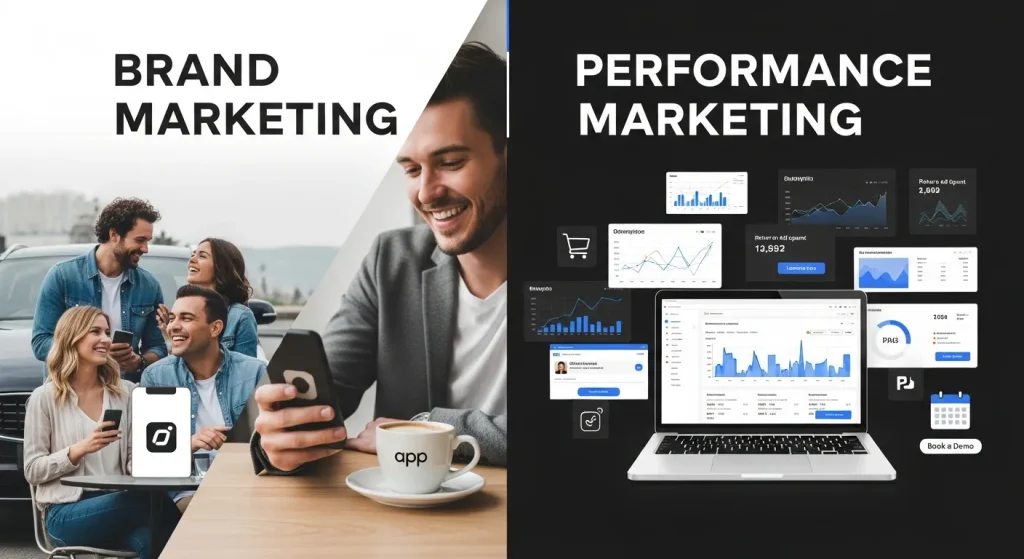
In marketing, two powerful approaches often take center stage: brand marketing and performance marketing. While both aim to drive business growth, they operate on different timelines and with distinct goals. Understanding the nuances of brand marketing and performance marketing is crucial for building a resilient, successful strategy.
This article provides a deep dive into the strategic comparison of brand marketing and performance marketing. We will explore the core definitions, objectives, and metrics for each. You’ll learn the unique strategies involved, from emotional branding and storytelling to data-driven PPC and affiliate campaigns. More importantly, we will show you how to create an integrated marketing plan that balances long-term brand equity with short-term, measurable results, ensuring sustainable growth for your business.
The Core Concepts: Brand Marketing and Performance Marketing
Every marketing effort can broadly be categorized into two main functions: building the brand or driving a specific action. The ongoing discussion of brand marketing and performance marketing isn’t about choosing one over the other; it’s about understanding how they complement each other to create a powerful, holistic strategy. One builds the foundation of trust and recognition, while the other capitalizes on that foundation to generate immediate, measurable outcomes.
What is Brand Marketing?
Brand marketing is the strategic practice of shaping a company’s public perception. It’s a long-term investment focused on creating a strong, positive, and memorable identity in the minds of consumers. This approach goes beyond selling a product; it’s about communicating your company’s values, mission, and story. The primary objective of all brand marketing is to build brand equity—the value a company generates from a product with a recognizable name when compared to a generic equivalent.
Think of iconic brands like Nike or Apple. Their marketing often focuses on emotions, aspirations, and lifestyle rather than just the features of a shoe or a phone. This is emotional branding at its finest. They have cultivated a deep connection with their audience, leading to unwavering loyalty and a willingness to pay a premium. This is the power of effective brand marketing.
Key objectives of brand marketing include:
- Increasing Brand Awareness: Making sure your target audience knows your brand exists and recalls it when making a purchase decision. Mastering how to increase brand awareness through digital marketing is a common goal.
- Building Brand Trust and Loyalty: Fostering a relationship with customers so they choose you repeatedly over competitors.
- Shaping Brand Perception: Controlling the narrative around your brand and what it stands for in the market.
- Creating Emotional Connections: Using storytelling and value alignment to connect with consumers on a deeper level.
A major focus of brand marketing is brand positioning in marketing, which is how you differentiate your brand in the customer’s mind. Creating a strong brand positioning in your market is essential for standing out in crowded industries.
What is Performance Marketing?
Performance marketing is a digital marketing strategy where businesses pay marketing service providers when a specific action is completed, such as a click, a lead, or a sale. It is entirely results-oriented and data-driven. The focus is on immediate, measurable ROI.
Unlike traditional advertising, where you pay upfront for ad space with no guarantee of results, performance marketing ties ad spend directly to tangible outcomes. This makes it a highly accountable and efficient use of marketing budgets. Common channels include search engine marketing (SEM), social media advertising, affiliate marketing, and programmatic advertising.
For a performance marketer, success is defined by clear key performance indicators (KPIs). They are constantly analyzing data to optimize campaigns for better results, asking questions like: “What is my Cost Per Acquisition (CPA)?” or “What is my Return on Ad Spend (ROAS)?”
Key objectives of performance marketing include:
- Driving immediate conversions: Generating sales, leads, or sign-ups quickly.
- Maximizing ROI: Ensuring every dollar spent on advertising generates a positive return.
- Acquiring new customers efficiently: Using precise targeting to reach high-intent audiences at a low cost.
- Generating measurable results: Tracking every aspect of a campaign to understand what works and what doesn’t.
The debate of brand marketing and performance marketing often centers on short-term gains versus long-term value, but the most successful companies understand the need for both.
Strategic Differences: A Head-to-Head Comparison
To truly grasp the concept of brand marketing and performance marketing, it’s helpful to compare them across several key strategic dimensions. While their end goal—business growth—is the same, their methods for achieving it are vastly different.
|
Feature |
Brand Marketing |
Performance Marketing |
|---|---|---|
|
Primary Goal |
Build long-term brand equity, trust, and loyalty. |
Drive immediate, measurable actions (sales, leads). |
|
Time Horizon |
Long-term (months to years). |
Short-term (days to weeks). |
|
Key Metrics |
Brand awareness, share of voice, brand sentiment, Net Promoter Score (NPS), brand recall. |
Cost Per Acquisition (CPA), Return on Ad Spend (ROAS), Click-Through Rate (CTR), Conversion Rate. |
|
Measurement |
Often qualitative and correlational; uses surveys, social listening, and market studies. |
Highly quantitative and direct; uses analytics platforms like Google Analytics and ad dashboards. |
|
Channels |
Content marketing, PR, sponsorships, social media engagement, TV ads, influencer marketing. |
Pay-Per-Click (PPC), social media ads, affiliate marketing, programmatic ads, retargeting. |
|
Audience Targeting |
Broad; aims to reach a wide segment of the target market to build recognition. |
Narrow and specific; targets users based on behavior, demographics, and expressed intent. |
|
Cost Structure |
Often upfront investment (e.g., campaign production, media buys). |
Pay-for-performance (e.g., pay-per-click, pay-per-sale). |
|
Risk |
Higher upfront financial risk with less predictable, long-term ROI. |
Lower financial risk as payment is tied to results, but can lead to dependency on paid channels. |
This table illustrates the fundamental tension and synergy in the brand marketing and performance marketing dynamic. Brand marketing fills the top of the funnel by creating awareness and demand, while performance marketing converts that demand at the bottom of the funnel.
Deep Dive into Brand Marketing Strategies
Effective brand marketing is an art form that uses psychology, storytelling, and consistency to build a lasting legacy. It’s about creating a brand that people not only recognize but also feel a connection with. Let’s explore some key strategies.
The Power of Brand Storytelling
Mastering brand storytelling is fundamental. It’s the cohesive narrative that weaves together the facts and emotions that your brand evokes. A compelling story helps humanize your brand, making it more relatable and memorable.
- Emotional Branding: This strategy focuses on creating an emotional bond with consumers. It taps into aspirations, fears, and desires to build a strong connection. The psychology behind emotional branding shows that people often buy based on emotion and then justify with logic.
- Brand Archetypes: Based on Carl Jung’s psychological archetypes, this framework uses universal patterns of behavior to define a brand’s personality. Is your brand a Hero, a Sage, or a Jester? Using brand archetypes helps create consistency in your messaging and personality.
- Interactive Storytelling in Branding: Modern technology allows for more immersive experiences. Brands are using interactive content, augmented reality branding, and even gamified branding to engage audiences in their story, making them active participants rather than passive viewers.
Building Brand Identity and Personality
A brand’s identity is more than just a logo. It’s the sum of all its parts, working together to create a distinct presence.
- The Psychology of Color in Branding: Colors evoke specific emotions and associations. The choices you make in your brand’s color palette can significantly impact consumer perception.
- What Is Brand Voice in Marketing? A brand voice is the distinct personality a brand takes on in its communications. Is it authoritative and professional, or witty and informal? A consistent brand voice makes the brand feel like a familiar person, building trust and recognition.
- Brand Personality in Marketing: Similar to brand voice, personality defines the human characteristics attributed to a brand. This is often described using the “Big 5” model of brand management and personality, which includes sincerity, excitement, competence, sophistication, and ruggedness.
Inclusive and Sustainable Branding
Modern consumers care about a brand’s values. Inclusive brand strategies that embrace diversity and equality are not just ethical but also good for business. Similarly, sustainable branding strategies that go beyond “greenwashing” and demonstrate a genuine commitment to environmental and social responsibility can build powerful brand equity. However, brands must be wary of the truth behind branded sustainability and environmental harm, as consumers are quick to spot inauthenticity.
Leveraging Content and Influencers
- What is Branded Content Marketing? This involves creating content that is valuable and entertaining on its own, with the brand integrated naturally. It’s less about a direct sales pitch and more about providing value to build an audience.
- Influencer Marketing: Collaborating with influencers is a powerful way to build trust and reach new audiences. From celebrity endorsements to micro-influencer strategies, the ROI of influencer marketing can be significant when executed authentically. Getting brand promotions on Instagram or YouTube through influencers is a common tactic.
The interplay between brand marketing and performance marketing is evident here. A strong brand marketing push with influencers can lead to better performance in direct-response campaigns.
Unpacking Performance Marketing Strategies
Performance marketing is a science. It’s about precision, measurement, and optimization. Every dollar is tracked, and every campaign is scrutinized for efficiency. Let’s break down the key strategies that drive immediate results.
Paid Advertising Channels
These channels are the bread and butter of performance marketing, allowing for precise targeting and measurable outcomes.
- Search Engine Marketing (SEM): This involves running paid ads on search engines like Google. By targeting keywords that signal high purchase intent, businesses can capture demand at the exact moment a consumer is looking for a solution. Metrics like Cost-Per-Click (CPC) and Click-Through Rate (CTR) are paramount.
- Social Media Advertising: Platforms like Facebook, Instagram, and LinkedIn offer powerful targeting options based on demographics, interests, and behaviors. Social media ads can be used for everything from driving website traffic to generating leads and direct sales. The ability to retarget users who have previously engaged with your brand makes it an essential tool.
- Connected TV (CTV) Advertising: Once considered a brand-building channel, TV advertising has entered the performance realm with CTV. Advertisers can now target specific households and measure direct outcomes like website visits and purchases, blending the impact of television with the measurability of digital marketing. This shift is a key evolution in the brand marketing and performance marketing landscape.
Affiliate and Partnership Marketing
- Affiliate Marketing: This is a classic performance-based model where you partner with individuals or companies (affiliates) who promote your product in exchange for a commission on sales they generate. It’s a low-risk way to expand your reach, as you only pay for actual conversions.
- Co-branding in Marketing: Co-branding partnerships, where two brands collaborate on a marketing campaign, can be structured as performance-based initiatives. Both brands can benefit from each other’s audiences while sharing the costs and tracking the results.
The Importance of Analytics and Optimization
Performance marketing lives and dies by data. Continuous optimization is non-negotiable.
- A/B Testing: Constantly testing different ad creatives, headlines, landing pages, and offers is crucial to improving campaign performance. Even small tweaks can lead to significant improvements in conversion rates and ROI.
- Conversion Rate Optimization (CRO): This is the systematic process of increasing the percentage of website visitors who take a desired action. It involves understanding how users navigate your site, what actions they take, and what’s stopping them from converting.
- Customer Journey Mapping: While often associated with brand strategy, understanding the customer journey is vital for performance marketers. It helps identify the right touchpoints to serve a performance-driven ad that nudges a user toward conversion.
The data-driven nature of performance marketing provides valuable insights that can inform brand strategy. For example, discovering which ad messages resonate most with an audience can help refine the overall brand voice. This feedback loop is essential in an integrated approach to brand marketing and performance marketing.
The Synergy: How Brand and Performance Marketing Work Together
The most successful marketing strategies don’t treat brand marketing and performance marketing as a binary choice. Instead, they view them as two essential components of a single, powerful engine. Brand marketing creates the fuel (awareness, trust, demand), and performance marketing ignites it (conversions, sales, ROI).
The 60/40 Rule and Beyond
A widely cited study by marketing effectiveness experts Les Binet and Peter Field suggests that, for optimal growth, brands should allocate roughly 60% of their budget to long-term brand building and 40% to short-term sales activation (performance marketing). While this is a general guideline and the ideal mix can vary by industry, company size, and business goals, it underscores the importance of investing in both.
- For Startups: A new business might lean more heavily on performance marketing initially to generate revenue and prove its business model. However, ignoring brand building from day one is a mistake. Early efforts in content marketing and establishing a brand voice can lay the groundwork for future success.
- For Established Companies: A well-known brand might invest more in brand marketing to defend its market share and build deeper emotional connections. However, performance marketing is still crucial for launching new products, running promotions, and driving online sales.
How a Strong Brand Amplifies Performance
Investing in brand marketing directly improves the efficiency of your performance marketing efforts. Here’s how:
- Higher Click-Through Rates (CTR): When users see an ad from a brand they recognize and trust, they are more likely to click on it. A strong brand helps your paid ads stand out from the competition.
- Lower Cost Per Acquisition (CPA): Higher engagement and conversion rates naturally lead to a lower cost to acquire each customer. Search engines and social media platforms often reward ads with high engagement by giving them better placement at a lower cost.
- Increased Conversion Rates: Trust is a major factor in a purchase decision. A visitor who lands on your website from a performance ad is more likely to convert if they already have a positive perception of your brand.
- Improved Lifetime Value (LTV): Brand marketing builds loyalty, which means customers acquired through performance channels are more likely to make repeat purchases, increasing their overall value to the business.
As Joe Chernov, a notable marketing leader, has said, “Show me a company with runaway demand gen costs and I’ll show you a company with limited brand awareness.” This perfectly captures the symbiotic relationship in the brand marketing and performance marketing equation.
Creating an Integrated Marketing Campaign
An integrated marketing campaign is one that uses both brand and performance tactics in a coordinated way to achieve a common goal.
Example: A New Product Launch
- Brand Marketing Phase (Pre-Launch):
-
- PR and Influencer Outreach: Generate buzz and media mentions about the upcoming product.
- Content Marketing: Publish blog posts, videos, and guides related to the problem the product solves, establishing authority and building an audience.
- Social Media Teasers: Use creative storytelling and visuals to build anticipation without revealing everything.
- Objective: Build brand awareness and create demand.
- Performance Marketing Phase (Launch):
-
- PPC Campaigns: Target keywords for people actively searching for the new product or solutions it provides.
- Social Media Conversion Ads: Run ads targeted at the audience that engaged with the pre-launch content, driving them to a sales page.
- Retargeting: Show ads to everyone who visited the website or watched the teaser videos, reminding them to make a purchase.
- Affiliate Marketing: Activate affiliates to promote the product to their audiences on a commission basis.
- Objective: Drive immediate sales and maximize ROI.
This integrated brand promotion approach ensures that when the performance campaigns launch, they are hitting a warm audience that is already aware of and interested in the brand, making every ad dollar work harder. This is the mastery of balancing brand marketing and performance marketing.
The Future of Marketing: Blurring the Lines
The digital landscape is constantly evolving, and the lines between brand marketing and performance marketing are becoming increasingly blurred. New technologies and changing consumer behaviors are forcing marketers to adopt a more holistic and integrated mindset.
The Rise of AI and Automation
Artificial intelligence is transforming both sides of the marketing coin.
- AI in Brand Marketing: AI tools can analyze vast amounts of data to measure brand sentiment and share of voice in real-time. Generative AI can assist in creating branded content, while AI-powered sensory branding can create unique sonic or visual identities.
- AI in Performance Marketing: AI algorithms power the optimization engines of major ad platforms, automatically adjusting bids and targeting to maximize performance. Predictive analytics can forecast trends and identify high-value customer segments before they even show intent.
Hyper-Personalization at Scale
Consumers now expect personalized experiences. The fusion of brand and performance data allows for hyper-personalized branding. A brand can use performance data (like past purchases and browsing behavior) to deliver a highly relevant brand message. For example, a sports apparel brand could send a running enthusiast content about marathon training (brand) followed by a targeted ad for new running shoes (performance).
The Convergence of Channels
Channels that were once purely for branding or performance are now hybrid.
- Content Marketing: While primarily a brand-building tool, content can be optimized to drive conversions with clear calls-to-action and retargeting pixels.
- Connected TV (CTV): As mentioned, this is a prime example of a brand channel becoming a performance powerhouse.
- Voice Search and Conversational AI: Optimizing for voice search is a brand play (being the top-of-mind answer) but can also lead to direct actions through conversational commerce. The brand voice in the era of conversational AI and chatbots becomes a critical touchpoint.
The future of brand marketing and performance marketing is not a competition but a complete integration. Marketers who can think cross-functionally and leverage data from both disciplines will build the most resilient and successful brands. The ultimate goal is to create a seamless customer experience where the brand story and the call to action feel like two parts of the same conversation.
Conclusion
The debate over brand marketing and performance marketing is ultimately a false dichotomy. Both are indispensable for sustainable business growth. Brand marketing is the long-term investment in your company’s reputation and relationship with its audience, building the invaluable assets of trust and recognition. Performance marketing is the short-term, data-driven engine that converts interest into immediate, measurable revenue. Neglecting one for the other leads to an unbalanced strategy—either a well-loved brand that struggles to make sales or a business that lives and dies by the next click, lacking any real customer loyalty. The true path to market leadership lies in a strategic, integrated approach where brand building creates a tailwind that makes every performance marketing dollar more effective, creating a virtuous cycle of growth.
Frequently Asked Questions (FAQs)
1. What is the main difference between brand marketing and performance marketing?
The main difference lies in their primary goals and timelines. Brand marketing focuses on long-term objectives like building brand awareness, trust, and loyalty. Its success is measured by metrics like brand recall and sentiment. Performance marketing, on the other hand, is focused on short-term, measurable actions like clicks, leads, and sales, with success measured by KPIs like Cost Per Acquisition (CPA) and Return on Ad Spend (ROAS).
2. Can a small business afford to do brand marketing?
Absolutely. Brand marketing isn’t just for large corporations with huge budgets. Small businesses can engage in highly effective, low-cost brand marketing activities. This includes creating valuable content through a blog or social media (content marketing), defining a unique brand voice, engaging with their community, and delivering exceptional customer service. These efforts build a strong reputation and loyal customer base over time without requiring a massive ad spend.
3. Which is more important: brand marketing or performance marketing?
Neither is more important; they are both critical and interdependent. A business that only focuses on performance marketing will struggle with high customer acquisition costs and low loyalty. A business that only focuses on brand marketing may have a great reputation but struggle to generate the immediate revenue needed to operate and grow. The most successful businesses create a balanced, integrated strategy that uses both.
4. What is the 60/40 rule in marketing?
The 60/40 rule is a guideline from research by Les Binet and Peter Field, which suggests that for optimal long-term growth, a business should allocate approximately 60% of its marketing budget to long-term brand-building activities and 40% to short-term sales activation (performance marketing). While the exact split can vary depending on the industry, company maturity, and goals, it highlights the need for significant investment in the brand.
5. How does brand marketing impact performance marketing results?
A strong brand acts as a major amplifier for performance marketing. When consumers recognize and trust your brand, they are more likely to click on your ads (higher CTR), more likely to convert once they reach your site (higher conversion rate), and often cost less to acquire (lower CPA). This is because the brand has already done the work of building credibility, so the performance ad has less friction to overcome.
6. What are some examples of brand marketing metrics?
Brand marketing metrics are often less direct than performance metrics. Key examples include:
- Brand Awareness: Measured through surveys asking consumers to name brands in a category (brand recall).
- Share of Voice (SOV): Your brand’s visibility in the market compared to competitors, tracked through social media mentions and media coverage.
- Brand Sentiment: The emotional tone of conversations about your brand online, measured using social listening tools.
- Net Promoter Score (NPS): A customer loyalty metric measured by asking customers how likely they are to recommend your brand.
7. What are some key performance marketing channels?
Performance marketing channels are digital platforms where you can pay based on specific actions. The most common channels include:
- Pay-Per-Click (PPC) Advertising: Ads on search engines like Google and Bing.
- Paid Social Media: Ads on platforms like Facebook, Instagram, LinkedIn, and TikTok.
- Affiliate Marketing: Partnering with publishers who earn a commission for driving sales.
- Programmatic Advertising: Automated buying of ad space to target specific users across the web.
- Connected TV (CTV): Placing targeted, measurable ads on streaming services.
8. How has AI changed the game for brand and performance marketing?
AI is revolutionizing both disciplines in the brand marketing and performance marketing landscape. For brand marketing, AI helps analyze consumer sentiment at scale and can assist in content creation. For performance marketing, AI algorithms are the core of ad platform optimization, automatically adjusting bids and targeting to maximize ROI. AI also enables hyper-personalization, allowing brands to deliver tailored messages at every stage of the customer journey.
9. Can content marketing be considered both brand and performance marketing?
Yes, content marketing is a perfect example of where the lines blur. Primarily, it’s a brand-building strategy; by providing valuable, relevant content, you build authority, trust, and an audience. However, it can be a powerful performance tool. A blog post can be optimized to rank for high-intent keywords, include clear calls-to-action to capture leads, and be used as a destination for paid traffic, making its performance directly measurable.
10. How should a new startup approach the brand marketing and performance marketing dilemma?
A startup should think about both from day one, but the allocation will likely be different from an established company. Initially, a larger portion of the budget and effort may go toward performance marketing to generate initial customers, prove the business model, and create cash flow. Simultaneously, the startup must engage in low-cost brand-building activities: defining its brand story and voice, creating foundational content, and building a community on social media. This early brand work will make their performance marketing efforts more effective as they scale.