Brand-Led Growth: Building a Strong Brand for Sustainable Business Success
Sarah Mitchell September 2, 2026
Brand-led growth uses a strong, recognizable, and trusted brand as a foundation for long-term business success. By combining a brand-led growth strategy, customer-centric experiences, strong positioning, brand awareness, loyalty, and brand equity development, businesses can create sustainable demand, stronger customer relationships, and a lasting competitive advantage.
Brand-led growth is a business approach that places the brand at the center of long-term growth. Instead of depending entirely on short-term promotions, paid advertising, discounts, or aggressive sales tactics, businesses using a brand-led approach build recognition, trust, emotional connections, and customer loyalty that can support growth over time.
In competitive markets, customers often have many choices that appear similar in terms of price, features, and functionality. A strong brand can help a business become more recognizable and give customers a reason to choose it over alternatives. When people understand what a company represents and consistently associate it with positive experiences, the brand can influence purchasing decisions even when competitors offer comparable products or services.
Brand-led growth connects branding with broader business objectives. Marketing, product development, customer experience, communication, sales, and company culture can all contribute to the same brand promise. The goal is to create a consistent experience that makes the brand valuable in the minds of customers.
Rather than treating branding as a visual identity or advertising exercise, brand-led growth treats the brand as an important business asset capable of influencing customer acquisition, retention, referrals, and revenue.
What Is Brand-Led Growth?
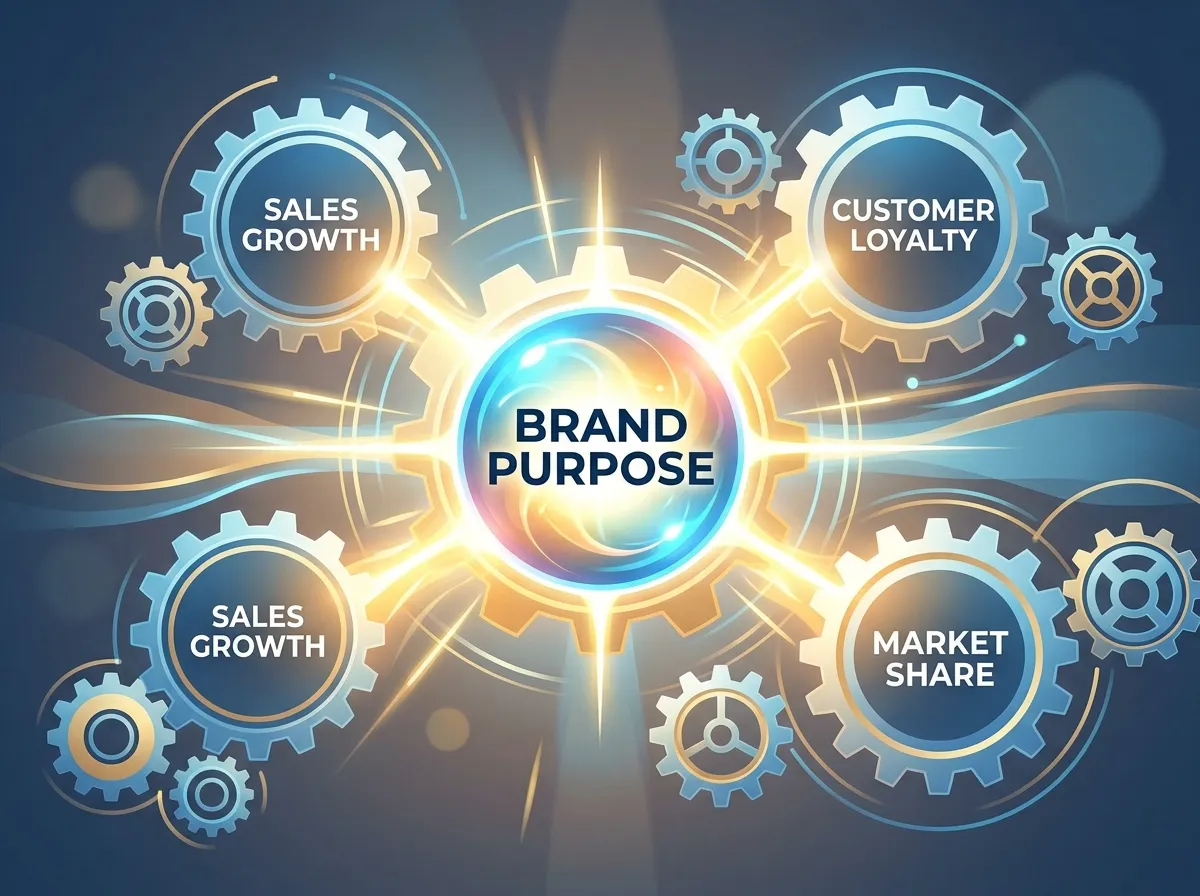
Brand-led growth is a growth model in which a company’s brand plays a central role in attracting customers, creating preference, increasing loyalty, and supporting business expansion.
A brand includes much more than a logo, color palette, or slogan. It represents the perceptions customers develop through their interactions with a company. Product quality, customer service, communication, reputation, values, pricing, user experience, and overall customer experience all contribute to that perception.
A company with a strong brand can become easier to recognize and remember. Customers may also feel more confident choosing it because they understand what it represents.
Brand-led growth therefore focuses on creating a clear and distinctive identity that can influence customer behavior throughout the buying journey.
The approach can be valuable for both established businesses and growing companies. A new company can use strong positioning to differentiate itself, while an established organization can use branding to strengthen loyalty and expand into new markets.
Brand-Led Growth Strategy
A brand-led growth strategy connects brand development with commercial objectives. It begins with understanding what the business wants to be known for and why customers should choose it.
The strategy needs to establish a clear brand position within the market. Customers should be able to understand what makes the company different and what value it provides.
Consistency is another important part of the strategy. If a business communicates one message through advertising but provides a completely different experience after purchase, the brand becomes difficult to trust.
A strong strategy aligns marketing communication, product experience, customer service, visual identity, and company behavior around a common brand promise. Businesses looking to build a sustainable model can also explore brand-led growth to understand how brand strength can support long-term business performance.
The strategy can also influence customer acquisition. When customers recognize and trust a brand, they may require less persuasion before considering its products or services. This can create advantages across the customer journey.
Brand Growth Strategy
A brand growth strategy focuses on expanding the reach, relevance, and value of a brand while maintaining a consistent identity.
Growth can come from increasing awareness among existing target audiences, entering new markets, introducing new products, expanding into new customer segments, or increasing customer loyalty.
Brand growth is often connected to distribution and marketing, but the underlying brand experience must support expansion. If a company grows rapidly without maintaining quality or consistency, customer perception can deteriorate.
A sustainable growth model therefore considers both visibility and customer experience.
Digital platforms have expanded the opportunities for brand growth. Search engines, social media, video platforms, podcasts, communities, email marketing, influencer partnerships, and online reviews can all contribute to brand recognition.
However, simply increasing exposure does not guarantee brand growth. The message needs to be distinctive and relevant enough for customers to remember.
Brand-Driven Growth
Brand-driven growth occurs when a strong brand becomes a meaningful contributor to customer acquisition and business performance.
When customers actively recognize, prefer, and recommend a brand, the company can benefit from organic demand. Customers may search specifically for the brand rather than generic products or services.
Brand-driven growth can also reduce dependence on constant promotional incentives. A company with strong customer preference may not need to compete entirely on price.
This does not mean performance marketing or sales activity becomes unnecessary. Instead, brand and performance activities can complement one another.
Brand building can create demand and preference over time, while performance marketing can capture and convert existing demand. When both work together, the business can create a more balanced growth engine.
Customer-Centric Growth Strategy
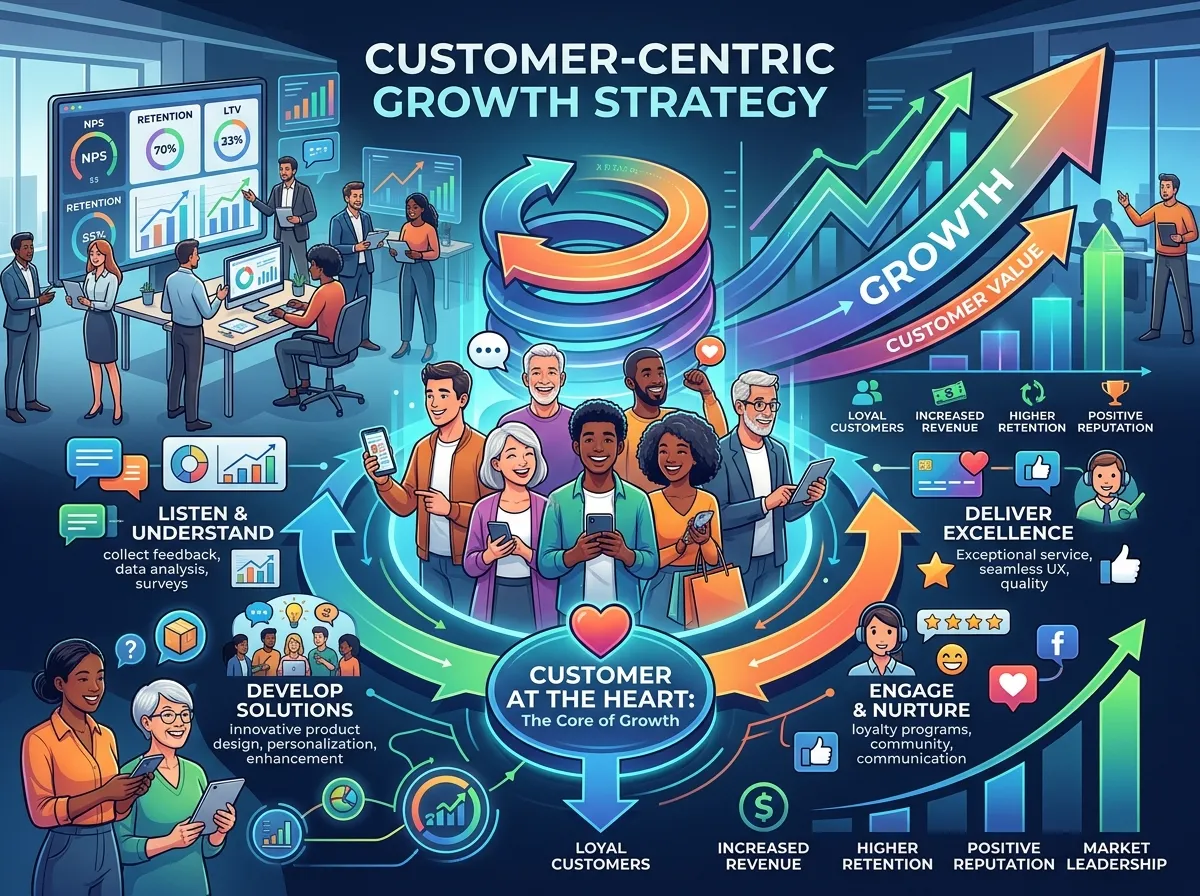
A customer-centric growth strategy places customer needs, expectations, and experiences at the center of business decisions.
Customer-centricity is particularly important for brand-led growth because brand perception is ultimately shaped by customers.
A company may describe itself as innovative, trustworthy, affordable, premium, or customer-focused, but customers form their own opinions based on their experiences.
Understanding customers requires more than demographic information. Businesses can examine customer motivations, pain points, preferences, purchasing behavior, feedback, support interactions, and reasons for choosing or leaving a brand.
These insights can influence product development, content, communication, customer service, and brand positioning. They can also support broader B2B brand positioning strategies when businesses need to communicate value clearly to professional buyers and decision-makers.
A customer-centric approach also recognizes that different customer segments may have different expectations. A brand can maintain a consistent identity while adapting its communication and experiences to different audiences.
Brand Awareness Strategy
A strong brand awareness strategy helps customers recognize and remember a business. Awareness is particularly important in competitive markets where multiple companies may offer similar products or services.
Brand awareness can be developed through consistent content, advertising, public relations, social media, events, partnerships, search visibility, community engagement, and memorable customer experiences.
Repetition can improve recognition, but effective awareness requires distinctive communication. If every competitor uses similar messages, generic advertising may not create meaningful differentiation.
Visual identity can also play an important role in recognition. Elements such as colors, typography, imagery, and design can create consistent associations that help customers identify a brand across different channels. Understanding color psychology in branding can help marketers make more informed decisions about how visual elements influence brand perception.
Strong brand awareness also increases the likelihood that customers will consider a business when a relevant need arises.
For example, a customer who repeatedly encounters useful content from a particular company may be more likely to investigate that company when they eventually need its product or service.
Awareness is therefore an important foundation for future demand.
Brand Positioning Strategy
A brand positioning strategy defines how a brand should be perceived in relation to competitors and alternatives.
Positioning answers important questions about the market, target audience, value proposition, differentiation, and reason for choosing the brand.
Effective positioning should be clear enough for customers to understand and distinctive enough to separate the business from competitors.
For example, two companies may sell similar software but position themselves differently. One may focus on simplicity for small businesses, while another may emphasize advanced functionality for enterprise organizations.
The products may overlap, but the brands create different expectations.
Strong positioning helps guide marketing communication and can also influence product development and customer experience. Every significant customer interaction should reinforce the intended position.
Brand Loyalty Strategy
A brand loyalty strategy focuses on encouraging customers to continue choosing a brand and recommending it to others.
Loyalty develops through repeated positive experiences rather than through promotional rewards alone. Product quality, reliability, customer support, convenience, emotional connection, and trust can all influence loyalty.
Businesses can strengthen loyalty by understanding what existing customers value and creating experiences that reinforce those expectations.
Personalized communication can also contribute to loyalty when it provides genuinely useful information. Customers may appreciate recommendations, educational resources, exclusive experiences, or relevant product updates.
Community can be another powerful element. Brands that create spaces where customers can interact with one another may develop stronger emotional relationships.
Loyal customers can become an important source of organic growth because they may recommend the brand to friends, colleagues, and online communities. In emerging digital markets, businesses can also explore specialized approaches such as NFT marketing strategies when these technologies are relevant to their audience and broader brand strategy.
Sustainable Brand Growth
Sustainable brand growth focuses on building long-term value instead of pursuing temporary increases in attention or revenue.
Short-term campaigns can generate immediate results, but sustainable growth requires a brand that remains relevant and trusted over time.
This involves maintaining product quality, delivering on promises, adapting to changing customer needs, and protecting brand reputation.
Sustainable growth also requires a balance between consistency and evolution. A brand should maintain its core identity while adapting its products, communication, and experiences as markets change.
Companies that remain completely static may become irrelevant, while companies that change their identity constantly can confuse customers.
A strong long-term brand maintains recognizable principles while evolving appropriately.
Brand Equity Development
Brand equity development refers to building the value associated with a brand in the minds of customers and within the market.
Positive brand equity can influence customer preference, pricing power, loyalty, reputation, and competitive advantage.
Customers may be willing to pay more for a familiar and trusted brand because they perceive lower risk or greater value.
Brand equity develops through repeated experiences. Advertising can introduce a brand, but the product and customer experience ultimately determine whether those associations become stronger or weaker.
Positive reviews, consistent quality, recognizable communication, customer advocacy, and strong reputation can all contribute to brand equity.
Over time, these associations become valuable assets that competitors cannot easily replicate.
Long-Term Brand Strategy
A long-term brand strategy provides direction for maintaining and developing brand value over an extended period.
Short-term marketing campaigns often focus on immediate objectives such as clicks, leads, sales, or conversions. Long-term brand strategy considers broader questions about recognition, reputation, differentiation, customer relationships, and market position.
A long-term perspective allows businesses to make decisions that may not produce immediate returns but contribute to future growth.
For example, creating high-quality educational content may not generate immediate sales from every reader, but it can strengthen authority and search visibility over time.
Similarly, investing in customer experience may increase costs in the short term while improving retention and referrals in the future.
Long-term thinking is particularly important when building a distinctive brand because meaningful brand associations usually develop through repeated exposure and consistent experiences.
Brand-Led Growth and Customer Experience
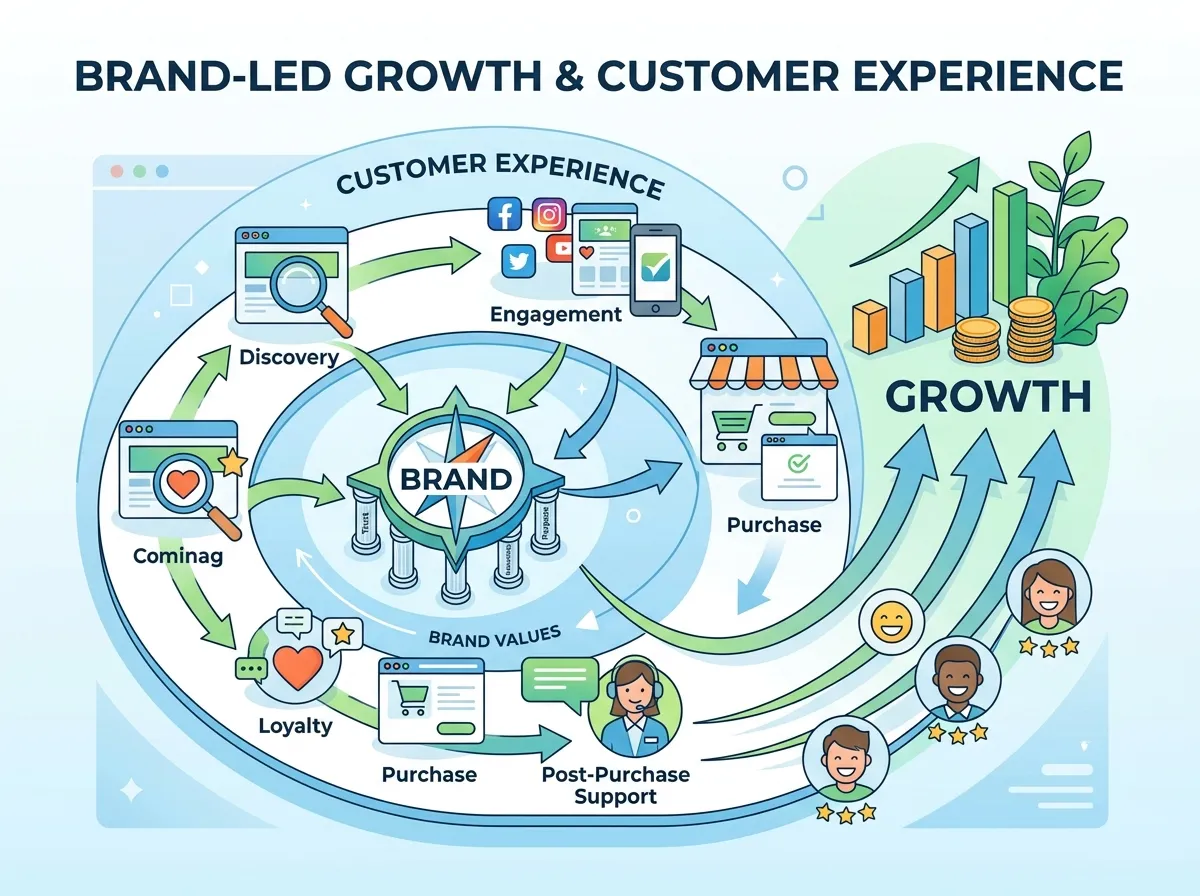
Customer experience is one of the strongest connections between branding and business growth.
A brand promise creates expectations, while customer experience determines whether those expectations are fulfilled.
If a company presents itself as premium but provides poor support, customers may quickly question the brand’s credibility. If a company promises simplicity but creates complicated purchasing processes, the experience contradicts the positioning.
Brand-led companies therefore consider every customer interaction as an opportunity to reinforce the brand.
Website design, product onboarding, packaging, sales conversations, customer support, billing, delivery, and follow-up communication can all influence brand perception.
Consistency across these touchpoints helps customers develop a clearer understanding of what the brand represents.
The Role of Content in Brand-Led Growth
Content can play an important role in developing brand recognition and authority.
Educational articles, videos, podcasts, reports, case studies, newsletters, social posts, and other content can help companies demonstrate expertise while communicating their unique perspective.
Content is particularly valuable because it can influence customers before they are actively ready to purchase.
A company that consistently answers customer questions can become associated with expertise and helpfulness. Over time, this can strengthen trust and brand preference.
Content should therefore reflect the brand’s positioning rather than simply target keywords or generate traffic.
A distinctive point of view, recognizable voice, consistent messaging, and useful information can make content more memorable.
Brand-Led Growth in the Digital Era
Digital channels have made brand building more measurable and accessible, but they have also increased competition for attention.
Customers can compare brands instantly, read reviews, watch demonstrations, investigate competitors, and share their experiences publicly.
This means businesses have less control over their brand reputation than they once did. Customers, employees, creators, reviewers, and communities all contribute to public perception.
Digital brand-led growth therefore requires consistency across owned, earned, and paid channels.
Search visibility can introduce customers to the brand. Social media can strengthen familiarity. Reviews can influence trust. Email can deepen relationships. Advertising can expand reach.
When these channels communicate a coherent identity, they can reinforce one another.
Measuring Brand-Led Growth
Brand-led growth should be evaluated using both brand and business metrics.
Traditional business metrics such as revenue, customer acquisition, retention, repeat purchases, and customer lifetime value remain important.
Brand indicators can include awareness, branded search demand, direct traffic, customer preference, brand consideration, sentiment, social engagement, reviews, and referral activity.
No single metric can fully represent brand strength. A business may experience increasing brand awareness without corresponding revenue growth if its product or market strategy is weak.
Similarly, revenue growth without stronger brand preference may depend heavily on advertising or discounts.
The strongest evaluation combines brand health with commercial performance to understand whether increased brand value is contributing to sustainable business results.
The Future of Brand-Led Growth
Brand-led growth is becoming increasingly important as customers gain access to more choices and more information.
Artificial intelligence is also changing how people discover and evaluate brands. Search behavior is evolving, recommendation systems are becoming more sophisticated, and customers can compare information faster than ever.
This makes distinctive positioning and trustworthy brand signals increasingly valuable.
Companies will need to communicate clearly while maintaining authentic experiences across digital and physical channels.
The brands most likely to succeed over the long term will be those that understand their customers, maintain a strong identity, deliver consistent value, and adapt to changing expectations without losing their core purpose.
Conclusion
Brand-led growth places the brand at the center of long-term business development. It connects brand awareness, positioning, customer experience, loyalty, content, and business strategy to create sustainable demand and stronger customer relationships.
A successful brand-led growth strategy is supported by a clear brand growth strategy, distinctive brand positioning strategy, effective brand awareness strategy, and strong brand loyalty strategy. At the same time, a customer-centric growth strategy ensures that brand decisions remain connected to genuine customer needs.
Through consistent brand equity development, businesses can create assets that become more valuable over time. Combined with a thoughtful long-term brand strategy, this can help organizations reduce dependence on short-term tactics and build stronger competitive advantages.
Ultimately, brand-led growth is about more than making a company recognizable. It is about creating a brand that customers understand, trust, prefer, remember, and are willing to return to. When brand promise and customer experience consistently reinforce one another, the brand can become a powerful engine for sustainable business growth.
Frequently Asked Questions
1. What is brand-led growth?
Brand-led growth is a business growth approach that places the brand at the center of customer acquisition, loyalty, differentiation, and long-term business development. It focuses on building recognition, trust, preference, and lasting customer relationships.
2. Why is brand-led growth important?
Brand-led growth can help businesses differentiate themselves, build customer trust, strengthen loyalty, increase brand preference, and create sustainable demand. A strong brand can also reduce reliance on price-based competition and short-term promotional tactics.
3. What is a brand-led growth strategy?
A brand-led growth strategy connects brand development with commercial objectives. It aligns positioning, communication, customer experience, product value, and marketing activities around a consistent brand promise.
4. How does brand positioning support growth?
A strong brand positioning strategy helps customers understand what a company offers, who it serves, and why it is different from competitors. Clear positioning can make a brand easier to recognize and consider during purchasing decisions.
5. What is the difference between brand-led growth and performance marketing?
Brand-led growth focuses on building long-term brand awareness, preference, trust, and loyalty, while performance marketing typically focuses on measurable short-term actions such as clicks, leads, and conversions. Both approaches can work together as part of a broader growth strategy.
6. How does brand awareness contribute to growth?
Brand awareness increases the likelihood that customers recognize and remember a business when they have a relevant need. Strong awareness can increase consideration and provide a foundation for future customer acquisition.
7. What is brand equity development?
Brand equity development is the process of increasing the value and positive associations connected to a brand. Strong brand equity can influence customer preference, loyalty, reputation, perceived value, and competitive advantage.
8. How can businesses build brand loyalty?
Businesses can build brand loyalty by consistently delivering quality, meeting customer expectations, providing excellent experiences, communicating relevantly, and developing meaningful relationships with customers.
9. What is sustainable brand growth?
Sustainable brand growth focuses on increasing brand value and business performance over the long term without relying entirely on temporary promotions or unsustainable customer acquisition tactics. It depends on consistent value, customer trust, strong experiences, and ongoing relevance.
10. Why is a long-term brand strategy important?
A long-term brand strategy gives a business consistent direction for developing recognition, reputation, differentiation, and customer relationships. It helps ensure that short-term marketing activities contribute to broader and more sustainable brand objectives.