Brand Architecture: A Complete Guide to Building a Strong Brand Structure

Brand architecture is a system for organizing a company’s brands, products, and sub-brands. A strong brand architecture strategy helps customers understand brand relationships, improves clarity, reduces confusion, and supports long-term business growth.
Brand architecture is an important part of brand management for companies that operate multiple products, services, or brands. As a business grows, it may introduce new offerings, enter different markets, acquire other companies, or create specialized brands for different customer groups. Without a clear structure, customers can become confused about how these brands are connected.
A well-designed brand architecture provides a framework for organizing the relationships between a company’s corporate brand, individual brands, products, and sub-brands. It helps businesses determine which name should receive the most attention, how much each brand should be connected to the parent company, and how different offerings should be positioned.
Brand architecture is not only about logos and names. It is a strategic system that can influence marketing, customer perception, product development, communication, and long-term brand growth.
What Is Brand Architecture?
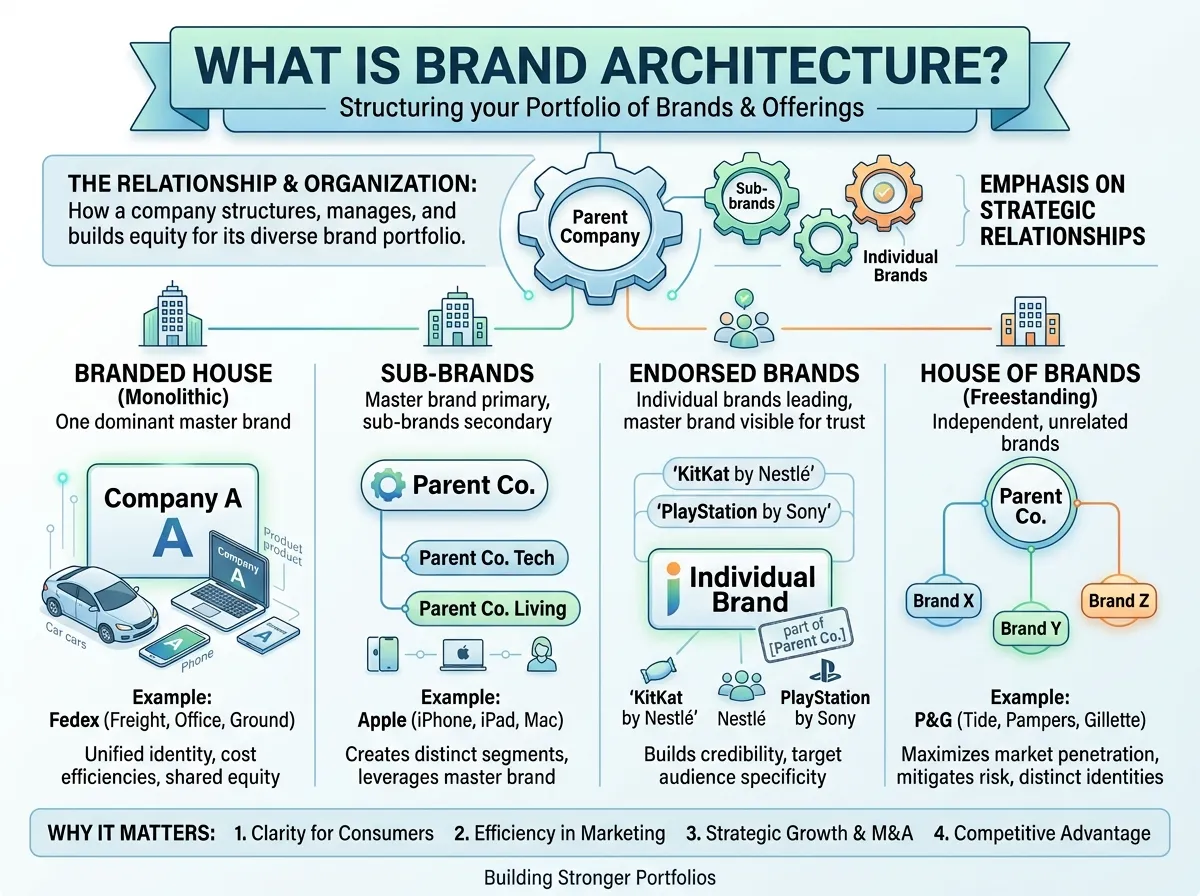
Brand architecture is the organizational structure that defines how the different brands within a company relate to one another. It explains the relationship between the parent brand, individual brands, sub-brands, product lines, and services.
For a company with only one product or service, brand architecture may be relatively simple. However, a business with several products or brands needs a clear system to prevent overlapping identities and confusing customer experiences.
For example, a parent company may operate several brands that target completely different audiences. Alternatively, it may use one main corporate brand across all of its products. These different approaches require different types of brand architecture.
The purpose is to create a structure that makes sense both internally and externally. Employees should understand how brands are organized, while customers should be able to recognize the relationship between different offerings.
Why Is Brand Architecture Important?
Brand architecture becomes increasingly important as a business expands. Adding products and brands without a clear structure can create unnecessary complexity.
Customers may not understand whether two products belong to the same company or whether they are completely separate brands. Marketing teams may also struggle to determine which brand identity should be used for a new campaign or product.
A clear structure can make communication more consistent. It can also help businesses decide where to invest their marketing resources and how different brands should support the overall business strategy.
Brand architecture can also make acquisitions, product launches, and international expansion easier to manage. When the relationships between brands are clearly defined, businesses can make strategic decisions without rebuilding their entire brand system every time they introduce something new.
Brand Architecture Strategy
A brand architecture strategy defines how a company organizes and manages its complete brand portfolio. The strategy should reflect the company’s business objectives, target audiences, market position, and future growth plans.
Before selecting a structure, businesses should understand the role of each existing brand. Some brands may have strong customer recognition, while others may have little awareness but significant growth potential.
The company should also consider whether customers benefit from seeing a connection between brands. If customers trust the parent company, linking a new product to that corporate identity may make adoption easier. In other situations, separating brands can allow each one to develop its own identity and appeal to a specific audience.
A strong strategy should be flexible enough to support future products and business changes. It should also consider how emotional branding in the digital age can influence the way customers perceive and connect with different brands.
Brand Architecture Framework
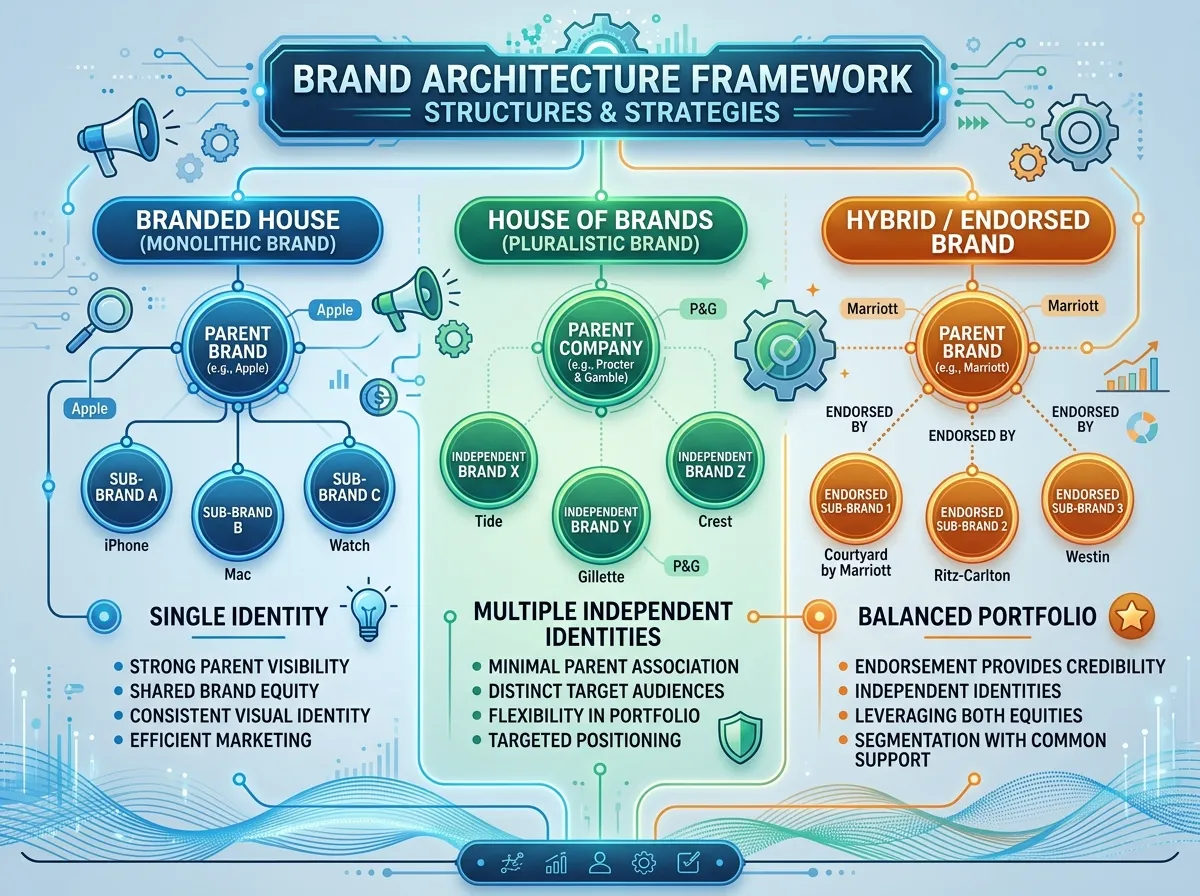
A brand architecture framework provides a structured way to evaluate the relationships between brands. It typically considers the corporate brand, master brand, sub-brands, individual product brands, and product lines.
The framework helps businesses decide how much visibility the parent brand should have and how independent individual brands should become.
Some organizations place the corporate brand at the center and connect nearly every offering to it. Others give individual brands greater independence and keep the parent company less visible.
The right framework depends on the company’s circumstances. There is no universal model that works for every organization.
A company should choose a framework that makes its portfolio easier for customers to understand while supporting its commercial and strategic goals. This approach can also improve user experience and branding by making interactions with different brands more consistent and understandable.
Brand Portfolio Strategy
A brand portfolio strategy focuses on managing all the brands and offerings owned by an organization. It considers how each brand contributes to the overall business and whether there is unnecessary overlap between brands.
A strong portfolio should have a clear purpose for each brand. If two brands target exactly the same audience with nearly identical offerings, they may compete with each other rather than expand the company’s market opportunity.
Businesses can use portfolio strategy to identify gaps, reduce duplication, strengthen high-performing brands, and decide whether certain brands should be expanded, repositioned, combined, or discontinued.
Portfolio decisions should be based on customer demand, market opportunities, profitability, brand equity, and long-term business objectives. A well-managed portfolio can also help create stronger brand ecosystems by establishing clear relationships between different brands and customer touchpoints.
Understanding Brand Hierarchy
Brand hierarchy describes the levels within a company’s brand system. At the highest level, there may be a corporate or parent brand. Below it may be master brands, sub-brands, product brands, and individual products or services.
A clear hierarchy helps customers understand how different offerings relate to one another.
For example, a company may use its corporate name as the primary brand and then create distinct names for specific product categories. Another company may have a master brand that appears prominently on every product while using descriptive names for individual offerings.
The hierarchy should remain understandable. Too many levels can create unnecessary complexity and make it difficult for customers to know what they are buying.
Corporate Brand Architecture
Corporate brand architecture focuses on the relationship between a company’s main corporate identity and the brands, products, and services it owns.
The corporate brand can play a major role in establishing credibility and trust. When customers already have a positive perception of the parent company, connecting new offerings to that identity can provide an advantage.
Corporate brand architecture is particularly important for companies that operate across multiple markets or business categories. A clear structure can help maintain consistency while allowing individual offerings to communicate their specific value.
However, the corporate brand should not necessarily dominate every communication. The appropriate level of visibility depends on the chosen architecture model and the needs of the target audience.
Branded House Strategy
A branded house strategy uses one primary brand across multiple products and services. Individual offerings typically share the main brand name and visual identity.
This approach can make brand building more efficient because marketing investments can strengthen the overall brand rather than requiring separate awareness campaigns for every product.
When customers trust the master brand, new products may also benefit from existing brand recognition.
However, a branded house can create risks. If one product experiences a serious reputation problem, the negative perception may affect other products connected to the same brand.
This model can work particularly well when products have related audiences, values, and positioning.
House of Brands Strategy
A house of brands strategy involves maintaining multiple independent brands under a parent company. Each brand can have its own identity, positioning, audience, and marketing approach.
This structure allows businesses to target different customer groups without forcing every offering to share the same identity.
For example, a company operating in several unrelated markets may benefit from allowing each brand to develop independently.
The main challenge is resource allocation. Each independent brand may require its own marketing, communication, research, and brand management. Building awareness separately can therefore be more expensive than using a shared master brand.
The model is most useful when independence provides meaningful strategic value.
Sub-Brand Strategy
A sub-brand strategy combines the strength of a parent or master brand with a distinct identity for a particular product or service.
Sub-brands can help businesses differentiate offerings while still benefiting from the credibility of the primary brand.
This approach can be useful when products target different customer segments or have different features while remaining connected to the same overall organization.
The relationship between the master brand and sub-brand should be clear. Customers should understand the connection without becoming confused about what the individual offering represents.
A successful sub-brand can develop its own recognition while strengthening the broader brand portfolio.
Brand Structure
Brand structure refers to how all the brands and offerings within an organization are organized. A strong structure should make it easy to understand the role of each brand.
Businesses should consider which brands are strategically important, which products can share a common identity, and which offerings require greater independence.
Brand structure should also account for future growth. If a company expects to launch several new products, its architecture should make those additions easy to accommodate.
A structure that works for a small portfolio may become difficult to manage after significant expansion. Regular evaluation is therefore important.
Brand Portfolio Management
Brand portfolio management involves continuously evaluating and managing the brands within an organization. It is not a one-time activity.
Businesses should monitor brand performance, customer perception, market changes, competitive activity, and the relationship between different brands.
Portfolio management can help identify brands that are growing, declining, overlapping, or no longer aligned with the company’s strategy.
It can also help businesses decide where to invest. Strong brands may receive additional resources, while weaker brands may require repositioning or restructuring.
Effective portfolio management ensures that each brand has a clear role and contributes to the overall business strategy.
Choosing the Right Brand Architecture Model
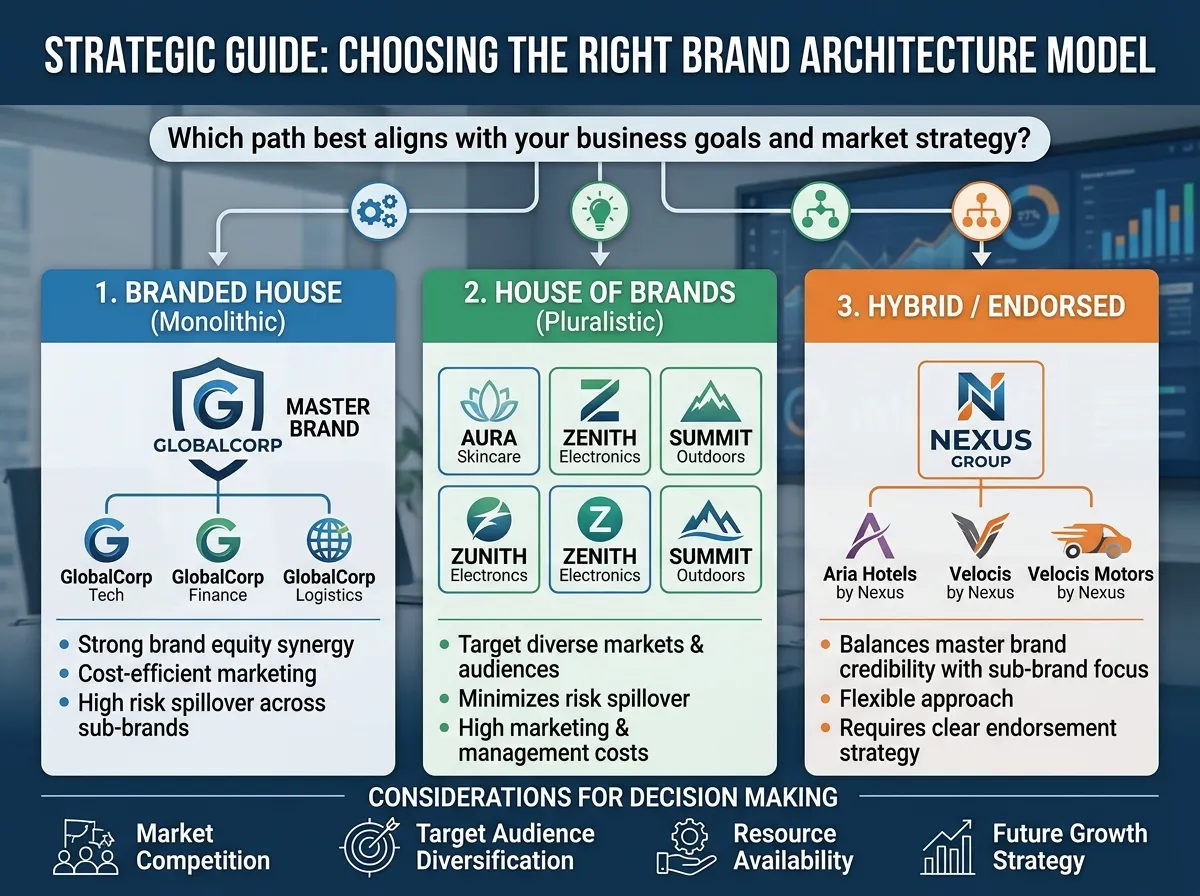
Choosing a brand architecture model requires an understanding of the company’s business and customers. Businesses should consider the number of brands they operate, the similarity between their products, the audiences they target, and the level of trust associated with the corporate brand.
A company with closely related products may benefit from a branded house because a single identity can create stronger recognition.
A business operating unrelated products for very different audiences may benefit from a house of brands because independent identities provide greater flexibility.
A company with a strong master brand but several specialized products may find a sub-brand approach more suitable.
The decision should also consider future growth. Businesses should avoid choosing a structure based only on their current portfolio if they expect significant expansion.
Brand Architecture and Customer Perception
Customer perception should remain central to architecture decisions. Customers do not necessarily think about brands in the same way that companies organize them internally.
A business may consider two products closely related, while customers may see them as completely different. Research can help identify how customers understand the relationship between brands.
Clear naming, consistent visual elements, and logical messaging can help customers understand the portfolio.
The goal is not simply to create an organizational chart. The architecture should create a customer experience that is easy to understand.
Brand Architecture During Business Growth
As businesses grow, brand architecture often needs to evolve. New products, acquisitions, partnerships, and market expansion can create additional layers within the portfolio.
A startup may begin with one master brand and eventually develop several product lines. An established company may acquire another organization and need to decide whether to retain, merge, or reposition the acquired brand.
These decisions can have significant effects on customer recognition and marketing efficiency.
Businesses should therefore review their architecture whenever major strategic changes occur.
Common Brand Architecture Mistakes
One common mistake is creating too many brands without a clear reason. Every additional brand can require resources, marketing investment, and management attention.
Another problem is allowing brands to overlap heavily. When two offerings have similar audiences, positioning, and products, customers may struggle to understand the difference.
Businesses may also change names or relationships too frequently. Constant restructuring can weaken brand recognition and create uncertainty among customers.
Another mistake is designing architecture entirely around internal organizational structures. The way a company divides departments does not necessarily reflect how customers understand its brands.
The architecture should ultimately make the portfolio clearer and more valuable to the market.
How to Develop an Effective Brand Architecture
Developing effective brand architecture begins with a complete review of the existing portfolio. Businesses should identify every corporate brand, master brand, sub-brand, product, and service.
The next step is understanding customer perception and market positioning. Research can reveal how customers view each brand and whether they understand the relationships between offerings. Understanding the neuroscience of branding can also help businesses consider how customers emotionally and cognitively respond to different brand identities.
Businesses should then identify the strategic role of each brand. Some may be designed for premium customers, others for mass-market audiences, and others for specialized segments.
Once these roles are clear, the company can select an appropriate architecture model and establish naming, visual identity, messaging, and governance guidelines.
The final structure should be documented so that marketing teams, product teams, and leadership can apply it consistently.
Measuring Brand Architecture Success
Brand architecture can be evaluated through brand awareness, customer understanding, market performance, portfolio growth, and marketing efficiency.
Businesses can research whether customers understand the relationship between brands and whether the structure makes purchasing decisions easier.
They can also monitor whether different brands are competing unnecessarily for the same customers.
From an operational perspective, businesses can evaluate whether the architecture reduces duplicated marketing efforts and makes it easier to launch new products.
A successful architecture should ultimately support both customer clarity and business growth.
Final Thoughts
Brand architecture provides a strategic foundation for organizing multiple brands, products, and services. As companies expand, a clear structure becomes increasingly important for maintaining customer understanding and efficient brand management.
A strong brand architecture strategy can help businesses determine which brands should be connected, which should remain independent, and how different offerings should work together.
Whether a company uses a branded house strategy, house of brands strategy, or sub-brand strategy, the structure should be based on customer needs, business objectives, market conditions, and long-term growth plans.
Effective brand portfolio management ensures that the architecture continues to support the organization as its portfolio changes. By maintaining a clear brand hierarchy and logical brand structure, businesses can create stronger brands, reduce confusion, improve marketing efficiency, and build a more sustainable brand portfolio.
Frequently Asked Questions
1. What is brand architecture?
Brand architecture is the system a company uses to organize its corporate brand, individual brands, sub-brands, products, and services. It defines how these different elements relate to each other.
2. Why is brand architecture important?
Brand architecture helps customers understand a company’s portfolio and makes it easier for businesses to manage multiple brands. It can also improve marketing efficiency and support future growth.
3. What are the main types of brand architecture?
The most common approaches include a branded house, house of brands, and hybrid or sub-brand structures. Companies choose among them based on their products, audiences, business goals, and market conditions.
4. What is a branded house strategy?
A branded house strategy uses one primary brand across multiple products and services. The individual offerings typically benefit from the recognition and reputation of the main brand.
5. What is a house of brands strategy?
A house of brands strategy involves maintaining several independent brands under one parent company. Each brand can have its own identity, audience, positioning, and marketing strategy.
6. What is a sub-brand strategy?
A sub-brand strategy combines a parent or master brand with a distinct identity for a particular product or service. It allows businesses to create differentiation while maintaining a connection to the primary brand.
7. What is brand hierarchy?
Brand hierarchy describes the different levels within a company’s brand system. It can include a corporate brand, master brand, sub-brands, product brands, and individual products or services.
8. How does brand architecture support brand portfolio management?
Brand architecture provides a structure for managing multiple brands and identifying their roles. It helps businesses reduce unnecessary overlap, allocate resources, and make strategic decisions about their portfolio.
9. When should a company review its brand architecture?
Companies should review their architecture when they introduce major new products, acquire businesses, enter new markets, change their target audiences, or experience significant changes in customer perception.
10. How do you create an effective brand architecture?
An effective brand architecture begins with understanding the existing portfolio, customer perception, market positioning, and business objectives. The company can then select an appropriate structure and establish clear naming, identity, messaging, and management guidelines.