Business Innovation: Driving Growth and Competitive Advantage
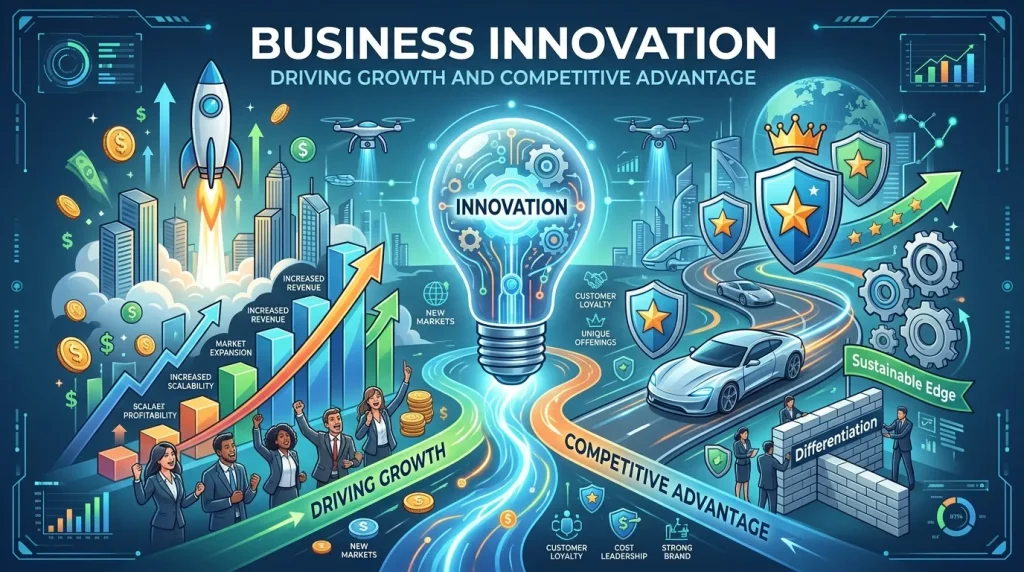
Business innovation helps companies create new value, improve operations, adapt to changing markets, and achieve sustainable growth. A strong innovation strategy combines customer needs, technology, business transformation, process improvements, and measurable objectives. By developing a culture that supports experimentation and connecting innovation with business goals, organizations can strengthen competitiveness and discover new opportunities.
What Is Business Innovation?
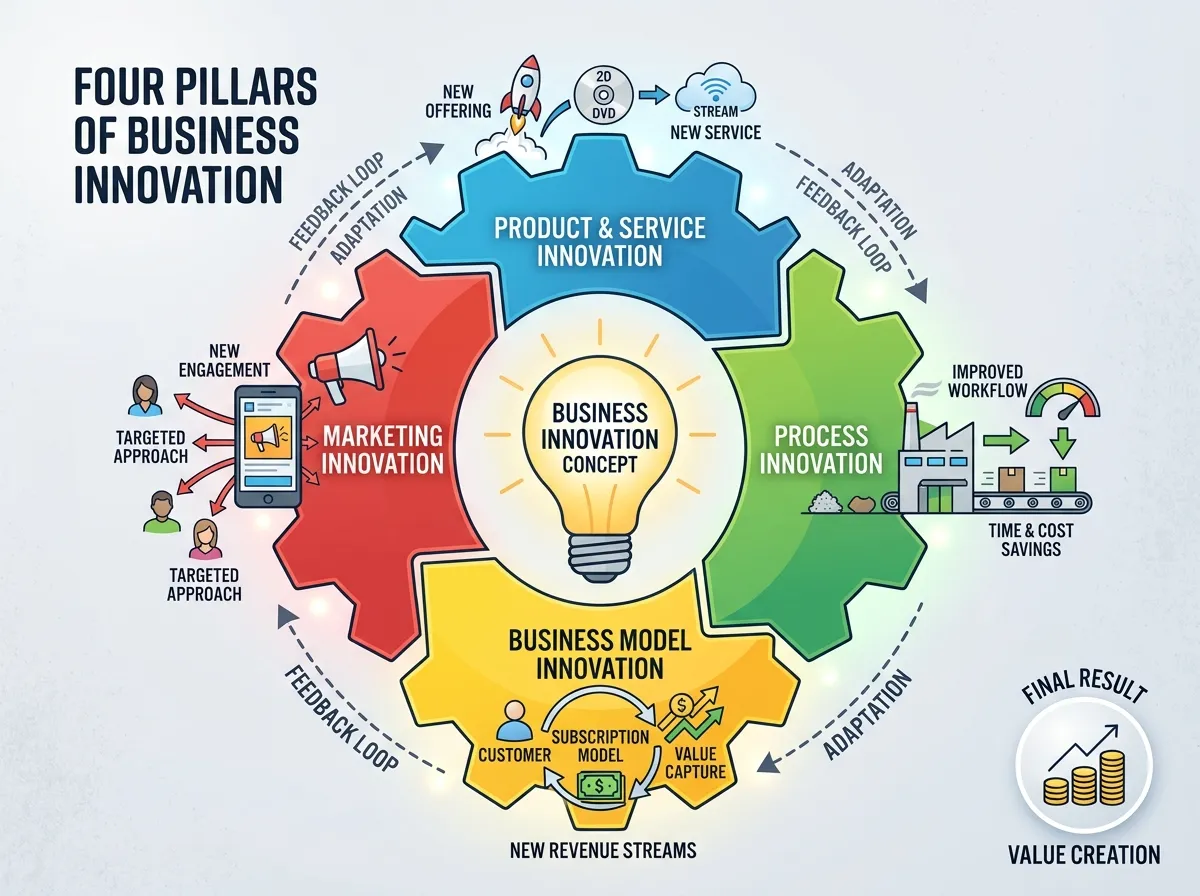
Business innovation is the process of introducing new or improved ideas, products, services, processes, technologies, or business models that create value for a company and its customers. It is not limited to developing a completely new product. Businesses can innovate by improving customer experiences, simplifying operations, adopting new technologies, entering new markets, or changing the way they deliver value.
In competitive markets, innovation helps organizations respond to changing customer expectations and industry trends. Companies that continuously evaluate how they operate are often better positioned to identify opportunities, solve problems, and create sustainable growth.
Business innovation can take many forms. A company may introduce an innovative product, automate an inefficient process, develop a new pricing model, improve its digital customer journey, or use data to make better decisions. The most effective innovation connects new ideas with measurable business objectives.
Why Business Innovation Matters
Markets rarely remain unchanged for long. Customer preferences evolve, competitors introduce new solutions, and technology changes how organizations operate. Businesses that depend entirely on existing products and processes can struggle when market conditions shift.
Innovation gives organizations the ability to adapt. A strong business innovation strategy allows companies to identify opportunities, test new ideas, and invest resources in initiatives that can produce meaningful results.
Innovation can also improve operational efficiency. For example, businesses can use automation to reduce repetitive work, analytics to understand customer behavior, and digital platforms to improve communication. These improvements can reduce costs while allowing employees to focus on higher-value activities.
Another important benefit is differentiation. When several companies offer similar products or services, innovative customer experiences, processes, and business models can give one organization a stronger position in the market.
Business Innovation Strategy and Long-Term Growth
A business innovation strategy provides a structured connection between innovation and overall business objectives. Instead of pursuing new ideas simply because they appear interesting, organizations can evaluate whether an innovation supports revenue growth, customer satisfaction, efficiency, market expansion, or another strategic priority.
Successful innovation usually begins with identifying a meaningful problem or opportunity. Businesses can then generate potential solutions, evaluate their feasibility, test promising concepts, and scale those that demonstrate value.
This approach reduces the risk of investing heavily in ideas before understanding whether customers actually want them. Small experiments and prototypes can provide valuable feedback before a company commits significant resources.
The Role of Innovation Management Strategy
An innovation management strategy helps organizations organize and manage the innovation process. Without effective management, good ideas can become lost among competing priorities or fail because teams lack resources and clear responsibilities.
Innovation management involves identifying opportunities, collecting ideas, evaluating potential projects, allocating resources, and measuring outcomes. It also requires communication between departments because innovation rarely belongs to a single team.
Leadership plays an important role as well. Employees are more likely to contribute ideas when organizations create an environment where experimentation is encouraged and reasonable failures are treated as learning opportunities.
Business Growth Innovation
Business growth innovation focuses specifically on using new ideas to expand revenue, customers, market share, or other important business outcomes. Growth can come from improving an existing product, reaching a new audience, developing additional services, or creating entirely new revenue streams.
For example, a traditional business may introduce a digital subscription service to complement its existing offerings. Another company might use personalization to increase customer retention. Both approaches represent innovation because they change how the business creates or captures value.
The connection between innovation and measurable growth is particularly important. Innovation should not simply produce activity; it should contribute to meaningful business performance.
Companies can use metrics such as revenue from new products, customer acquisition, retention, conversion rates, operational savings, and customer satisfaction to understand whether innovation initiatives are producing results.
Innovative Business Ideas and Market Opportunities
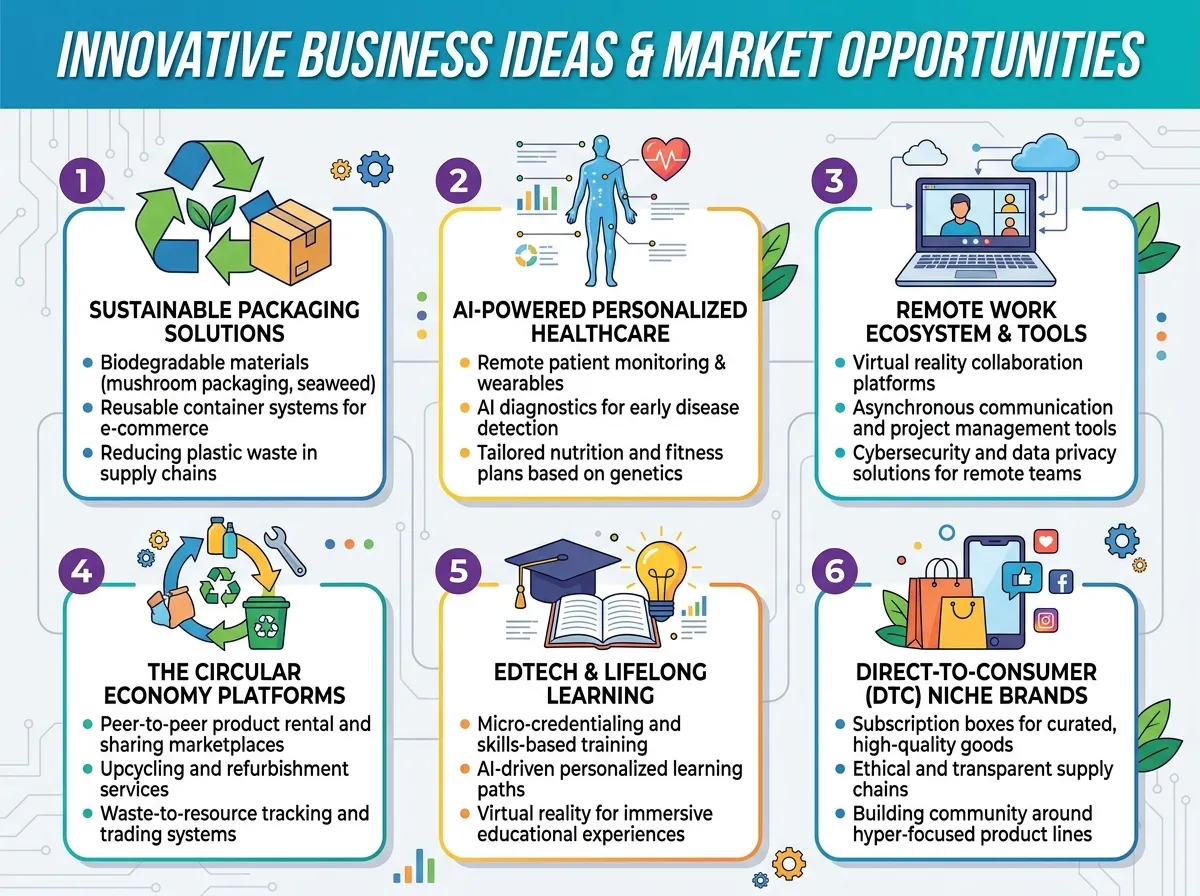
Innovative business ideas often emerge from observing customer frustrations and unmet needs. Instead of starting with technology, organizations can start by asking what customers are struggling with and whether there is a better way to solve the problem.
Customer feedback, market research, employee suggestions, competitor analysis, and industry trends can all reveal potential opportunities.
However, not every new idea deserves investment. Businesses should consider factors such as market demand, implementation costs, competitive advantages, technical feasibility, and potential returns.
An idea becomes more valuable when it solves a real problem while creating a sustainable advantage for the organization.
Digital Business Innovation
Technology has become one of the major drivers of digital business innovation. Cloud platforms, artificial intelligence, automation, analytics, mobile applications, and digital communication tools are changing how companies operate and interact with customers.
Digital innovation can improve almost every part of an organization. Marketing teams can use automation to personalize campaigns, sales teams can use data to identify opportunities, and customer service teams can use conversational technologies to provide faster assistance.
Digital transformation should not be confused with simply purchasing new software. The real value comes from changing processes and experiences in ways that produce better business outcomes.
For companies investing in digital initiatives, the broader brand impact should also be considered. Understanding performance through metrics such as Brand Equity KPIs can help organizations evaluate whether innovation is strengthening the overall value of the brand.
Business Transformation Strategy
A business transformation strategy focuses on significant changes to how an organization operates, competes, and creates value. Innovation often becomes a central component of transformation because businesses need new approaches to remain relevant in changing markets.
Transformation can involve technology, organizational structures, customer experiences, products, services, or business models. It may also require changes in company culture.
Successful transformation requires more than implementing new systems. Employees need to understand why changes are happening and how the new approach supports organizational objectives. Clear leadership, communication, training, and measurable goals can make transformation efforts more effective.
Innovation and Growth Strategy
An innovation and growth strategy brings innovation directly into the organization’s broader growth objectives. Rather than treating innovation as an isolated project, companies can connect it with market expansion, customer acquisition, product development, and revenue generation.
This connection also makes it easier to evaluate investment decisions. Businesses can compare innovation initiatives based on potential market size, expected return, strategic relevance, and implementation requirements.
Financial evaluation is particularly important when innovation requires significant investment. Organizations can also consider the principles discussed in The ROI of Brand Strategy when evaluating how strategic initiatives contribute to long-term business value.
Corporate Innovation Strategy
A corporate innovation strategy is especially important for larger organizations with multiple departments, products, and markets. Large companies often have significant resources for innovation, but they can also face challenges such as bureaucracy, slow decision-making, and resistance to change.
Corporate innovation can include internal research and development, partnerships with startups, innovation labs, employee-led initiatives, strategic investments, and collaborations with technology providers.
The objective is to create systems that allow promising ideas to move from experimentation to implementation without losing alignment with corporate objectives.
Business Process Innovation
Business process innovation focuses on improving the way work is performed. It can involve removing unnecessary steps, automating repetitive activities, redesigning workflows, or introducing new technologies.
Process innovation can have a direct effect on efficiency and customer satisfaction. Faster order processing, easier onboarding, automated reporting, and streamlined communication are examples of improvements that can create value without changing the core product.
Organizations should regularly examine processes that consume significant time or resources. Small process improvements can accumulate into substantial operational gains over time.
Innovation-Driven Business Growth
Innovation-driven business growth occurs when new ideas become a consistent source of competitive advantage and expansion. Companies that successfully develop an innovation culture are better equipped to respond when customer needs and market conditions change.
Innovation can also strengthen brand positioning. A business known for solving customer problems and introducing valuable improvements can build stronger recognition and loyalty.
Marketing plays an important role in communicating these innovations. Businesses can use content, social media, video, events, partnerships, and other channels to explain the value of new products and services. For example, businesses looking to increase visibility can explore How to Get Brand Promotion on YouTube as part of a broader promotional strategy.
Innovation should also remain consistent across communication channels. Integrated Brand Promotion can help businesses communicate new offerings through connected promotional activities rather than relying on isolated campaigns.
Building a Culture of Innovation
Long-term innovation depends heavily on organizational culture. Employees should have opportunities to identify problems, suggest improvements, collaborate across departments, and experiment with new approaches.
A culture of innovation does not mean every idea must be implemented. Instead, it means useful ideas receive a fair opportunity to be evaluated.
Leadership should establish clear priorities while giving teams enough flexibility to experiment. Recognition can also encourage employees to participate in innovation initiatives.
Most importantly, organizations should learn from unsuccessful experiments. Not every innovation will deliver the expected result, but each experiment can provide information that improves future decision-making.
Measuring Business Innovation
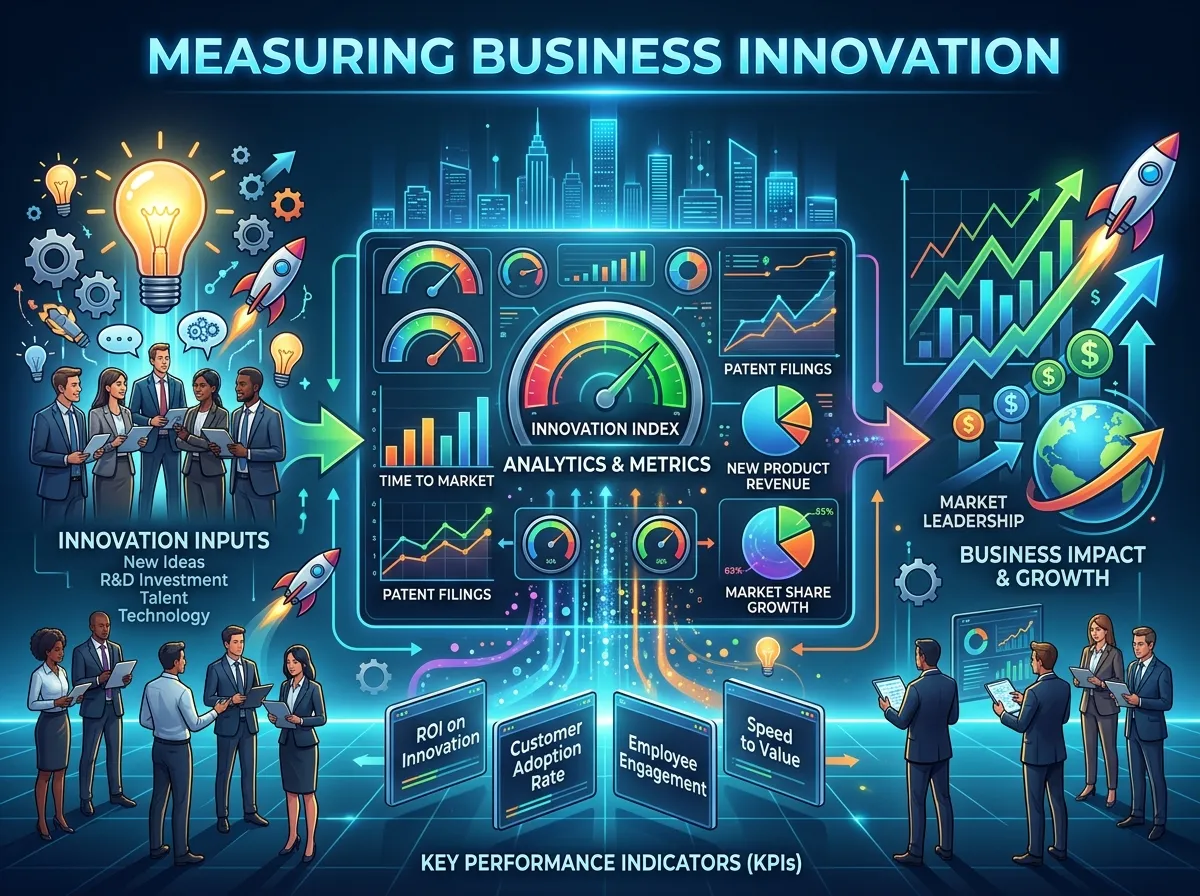
Innovation should be measured using indicators that reflect the organization’s objectives. Financial metrics may include revenue from new products, cost savings, profit contribution, and return on investment.
Customer-focused metrics can include satisfaction, retention, adoption rates, engagement, and feedback. Operational metrics may include productivity, processing time, error reduction, and automation rates.
There is no universal innovation metric. The right measurements depend on what the business is trying to achieve. A company focused on product development may prioritize adoption and revenue, while an organization focused on process innovation may prioritize efficiency and cost reduction.
Final Thoughts
Business innovation is a powerful driver of competitiveness, adaptability, and long-term growth. It can involve products, services, technology, customer experiences, business models, or internal processes.
From innovative business ideas and digital business innovation to business process innovation and innovation-driven business growth, organizations have many opportunities to create value through new approaches.
The most successful businesses do not innovate simply to follow trends. They innovate to solve meaningful problems, serve customers better, improve performance, and build sustainable advantages. When innovation becomes part of strategic decision-making and organizational culture, it can become a continuous source of growth.
Frequently Asked Questions
1. What is business innovation?
Business innovation is the introduction of new or improved products, services, processes, technologies, experiences, or business models that create value. It can range from developing a completely new product to improving an existing workflow. Effective innovation addresses real customer or business needs and supports measurable organizational objectives.
2. Why is business innovation important?
Business innovation helps companies respond to changing customer expectations, technological developments, and competitive pressures. It can improve efficiency, create new revenue opportunities, strengthen customer experiences, and differentiate a company from competitors. Continuous innovation can also help organizations remain adaptable over the long term.
3. What is a business innovation strategy?
A business innovation strategy connects innovation activities with broader business goals. It helps organizations identify opportunities, evaluate ideas, prioritize investments, test concepts, and measure results. A strong strategy ensures that innovation contributes to objectives such as growth, customer retention, operational efficiency, or market expansion.
4. How does innovation contribute to business growth?
Innovation can support growth by creating new products, improving existing offerings, entering new markets, increasing customer retention, and developing additional revenue streams. It can also reduce operating costs through process improvements and automation. When innovation is connected to measurable business goals, it can become an important source of sustainable growth.
5. What is digital business innovation?
Digital business innovation involves using digital technologies to create new or improved products, services, processes, customer experiences, or business models. Artificial intelligence, cloud computing, automation, analytics, mobile platforms, and digital communication tools can all support digital innovation when they solve meaningful business problems.
6. What is business process innovation?
Business process innovation involves changing how work is performed to improve efficiency, quality, speed, or customer outcomes. Businesses may automate repetitive tasks, eliminate unnecessary steps, redesign workflows, or introduce new technologies. Even relatively small process improvements can create significant benefits when applied across an organization.
7. What are examples of innovative business ideas?
Innovative business ideas can include subscription-based services, AI-powered customer support, personalized digital experiences, automated business services, new delivery models, digital marketplaces, and technology-enabled products. The strongest ideas typically address an identifiable customer problem and offer a practical reason for people to adopt the solution.
8. How can companies create a culture of innovation?
Companies can encourage innovation by giving employees opportunities to share ideas, experiment, collaborate, and solve problems. Leadership should provide clear priorities and resources while accepting that some experiments will fail. Recognizing useful contributions and learning from unsuccessful projects can also encourage employees to participate in future innovation initiatives.
9. How can businesses measure innovation?
Businesses can measure innovation through financial, customer, and operational metrics. Depending on the objective, measurements may include revenue from new products, customer adoption, retention, satisfaction, cost savings, productivity, conversion rates, or return on investment. The most useful metrics are directly connected to the purpose of the innovation initiative.
10. What is the difference between innovation and business transformation?
Innovation generally involves creating or implementing new ideas that produce value, while business transformation usually refers to broader and more significant changes to how an organization operates or competes. Innovation can be an important part of transformation, but transformation may also involve organizational, cultural, technological, and structural changes beyond individual innovations.