Customer Experience Strategy: Build Better Experiences

A strong customer experience strategy helps businesses create positive, consistent, and valuable interactions across every customer touchpoint. By understanding customer needs, improving the customer journey, using digital tools, personalizing communication, and continuously measuring satisfaction, businesses can build stronger relationships, improve retention, and support long-term growth.
Customer expectations have changed significantly as people interact with brands across websites, social media, mobile applications, email, online stores, customer service channels, and physical locations. Customers do not evaluate a business based only on its products or prices. They also consider how easy it is to find information, make a purchase, receive support, solve problems, and communicate with the brand.
This makes customer experience an important part of modern business strategy.
A well-planned customer experience strategy gives businesses a structured approach to understanding customer expectations and improving interactions throughout the entire relationship. Instead of focusing on individual touchpoints, businesses can look at the complete experience from the customer’s perspective.
When customers consistently receive helpful, convenient, and personalized experiences, they are more likely to trust a brand, return for future purchases, and recommend it to others.
What Is a Customer Experience Strategy?
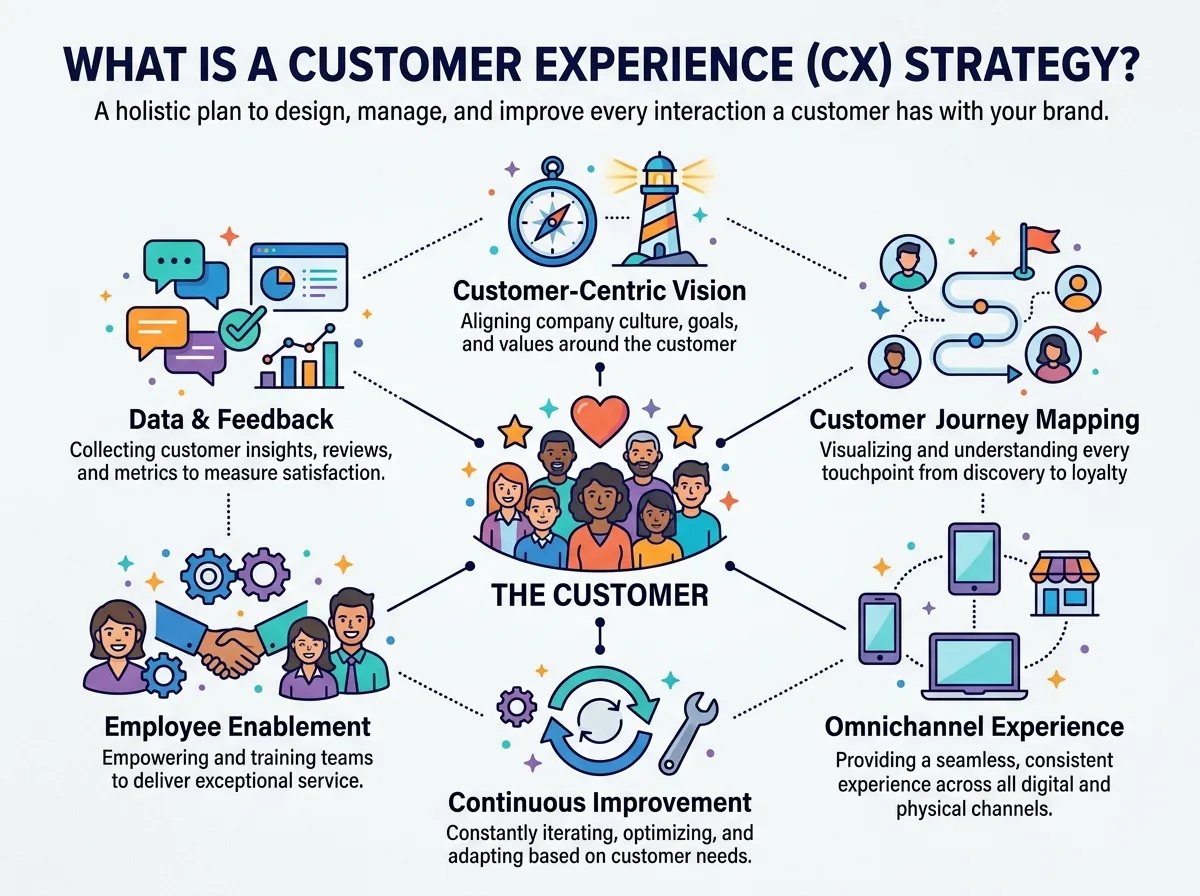
A customer experience strategy is a structured plan for improving every interaction customers have with a business. It covers the complete customer journey, including awareness, research, purchase, onboarding, customer support, retention, and advocacy.
The goal is not simply to make individual interactions pleasant. The goal is to create a consistent experience that meets customer expectations while supporting business objectives.
A successful strategy combines customer research, journey analysis, employee training, technology, personalization, service improvements, and performance measurement.
For example, a company may discover through customer feedback that people find its online checkout process confusing. Improving the checkout experience can reduce friction, increase conversions, and create a more positive perception of the brand.
Why Customer Experience Matters for Business Growth
Customer experience influences how people perceive and interact with a brand. Even a strong product can struggle if customers face unnecessary difficulties during the buying or support process.
A positive experience can improve customer loyalty because people are more likely to continue working with brands that consistently meet their expectations.
It can also influence word-of-mouth marketing. Customers who have positive experiences may recommend a company to friends, colleagues, or professional networks.
On the other hand, repeated friction can cause customers to abandon purchases or switch to competitors.
For this reason, businesses should treat experience improvement as an ongoing business priority rather than a one-time marketing project.
1. Understand Your Customers
An effective strategy begins with a clear understanding of customers. Businesses need to know who their customers are, what they want, what problems they experience, and what influences their purchasing decisions.
Customer surveys, interviews, reviews, support conversations, website behavior, sales feedback, and analytics can reveal valuable insights.
Businesses should also identify differences between customer segments. A first-time buyer may need more educational information, while an existing customer may want faster support or personalized recommendations.
Customer data should not simply be collected. It should be analyzed and turned into practical improvements.
Understanding customer expectations makes it easier to build a customer-centric experience strategy that reflects real needs instead of assumptions.
2. Map the Complete Customer Journey
The customer journey includes every stage through which a person interacts with a brand. It can begin when someone first discovers a company and continue through research, purchase, onboarding, support, repeat purchases, and referrals.
A customer journey strategy helps businesses understand what customers experience at each stage.
For example, a potential customer might discover a brand through search engines, visit its website, read reviews, compare products, contact customer support, make a purchase, and later receive follow-up emails.
Each interaction can influence the overall perception of the business.
Journey mapping helps identify gaps and friction points. If customers frequently abandon a process at a particular stage, businesses can investigate why and make targeted improvements.
3. Create Consistent Experiences Across Channels
Customers often interact with businesses through multiple channels. They may discover a company through social media, visit its website, contact support through live chat, and complete a purchase through a mobile application.
These interactions should feel connected.
Inconsistent information, branding, pricing, or service quality can create confusion and reduce trust.
A strong digital customer experience strategy connects digital touchpoints so customers can move between channels without unnecessary friction.
For example, if a customer starts a support conversation through live chat and later contacts the company by email, the support team should ideally have access to relevant conversation history.
Consistency creates a smoother experience and helps customers feel that they are interacting with one organization rather than disconnected departments.
4. Personalize Customer Interactions
Customers increasingly expect businesses to understand their interests and preferences. Personalization can make interactions more relevant and reduce the amount of effort customers need to spend finding useful information.
Businesses can personalize experiences using purchase history, browsing behavior, previous interactions, customer preferences, and segmentation.
For example, an ecommerce business can recommend products based on previous purchases, while a SaaS company can provide onboarding content based on the customer’s selected features.
However, personalization should be helpful rather than intrusive. Businesses need to use customer information responsibly and provide value through relevant recommendations and communication.
5. Improve Customer Engagement
Customer engagement is about creating meaningful interactions that encourage customers to remain connected with a brand.
A strong customer engagement strategy can include educational content, personalized emails, loyalty programs, social media interactions, community building, surveys, webinars, and proactive customer support.
Engagement should not focus entirely on selling. Businesses can strengthen relationships by providing useful information and helping customers achieve better outcomes.
For example, a software company can share tutorials and best practices that help customers get more value from its product.
When customers consistently receive useful interactions, the relationship can become stronger over time.
6. Build a Strong Customer Satisfaction Strategy
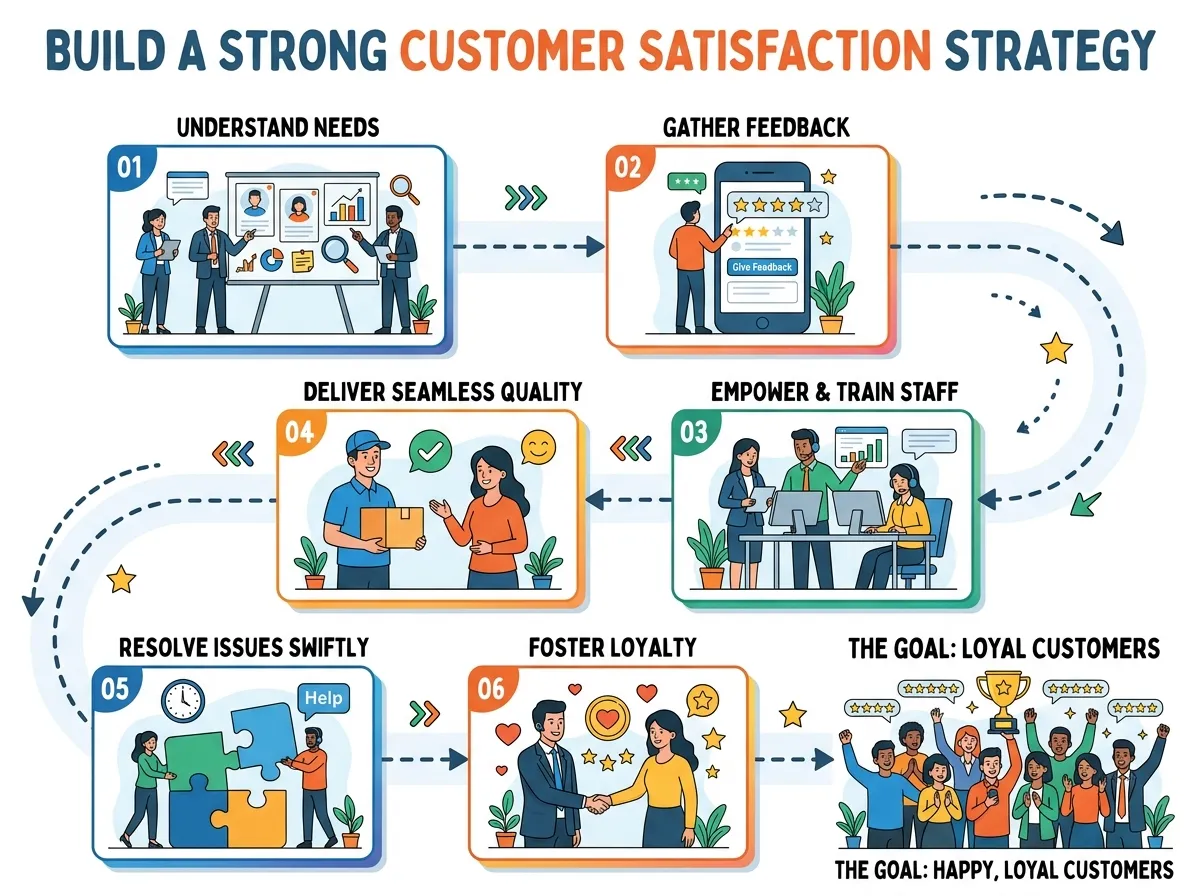
Customer satisfaction provides an important indication of whether a business is meeting expectations.
A customer satisfaction strategy should involve more than collecting ratings. Businesses need to understand why customers are satisfied or dissatisfied and determine what changes can improve the experience.
Surveys can measure satisfaction after purchases or support interactions. Reviews can reveal recurring issues. Customer service data can identify common complaints.
Businesses can also use metrics such as Customer Satisfaction Score, Net Promoter Score, and Customer Effort Score to evaluate different aspects of the customer relationship.
The most important step is acting on the feedback. Asking customers for their opinions without addressing recurring problems can make feedback programs ineffective.
7. Reduce Friction at Important Touchpoints
Customers generally prefer experiences that are simple and convenient. Complicated forms, slow websites, confusing navigation, unclear pricing, and difficult support processes can create unnecessary friction.
Businesses should regularly review high-value touchpoints and ask whether customers can complete important tasks easily.
For example, a checkout process may require fewer steps. A customer support system may provide self-service options for common questions. A website may improve navigation so visitors can find products or information faster.
These improvements are part of customer experience optimization.
Small changes can sometimes have a significant effect because they remove barriers that affect large numbers of customers.
8. Use Technology to Improve the Experience
Technology can support customer experience by making interactions faster, more personalized, and more convenient.
Businesses can use CRM platforms, AI chatbots, marketing automation, customer data platforms, recommendation systems, analytics tools, and self-service portals to improve customer interactions.
For example, a chatbot can answer common questions at any time, while a CRM system can help customer service teams access relevant customer information.
Technology should support the customer rather than create additional complexity. Businesses should evaluate whether a tool genuinely improves the experience before implementing it.
The best technology strategy combines automation with human support where personal interaction is important.
9. Make Your Brand More Accessible
Customer experience should be inclusive and accessible to people with different needs and abilities.
Accessible websites, readable content, clear navigation, captions, descriptive image text, keyboard-friendly interfaces, and understandable communication can help more people interact comfortably with a brand.
A commitment to accessibility can also strengthen brand perception because it demonstrates that the business considers the needs of a broader audience.
Businesses interested in creating more inclusive experiences can explore this resource on [brand accessibility and inclusive customer experiences]The Ultimate Guide to Brand Accessibility.
Accessibility should be considered during the design process rather than treated as an afterthought.
10. Differentiate the Brand Through Experience
Products and services can become increasingly similar in competitive markets. Customer experience can provide another way for businesses to stand apart.
A company may differentiate itself through faster support, personalized service, convenient purchasing, transparent communication, or a simpler digital experience.
This is particularly important for B2B organizations where multiple providers may offer similar solutions. Businesses can explore [B2B brand differentiation strategies]B2B Brand Differentiation to understand how a stronger brand position can help companies stand out in competitive professional markets.
The experience should support the brand promise. If a company presents itself as customer-focused but provides slow or difficult support, the gap between messaging and reality can damage trust.
11. Use Customer Feedback to Drive Improvement
Customer feedback provides direct insight into how people experience a business.
Feedback can come from surveys, reviews, social media comments, support tickets, interviews, sales conversations, and customer success teams.
Businesses should categorize feedback to identify recurring themes. If many customers mention the same issue, it may represent a larger experience problem that deserves attention.
A feedback loop should connect customer insights with internal teams. Marketing, sales, product, customer service, and leadership teams can use these insights to prioritize improvements.
This creates an ongoing process of customer experience improvement strategy, where changes are based on actual customer needs.
12. Use Behavioral Insights to Improve Experiences
Customer decisions are influenced by emotions, perceptions, expectations, and cognitive factors. Understanding these influences can help businesses design clearer and more engaging experiences.
For example, social proof, trust signals, familiar design patterns, clear messaging, and reduced decision complexity can influence how customers interact with a brand.
Businesses exploring behavioral marketing can also learn about [neuromarketing in branding and consumer psychology]Neuromarketing in Branding.
The objective should not be to manipulate customers. Instead, behavioral insights can help businesses understand what makes experiences clearer, easier, and more relevant.
13. Improve the Digital Customer Journey
Digital experiences have become a major part of the customer relationship. Website speed, mobile usability, navigation, search functionality, checkout, online support, and communication all influence how customers perceive a brand.
Customer journey optimization involves identifying areas where users experience friction and improving them based on data and feedback.
Analytics can reveal where visitors leave a website, which pages receive the most engagement, and which steps create the highest abandonment rates.
Businesses can then test improvements and measure the results.
For example, simplifying a form may increase completion rates, while improving website navigation may help users find important product information faster.
14. Turn Customer Experience Into a Continuous Process
Customer expectations continue to change, so businesses cannot rely on a strategy created several years ago.
Customer experience transformation requires continuous learning and adaptation. Businesses should regularly review customer feedback, technology, market changes, competitor experiences, and performance data.
Transformation does not always require a complete business overhaul. It can involve a series of targeted improvements across customer service, digital channels, product experiences, communication, and internal processes.
The most effective organizations create a culture where employees regularly look for ways to make customer interactions easier and more valuable.
Measuring the Success of a Customer Experience Strategy
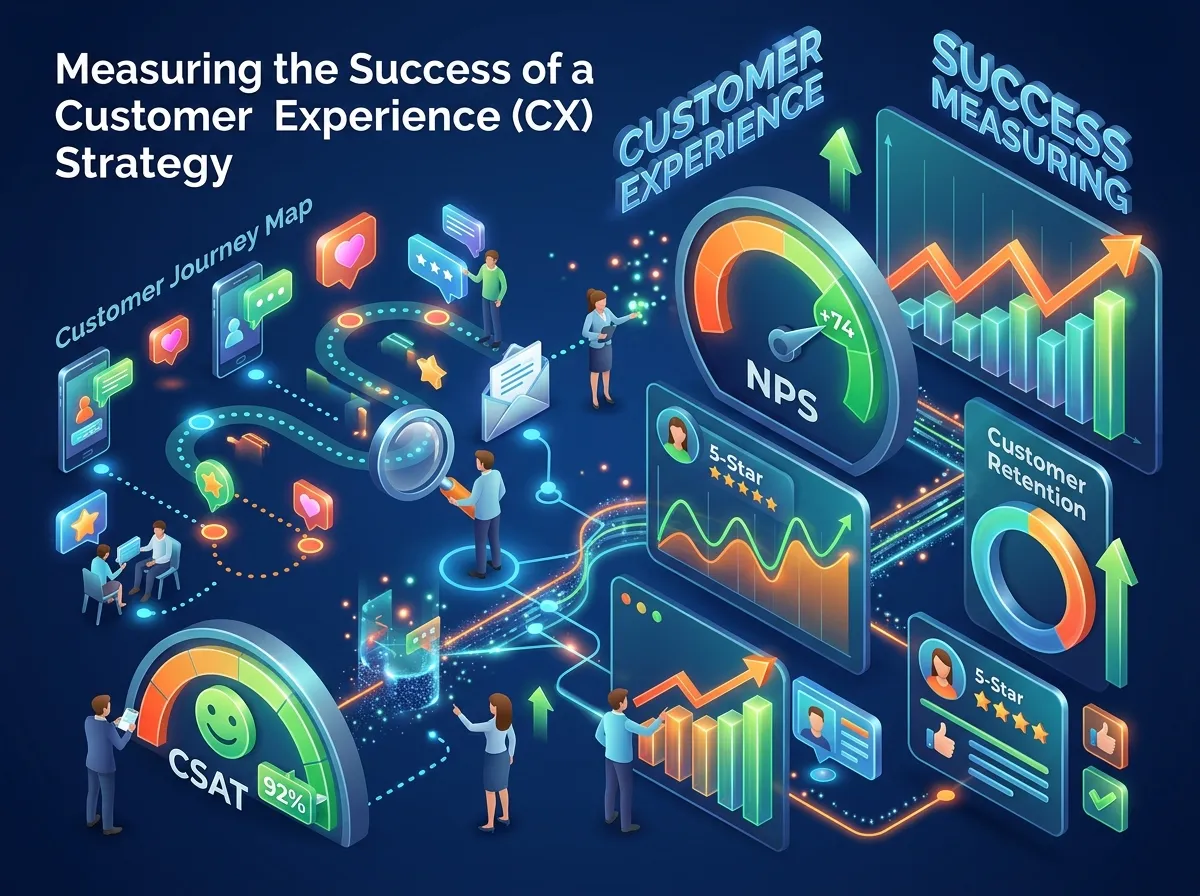
A customer experience strategy needs measurable outcomes.
Businesses can track customer satisfaction, Net Promoter Score, Customer Effort Score, retention rate, repeat purchase rate, churn rate, support resolution time, conversion rate, and customer lifetime value.
Different metrics provide different insights.
For example, satisfaction scores can reveal how customers feel about an interaction, while retention rates show whether positive experiences are contributing to long-term relationships.
Businesses should combine quantitative data with qualitative feedback. Numbers can show what is happening, while customer comments can help explain why it is happening.
Regular measurement makes it easier to prioritize improvements and demonstrate the business value of customer experience initiatives.
The Role of Zero-Click Experiences
Customers increasingly want quick access to useful information without navigating through multiple pages or completing unnecessary steps.
Zero-click experiences can support this expectation by providing answers directly within search results, social platforms, digital assistants, or other customer touchpoints.
Businesses can learn more about [zero-click marketing strategies]Zero-Click Marketing and consider how direct information delivery can reduce friction in the customer journey.
The broader principle is simple: businesses should make it as easy as possible for customers to find information and complete important tasks.
Conclusion
A strong customer experience strategy helps businesses build meaningful relationships by improving every stage of the customer journey. From understanding customer needs and creating consistent experiences to improving digital interactions, personalization, accessibility, support, and feedback systems, every touchpoint contributes to the overall customer perception.
Businesses should not treat customer experience as the responsibility of one department. Marketing, sales, customer service, product, technology, and leadership teams all influence the experience.
By combining customer insights with continuous optimization and the right technology, businesses can reduce friction, improve satisfaction, strengthen loyalty, and create meaningful competitive differentiation.
The most successful strategy is one that evolves with customers. Regular measurement, feedback, testing, and improvement can turn customer experience into a long-term source of trust, retention, and business growth.
Frequently Asked Questions
1. What is a customer experience strategy?
A customer experience strategy is a structured plan for improving how customers interact with a business across every stage of their relationship. It covers areas such as marketing, purchasing, onboarding, customer service, digital experiences, and retention.
2. Why is customer experience important?
Customer experience affects customer satisfaction, loyalty, retention, recommendations, and brand perception. A positive experience can encourage customers to continue purchasing and recommend a business to others.
3. What is customer experience management?
Customer experience management involves monitoring, analyzing, and improving customer interactions across different touchpoints. It uses customer feedback, behavioral data, technology, and performance metrics to improve the overall experience.
4. How can businesses improve customer experience?
Businesses can improve customer experience by understanding customer needs, simplifying processes, improving support, personalizing communication, optimizing websites and apps, collecting feedback, and continuously addressing customer pain points.
5. What is a customer journey strategy?
A customer journey strategy focuses on understanding and improving the complete path customers take when interacting with a business. It covers stages such as awareness, consideration, purchase, onboarding, support, retention, and advocacy.
6. What is customer experience optimization?
Customer experience optimization involves identifying friction points and improving customer interactions based on data, feedback, and testing. It can include website improvements, faster support, simpler processes, better personalization, and improved communication.
7. How does personalization improve customer experience?
Personalization makes interactions more relevant by using information such as customer preferences, behavior, purchase history, and previous interactions. Relevant recommendations and communication can make it easier for customers to find what they need.
8. How can technology support customer experience?
Technology such as CRM platforms, AI chatbots, analytics tools, marketing automation, recommendation systems, and self-service portals can make customer interactions faster, more convenient, and more personalized.
9. What metrics should businesses use to measure customer experience?
Common metrics include Customer Satisfaction Score, Net Promoter Score, Customer Effort Score, retention rate, churn rate, repeat purchase rate, support resolution time, conversion rate, and customer lifetime value.
10. How often should a business review its customer experience strategy?
Customer experience should be reviewed continuously rather than only once a year. Businesses should regularly analyze feedback, performance data, customer behavior, and changing expectations so they can make timely improvements.