Sustainability in Brand Strategy: Beyond Greenwashing to Authentic Commitment
Authentic sustainability in brand strategy is no longer a niche advantage; it is a core requirement for building trust, driving growth, and ensuring long-term relevance.
This guide explores how to embed genuine sustainability in brand strategy, moving beyond superficial greenwashing. Discover actionable steps for transparent communication, ethical sourcing, and measuring impact. Learn how authentic commitment to sustainability builds brand loyalty, enhances reputation, and creates lasting value.
The Green Shift: From Marketing Trend to Business Imperative
For years, “sustainability” was a buzzword, a box for marketing departments to check with a few eco-friendly labels and a press release about planting trees. It was a nice-to-have, an add-on to a pre-existing business model. That era is over. Today, a new generation of consumers, armed with information and driven by values, demands more than just green marketing; they demand green DNA. This is where sustainability in brand strategy evolves from a peripheral tactic to a central pillar of corporate identity and long-term success.
The modern marketplace is riddled with the ghosts of greenwashing—brands that made lofty environmental claims without the substance to back them up. Consumers have become expert detectives, quick to spot inconsistencies and punish inauthenticity with their wallets and their voices. A vague claim of being “eco-friendly” is now a red flag, not a selling point. This heightened scrutiny means that a superficial approach to sustainability in brand strategy is more dangerous than doing nothing at all. It erodes trust, the most valuable asset a brand can possess.
True sustainability in brand strategy is about a fundamental and authentic commitment that permeates every level of the organization. It’s about re-examining supply chains, redesigning products for circularity, empowering employees to be agents of change, and communicating with radical transparency. It’s not about being perfect; it’s about being honest about the journey and demonstrating a real, measurable commitment to doing better. This approach transforms sustainability from a cost center into a powerful driver of innovation, brand loyalty, and competitive advantage. Integrating genuine sustainability in brand strategy isn’t just good for the planet—it’s essential for building a resilient, respected, and profitable brand for the future.
1. Deconstructing Greenwashing: The High Cost of Inauthenticity

Before a brand can build an authentic strategy, it must understand what it’s fighting against: greenwashing. Defined by Wikipedia as the process of conveying a false impression or providing misleading information about how a company’s products are more environmentally sound, greenwashing is the cardinal sin of modern branding. It’s not just bad ethics; it’s a disastrous business decision. Today’s consumers, particularly Millennials and Gen Z, are highly adept at spotting and punishing it.
The fallout from greenwashing is severe and multi-faceted, directly impacting brand equity and customer trust. When a brand’s claims are exposed as false, it creates a deep sense of betrayal that is difficult to repair. This is not a simple marketing misstep; it’s a violation of the trust that forms the foundation of the customer relationship. The damage extends beyond just the eco-conscious segment, tarnishing the brand’s overall reputation for honesty and integrity.
Common Forms of Greenwashing to Avoid:
- Vague or Unproven Claims: Using terms like “eco-friendly,” “green,” or “natural” without any specific, verifiable data or certifications to back them up. An effective sustainability in brand strategy relies on precision.
- The Hidden Trade-Off: Highlighting one small sustainable attribute of a product while ignoring other, more significant environmental harms. For example, a t-shirt made from “5% organic cotton” while the other 95% is produced with polluting dyes and exploitative labor.
- Irrelevant Claims: Boasting about a “CFC-free” product, even though CFCs have been banned by law for decades. This is an attempt to gain credit for something that is legally required and not a voluntary positive action.
- Lesser of Two Evils: Framing a product as sustainable simply because it is slightly less harmful than others in its category, even if the entire category is inherently unsustainable.
- Fibbing: Making outright false claims or using fake eco-labels and certifications to mislead consumers.
The core problem with greenwashing is that it treats sustainability in brand strategy as a marketing campaign rather than an operational philosophy. Authentic sustainability requires a commitment that begins with the brand purpose development and extends through every facet of the business. It’s about making difficult, often costly, decisions to reduce negative impact, not just finding clever ways to talk about it. The brands that understand this distinction are the ones that will build the deep, resilient loyalty that inauthentic brands can only dream of.
2. The Foundation: Weaving Sustainability into Your Core Brand Values
Authentic sustainability in brand strategy cannot be a fresh coat of paint on an old structure. It must be woven into the very fabric of your brand’s identity, starting with its core values and purpose. When sustainability is a genuine part of who you are, it informs every decision, from the C-suite to the factory floor. This is the difference between “doing” sustainable things and “being” a sustainable brand.
Defining Your “Why”
Your sustainability journey should begin with a fundamental question: “Why does this matter to our brand?” The answer cannot be “because customers want it” or “because it’s good for PR.” A truly resonant purpose connects your brand’s unique capabilities to a specific environmental or social problem you are passionate about solving.
- Example: Patagonia. Their purpose isn’t just to “be sustainable.” It is to “save our home planet.” This powerful mission drives every decision, from donating 1% of sales to environmental causes to creating their “Worn Wear” program to extend the life of their products. This is a prime example of a brand purpose in action.
- Example: Lush Cosmetics. Their core value of fighting animal testing is a non-negotiable part of their identity. This purpose dictates their ingredient sourcing, product development, and advocacy campaigns, creating an incredibly loyal community of customers who share that value.
From Values to Action: The Internal Commitment
Once your purpose is defined, it must be embedded internally before you can communicate it externally. This is where many attempts at sustainability in brand strategy fail.
- Leadership Buy-in: The commitment must start at the top. The CEO and leadership team must champion the cause, allocate resources, and hold the organization accountable to its goals.
- Employee Engagement (Internal Branding): Your employees are your most important brand ambassadors. They need to understand and believe in the brand’s sustainability mission. Internal branding initiatives like training programs, volunteer days, and green challenges can turn employees into passionate advocates who live the brand’s values.
- Operational Integration: Sustainability cannot be the sole responsibility of a single department. It needs to be integrated into KPIs across the organization. The product team should be measured on reducing waste, the supply chain team on ethical sourcing, and the marketing team on transparent communication.
By starting with a deep, authentic purpose and embedding it throughout your organization, you create a solid foundation. This ensures that when you do start communicating your efforts externally, your message is not just marketing—it’s a reflection of who you truly are. This approach to sustainability in brand strategy builds unwavering brand consistency.
3. The Pillars of an Authentic Sustainability Strategy
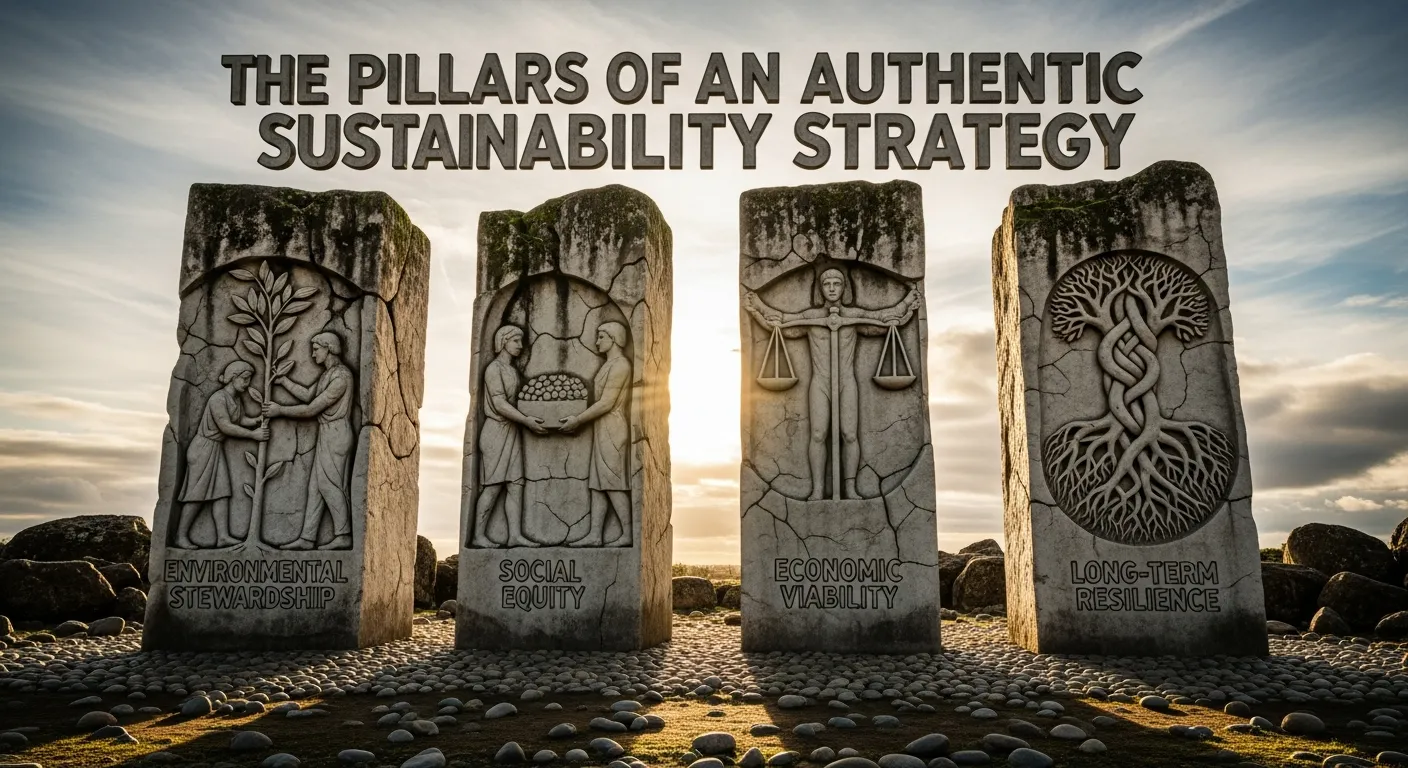
A robust and credible sustainability in brand strategy rests on several key pillars that work together to create a holistic and impactful approach. These pillars ensure that your efforts are comprehensive, measurable, and transparent, moving you far beyond the realm of greenwashing.
Pillar 1: Radical Transparency and Traceability
Transparency is the antidote to greenwashing. In an authentic sustainability in brand strategy, you must be willing to show your work—the good, the bad, and the ugly.
- Supply Chain Visibility: Modern consumers want to know the story behind their products. Where did the raw materials come from? Who made them? What were the conditions? Brands like Everlane have built their entire model on “Radical Transparency,” detailing the costs and factories behind each product. Technologies like blockchain are increasingly being used to create immutable records of a product’s journey.
- Honest Reporting: Don’t just publish a glossy annual CSR report. Provide regular, accessible updates on your progress toward your sustainability goals. This includes admitting where you’ve fallen short. Acknowledging challenges and outlining your plan to overcome them builds more trust than pretending to be perfect.
- Third-Party Certifications: Certifications from reputable organizations (e.g., B Corp, Fair Trade, LEED, FSC) provide third-party validation of your claims. They serve as a trusted shortcut for consumers, signaling that your brand has met rigorous standards for social and environmental performance.
Pillar 2: Ethical and Sustainable Sourcing
The impact of your brand begins long before a product is assembled. An ethical supply chain is a non-negotiable component of a genuine sustainability in brand strategy.
- Material Selection: Prioritize materials that are recycled, renewable, biodegradable, or have a lower environmental footprint. This could mean using organic cotton instead of conventional cotton, recycled polyester (rPET) instead of virgin polyester, or innovative materials derived from agricultural waste.
- Supplier Code of Conduct: Establish and enforce a strict code of conduct for all your suppliers that covers fair labor practices, safe working conditions, and environmental management. This isn’t just about sending a document; it involves regular audits and building partnerships with suppliers who share your values.
- Local Sourcing: Whenever possible, sourcing locally can significantly reduce your carbon footprint from transportation and support local economies.
Pillar 3: Circular Economy and Product Lifecycle
The traditional linear model of “take-make-dispose” is inherently unsustainable. A forward-thinking sustainability in brand strategy embraces the principles of a circular economy.
- Designing for Durability and Repair: Create products that are built to last, not to be replaced. Brands like Patagonia and Nudie Jeans offer repair services to extend the life of their products, fostering a culture of care and anti-consumerism.
- Product Take-Back Programs: Implement programs that allow customers to return products at the end of their life so they can be properly recycled, upcycled, or disposed of. This demonstrates that you are taking responsibility for the entire lifecycle of your products.
- Innovative Packaging: Packaging is often the most visible—and most criticized—source of waste. Explore solutions like compostable materials, minimal packaging, or reusable packaging systems. The rise of refillable models in the CPG brand marketing space is a direct response to this challenge.
Pillar 4: Social Responsibility and Community Impact
True sustainability in brand strategy is not just about the environment; it’s about people. The social pillar (the “S” in ESG) is equally important.
- Fair Labor and Living Wages: Ensuring that everyone in your supply chain, from the farmer to the factory worker, is paid a fair living wage is a cornerstone of ethical branding.
- Diversity, Equity, and Inclusion (DEI): An authentic commitment to sustainability includes fostering an inclusive internal culture and ensuring your marketing and products are accessible and representative of diverse communities. This is a key part of building inclusive brand strategies.
- Community Investment: Give back to the communities where you operate. This could be through corporate volunteering, financial donations to local non-profits, or partnerships that support local development.
By building your strategy on these four pillars, you create a comprehensive and defensible approach to sustainability that is resilient to accusations of greenwashing and deeply resonant with conscious consumers.
4. Communicating Your Commitment: Storytelling Over Bragging

Once you have put in the hard work to build an authentic sustainability in brand strategy, the next crucial step is communicating it. However, the communication itself must be as authentic and transparent as the actions behind it. The goal is not to brag about how “green” you are, but to tell a compelling story that educates, inspires, and invites your audience to be part of the journey. This is where mastering brand storytelling becomes critical.
The Principles of Authentic Sustainability Communication:
- Educate, Don’t Preach: Your audience may not be experts in carbon footprints or circular economies. Use clear, simple language to explain what you are doing and why it matters. Infographics, short videos, and blog posts can break down complex topics into digestible content. The aim is to empower your audience with knowledge, not to make them feel guilty.
- Be Specific and Data-Driven: Avoid vague platitudes. Instead of “We’re reducing our footprint,” say “By redesigning our packaging, we’ve eliminated 20 tons of single-use plastic from our supply chain this year.” Specific, measurable claims are credible; vague statements are not. This is a form of data-driven brand storytelling.
- Show, Don’t Just Tell: Use visual storytelling to bring your sustainability efforts to life. Share behind-the-scenes footage of your ethical factory, introduce the artisans who make your products, or show your team participating in a river cleanup. Visuals create a powerful emotional branding connection that text alone cannot.
- Embrace Imperfection: Be honest about your challenges. A post that says, “We’ve successfully moved to 80% recycled materials, but finding a sustainable alternative for this last 20% is proving tough. Here’s what we’re trying…” is far more believable than a post that claims perfection. It shows humility and reinforces that you are on a genuine journey.
- Integrate Sustainability into All Marketing: Your commitment to sustainability in brand strategy shouldn’t be confined to a hidden page on your website. It should be a consistent thread throughout your marketing. Mention it in product descriptions, feature it in your email newsletters, and make it a part of your social media content. This is a core tenet of integrated marketing.
Channels for Effective Communication:
|
Channel |
Best For |
Example |
|---|---|---|
|
Website/Blog |
Deep-dive storytelling, detailed reports, and educational content. |
A dedicated “Sustainability” section with detailed information on materials, factories, and goals. Blog posts that explain concepts like carbon offsetting or regenerative agriculture. |
|
Social Media |
Behind-the-scenes content, community engagement, and visual storytelling. |
Instagram Stories showing the process of making a product from recycled materials. A TikTok video explaining how to properly dispose of your packaging. |
|
Product Packaging |
At-a-glance information and reinforcing brand values at the point of sale. |
QR codes that link to more information about the product’s origin. Clear labeling of certifications like Fair Trade or B Corp. |
|
Email Marketing |
Nurturing your most engaged audience with updates and exclusive content. |
A monthly newsletter update on your progress toward sustainability goals. Highlighting a “sustainable product of the month.” |
|
PR & Influencer Marketing |
Third-party validation and reaching new audiences. |
Partnering with trusted eco-influencers who can authentically share your story. Pitching stories to media outlets focused on sustainability and ethical business. |
By adopting a storytelling mindset, you transform your sustainability efforts from a list of corporate achievements into a shared narrative. This approach doesn’t just inform your audience—it enrolls them in your mission, fostering a level of brand loyalty that transactional marketing can never achieve.
5. Measuring What Matters: The ROI of Sustainability
A common misconception is that sustainability in brand strategy is purely a cost center. While there are initial investments, a well-executed strategy delivers a powerful and measurable return on investment (ROI) across multiple areas of the business. Tracking the right metrics is essential to prove the value of your efforts and to guide continuous improvement.
Brand and Marketing Metrics
A strong sustainability in brand strategy directly enhances your brand’s health and marketing effectiveness.
- Brand Perception and Sentiment: Use social listening tools to track how your brand is perceived in relation to sustainability. Are you being associated with positive terms like “ethical” and “innovative,” or negative terms like “greenwashing”? An improvement in net sentiment is a direct ROI.
- Brand Awareness and Share of Voice: As your authentic story resonates, you will see an increase in organic mentions and media coverage. Tracking your “share of voice” in conversations about sustainability within your industry can demonstrate growing brand leadership. Tools from SEMrush or Ahrefs can help track brand mentions and backlinks from sustainability-focused publications.
- Customer Acquisition and Loyalty: Track metrics like Customer Lifetime Value (CLV) and retention rates for your eco-conscious customer segment. You will often find that these customers are more loyal and have a higher CLV. Additionally, using unique tracking links via tools like Google Analytics for sustainability campaigns can measure how many new customers are acquired through these initiatives.
- Employee Engagement and Retention: A strong sense of purpose is a major driver of employee satisfaction. Track employee turnover rates and use internal surveys to measure engagement. Lower turnover and higher engagement reduce recruitment costs and improve productivity.
Business and Operational Metrics
The impact of sustainability in brand strategy goes far beyond marketing.
- Cost Savings: Operational efficiencies gained from sustainability initiatives often lead to significant cost reductions. This includes lower energy bills from using renewable energy, reduced material costs from using recycled content, and lower waste disposal fees.
- Innovation and New Revenue Streams: The constraints of sustainability often force innovation. This can lead to the development of new, premium product lines (e.g., a “conscious collection”), or new business models like rental or resale platforms, opening up entirely new revenue streams.
- Risk Mitigation: A sustainable supply chain is often a more resilient one. By diversifying suppliers and moving away from resources vulnerable to climate change or political instability, you reduce long-term business risk. A strong reputation for sustainability also mitigates the risk of consumer boycotts and regulatory fines.
Environmental Metrics
Finally, you must track your actual environmental impact. This is the foundation of your credibility.
- Carbon Footprint: Measure your Scope 1, 2, and 3 emissions and track your progress toward reduction goals.
- Waste Reduction: Track the amount of waste sent to landfills versus the amount recycled or composted.
- Water Usage: Measure water consumption in your operations and supply chain.
By tracking a holistic set of metrics, you can paint a complete picture of the value that sustainability in brand strategy brings to your organization. This data not only justifies the investment but also provides the insights needed to refine your strategy and deepen your impact over time.
Conclusion
Integrating authentic sustainability in brand strategy is the most significant and necessary evolution in branding of our time. It marks a definitive shift from a model based on image to one based on integrity. For brands willing to embrace this change, the rewards are immense: deeper customer loyalty, enhanced brand reputation, a powerful engine for innovation, and the ability to attract and retain top talent.
The path is not easy—it requires a genuine, top-to-bottom commitment, a willingness to be transparent, and the courage to prioritize purpose alongside profit. But the alternative—clinging to outdated business practices and risking the label of “greenwasher”—is no longer a viable option. The future belongs to brands that stand for something more.
Frequently Asked Questions (FAQs)
1. What is the difference between sustainable branding and green marketing?
Green marketing is a tactic focused on promoting the environmental attributes of a product. Sustainability in brand strategy is a holistic approach where environmental and social responsibility are integrated into the core of the brand’s identity, operations, and purpose.
2. How can a small business implement a sustainability strategy without a large budget?
Start small and focus on impact. You can begin with low-cost initiatives like reducing waste in your office, switching to recycled packaging, sourcing locally, or partnering with a local environmental non-profit. Transparency is free—be honest about your journey and your goals, no matter how small.
3. What is greenwashing, and how can I avoid it?
Greenwashing is misleading consumers about a company’s environmental practices. To avoid it, be specific and data-driven in your claims, get reputable third-party certifications (like B Corp or Fair Trade), and be transparent about your entire supply chain and the challenges you face.
4. How do I measure the ROI of my sustainability efforts?
Measure a mix of metrics. Track brand metrics like sentiment and share of voice, business metrics like customer retention and cost savings from operational efficiencies, and environmental metrics like carbon footprint reduction. The combined value demonstrates the holistic ROI.
5. Are consumers really willing to pay more for sustainable products?
Multiple studies show that a significant portion of consumers, especially younger generations, are willing to pay a premium for products from brands they trust to be genuinely sustainable and ethical. However, the brand must effectively communicate the value and authenticity behind the higher price.
6. What are the “three pillars” of sustainability?
The three pillars, often referred to as the “Triple Bottom Line,” are People, Planet, and Profit. This framework argues that a truly sustainable business must be environmentally sound (Planet), socially responsible (People), and financially viable (Profit).
7. How does sustainability affect employee retention?
Modern employees, particularly from Millennial and Gen Z cohorts, want to work for companies that align with their personal values. A strong, authentic sustainability in brand strategy can significantly boost employee morale, engagement, and loyalty, making it easier to attract and retain top talent.
8. What is a “circular economy” in the context of branding?
A circular economy is a model of production and consumption that involves sharing, leasing, reusing, repairing, refurbishing, and recycling existing materials and products for as long as possible. For brands, this means designing products for longevity and taking responsibility for them at the end of their life.
9. Can a luxury brand also be sustainable?
Yes. In fact, luxury brand marketing is increasingly intertwined with sustainability. The principles of luxury—quality craftsmanship, durability, and timeless design—are inherently sustainable. Many luxury brands are now leading the way in ethical sourcing, transparent production, and embracing circular models.
10. Where should I start when developing a sustainability strategy?
Start with an audit. Conduct a thorough assessment of your current operations to understand your environmental and social impact. Identify your biggest areas of negative impact and start there. This data-driven approach ensures you are focusing your efforts where they will matter most.