Brand Equity: How to Build and Strengthen Brand Value
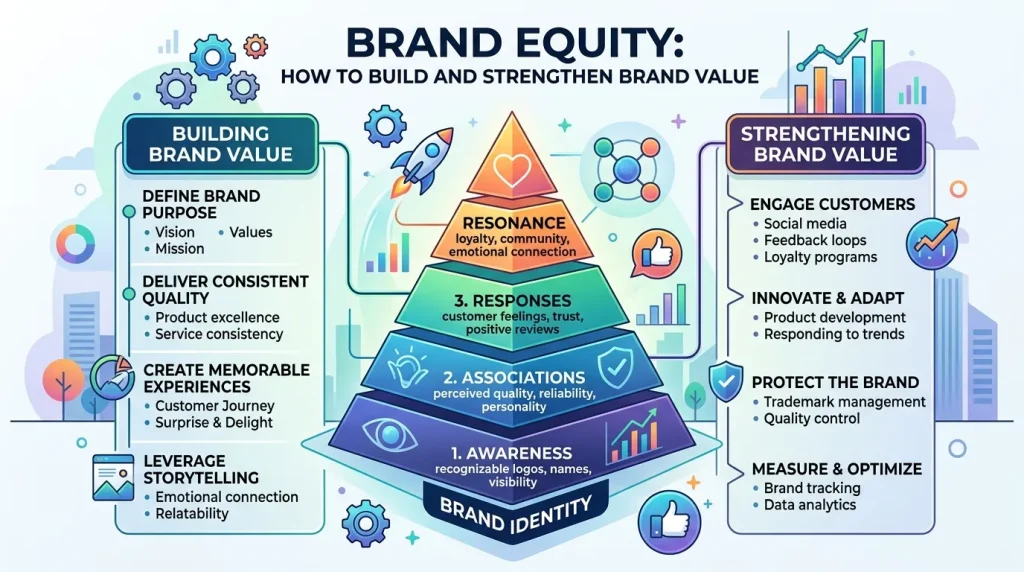
Brand equity represents the value a brand gains from customer awareness, recognition, trust, perceptions, and loyalty. Strong brand equity can help businesses differentiate themselves, strengthen customer relationships, support pricing power, and create long-term business value through consistent branding and positive customer experiences.
A brand is more than a name, logo, color scheme, or visual identity. It represents the overall perception customers develop through their interactions with a business. When customers recognize a company, trust its products, remember its message, and prefer it over alternatives, the brand has developed valuable equity.
Brand equity refers to the value associated with a brand based on how customers perceive, recognize, and respond to it. A business with strong brand equity may benefit from greater customer loyalty, stronger recognition, positive associations, and a more established position in its market.
Building this value does not happen overnight. It develops through consistent experiences, effective communication, reliable products or services, and meaningful customer relationships. Every interaction can influence how people perceive a brand, from advertising and social media content to customer service, packaging, websites, and events.
For businesses focused on long-term growth, understanding brand equity can provide a useful framework for improving brand perception and strengthening customer relationships.
What Is Brand Equity?
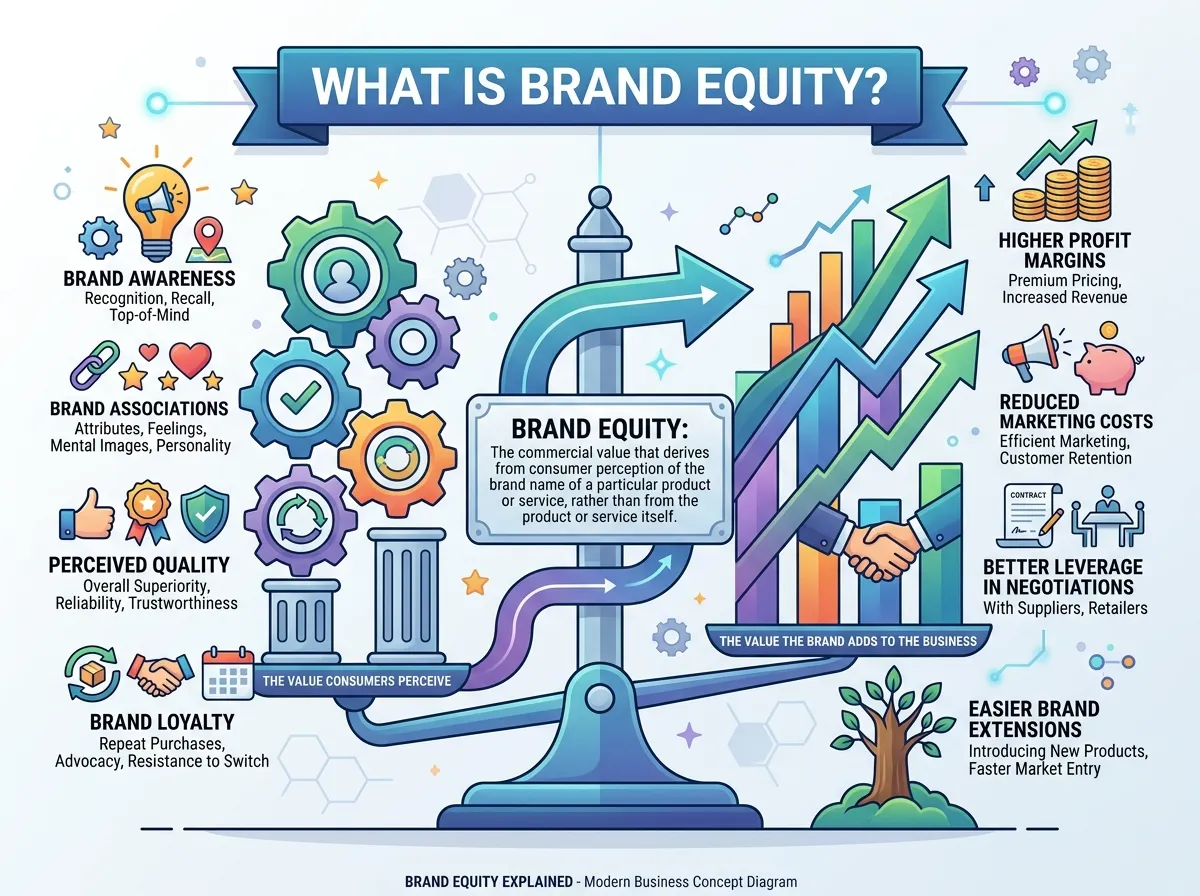
Brand equity is the value that a brand contributes to a product, service, or business beyond its basic functional characteristics. It reflects how customers recognize the brand, what they associate with it, how much they trust it, and whether they prefer it over competing options.
Two businesses may offer similar products, but customers may perceive one as more trustworthy, established, or valuable because of its brand. That difference can be influenced by years of marketing, customer experiences, product quality, reputation, and consistent communication.
Strong brand equity can make a brand easier to remember and more meaningful to customers. It can also influence purchasing decisions because people often rely on familiar brands when evaluating products or services.
However, brand equity is not limited to awareness. A company can be widely recognized while still having weak customer trust or negative perceptions. Sustainable equity depends on several interconnected elements, including recognition, reputation, loyalty, perceived value, and customer experience.
Why Brand Equity Matters
Businesses invest in branding because strong equity can influence how customers respond to products, services, and marketing communication. When customers already understand and trust a brand, they may be more receptive to new products, campaigns, and offers.
Brand value can also influence how a company differentiates itself in a crowded market. When products have similar features or prices, the strength of the brand can become an important factor in customer decision-making.
Strong equity may also support customer retention. Customers who have developed positive associations with a brand may be more likely to return when they need a similar product or service.
Another benefit is consistency. A well-established brand gives businesses a foundation for communicating their values and positioning across different channels. This can make marketing efforts more recognizable and connected.
Brand equity can also influence business expansion. A company with strong customer trust may find it easier to introduce related products or services because existing customers already understand the brand.
Building Brand Equity Through Consistency
Building brand equity requires consistent experiences over time. Customers form perceptions based on repeated interactions, so businesses should aim to deliver a coherent brand experience across marketing, customer service, products, websites, social media, and other touchpoints.
Visual consistency is one part of the process. Logos, colors, typography, imagery, and other design elements can help customers identify a brand quickly. However, consistency in messaging and customer experience is equally important.
A business that promotes itself as customer-focused but provides slow or unhelpful support may create a gap between its message and actual experience. Over time, these inconsistencies can influence customer trust.
Consistency does not mean every communication must be identical. Instead, the brand should maintain recognizable values, positioning, tone, and expectations while adapting content to different audiences and channels.
Digital Brand Engagement can support this approach by connecting brand content with ongoing digital customer interactions.
Developing a Brand Equity Strategy
A strong brand equity strategy starts with a clear understanding of what the brand represents and how it should be perceived. Businesses need to identify their target customers, define their positioning, understand competitive differences, and establish a consistent message.
The strategy should also consider the complete customer journey. Customers may first encounter a brand through search results or social media, then visit the website, read reviews, interact with sales representatives, make a purchase, and later contact customer support.
Each of these experiences contributes to brand perception. A strong strategy therefore looks beyond individual marketing campaigns and considers the overall relationship between customers and the brand.
Content can play an important role in this process. Educational articles, videos, social media posts, case studies, customer stories, and other content can communicate expertise and reinforce brand positioning.
Businesses should also regularly evaluate customer feedback and market changes. A brand equity strategy should evolve when customer expectations, competitors, products, or market conditions change.
Brand Equity Management
Brand equity management involves monitoring and strengthening the factors that influence how customers perceive and respond to a brand. It requires businesses to pay attention to awareness, customer experiences, reputation, loyalty, communication, and perceived value.
Effective management begins with measurement. Businesses can monitor brand-related metrics to understand whether customers recognize the brand, associate it with desired qualities, and continue engaging with it.
Customer feedback is another important source of information. Reviews, surveys, social media conversations, support interactions, and customer interviews can reveal how people actually perceive the brand.
Brand management also involves identifying inconsistencies. If marketing promises differ from customer experiences, businesses may need to address the underlying problem rather than simply changing the messaging.
Over time, consistent management can help businesses protect the value they have built while identifying opportunities for improvement.
Brand Awareness and Equity
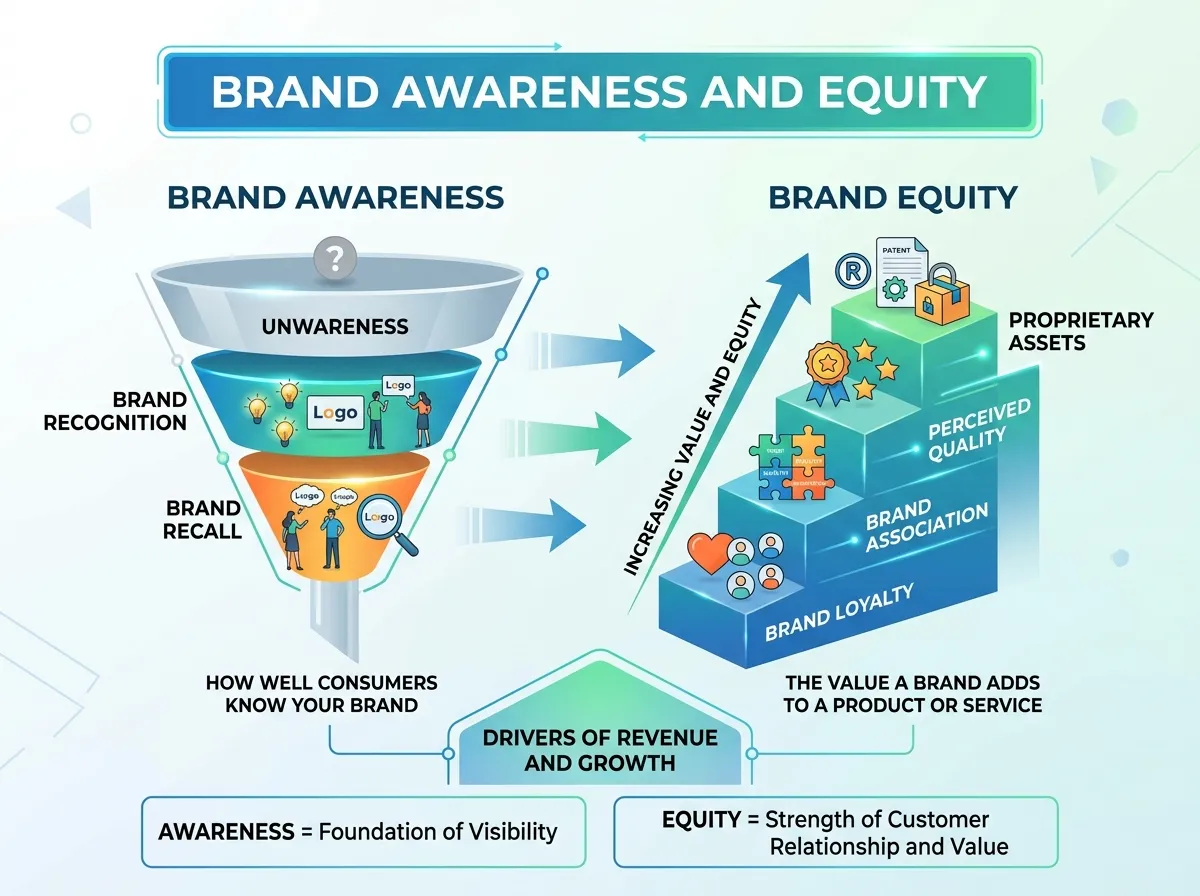
Brand awareness and equity are closely connected, but they are not the same thing. Brand awareness refers to how familiar customers are with a brand, while equity includes the broader value created by customer perceptions, associations, experiences, and loyalty.
Awareness is often an important starting point. Customers need to know that a brand exists before they can develop stronger associations with it.
However, awareness alone does not guarantee positive equity. A brand may be highly recognizable but have weak customer satisfaction or negative associations.
Businesses should therefore move beyond simply increasing visibility. Marketing should communicate useful information, establish clear positioning, and create positive experiences that give customers reasons to remember and trust the brand.
Content marketing, social media, search visibility, advertising, partnerships, events, and customer referrals can all contribute to awareness when they are connected to a consistent brand strategy.
Customer-Based Brand Equity
Customer-based brand equity focuses on the value of a brand from the customer’s perspective. It considers how customers recognize the brand, what they associate with it, how they judge its offerings, and how they respond to its communication.
This perspective is important because brand value ultimately depends on customer perceptions and behavior. A company may invest heavily in branding, but those efforts only become meaningful when customers develop relevant and positive associations.
Customer experiences can influence this process at every stage. Product quality, website usability, customer support, advertising, packaging, social media interactions, and post-purchase communication can all affect customer perceptions.
Businesses can strengthen customer-based equity by understanding what their audiences value and delivering experiences that consistently meet or exceed reasonable expectations.
Brand Perception and Customer Experience
Brand perception describes how customers view and interpret a brand. It can include associations related to quality, reliability, innovation, affordability, service, expertise, or other characteristics.
Perception develops from both direct and indirect experiences. A customer may form an opinion based on personal experience, while another person may be influenced by reviews, recommendations, social media content, advertising, or public discussions.
Because perception is shaped by many factors, businesses should monitor more than their own marketing communication. Customer conversations can provide useful insight into how the brand is actually understood.
A positive customer experience can reinforce desired perceptions. When a business consistently delivers what it promises, customers have more reasons to trust its messaging.
Businesses can also use content to clarify positioning. Helpful educational material can demonstrate expertise, while customer stories can provide evidence of real experiences.
Brand Loyalty and Long-Term Relationships
Brand loyalty reflects a customer’s continuing preference for a particular brand. Loyal customers may repeatedly purchase products, recommend the business to others, participate in communities, or actively engage with brand communication.
Loyalty generally develops through a combination of positive experiences and perceived value. A customer may remain loyal because of product quality, service, convenience, emotional connection, trust, or a combination of these factors.
Businesses should avoid assuming that loyalty comes automatically after a purchase. Maintaining relationships requires ongoing attention.
Personalized communication, loyalty programs, useful content, responsive support, exclusive experiences, and community engagement can help businesses maintain meaningful customer relationships.
Loyal customers can also contribute to brand visibility through word-of-mouth recommendations. Their experiences can influence other potential customers and contribute to broader brand recognition.
Brand Recognition and Market Visibility
Brand recognition refers to the ability of customers to identify a brand through elements such as its name, logo, packaging, design, messaging, or other distinctive characteristics.
Recognition can make a brand easier to remember when customers are comparing products or searching for solutions. Consistent visual and verbal branding can strengthen recognition across different channels.
Businesses can improve recognition by maintaining consistent brand assets and repeating important brand associations over time. However, repetition should be supported by useful communication rather than simply increasing promotional frequency.
Digital channels provide many opportunities to reinforce recognition. Websites, social media, search results, email, video content, online advertising, and digital communities can all contribute to repeated brand exposure.
The goal is to make the brand familiar while also giving customers meaningful reasons to remember it.
Brand Reputation and Trust
Brand reputation reflects the broader perception of a business based on its actions, communication, customer experiences, and public presence. Reputation can have a significant relationship with brand equity because trust influences how customers evaluate brands.
Businesses can strengthen reputation by delivering reliable products or services, responding professionally to customers, addressing problems transparently, and maintaining consistent communication.
Reviews and customer feedback are particularly important in digital environments. Potential customers can often see what existing customers say before making a purchasing decision.
When problems occur, the response can become part of the overall brand experience. Businesses should focus on resolving legitimate concerns and communicating clearly rather than attempting to hide negative feedback.
Reputation management should therefore be considered part of broader brand equity management.
Measuring Brand Equity
Brand equity should be measured using a combination of quantitative and qualitative indicators. No single metric can fully capture the value customers associate with a brand.
Businesses may examine brand awareness, recognition, customer preference, repeat purchases, customer retention, sentiment, reviews, engagement, and other indicators.
Financial measures can also provide useful context. Changes in revenue, customer acquisition, retention, pricing, and product performance may help businesses understand how brand strength relates to business outcomes.
Brand Equity KPIs provides additional context on metrics businesses can use to evaluate brand performance and track changes over time.
It is useful to combine numerical data with direct customer feedback. Surveys, interviews, reviews, social media discussions, and support interactions can reveal why customers behave in particular ways.
Digital Branding and Brand Equity
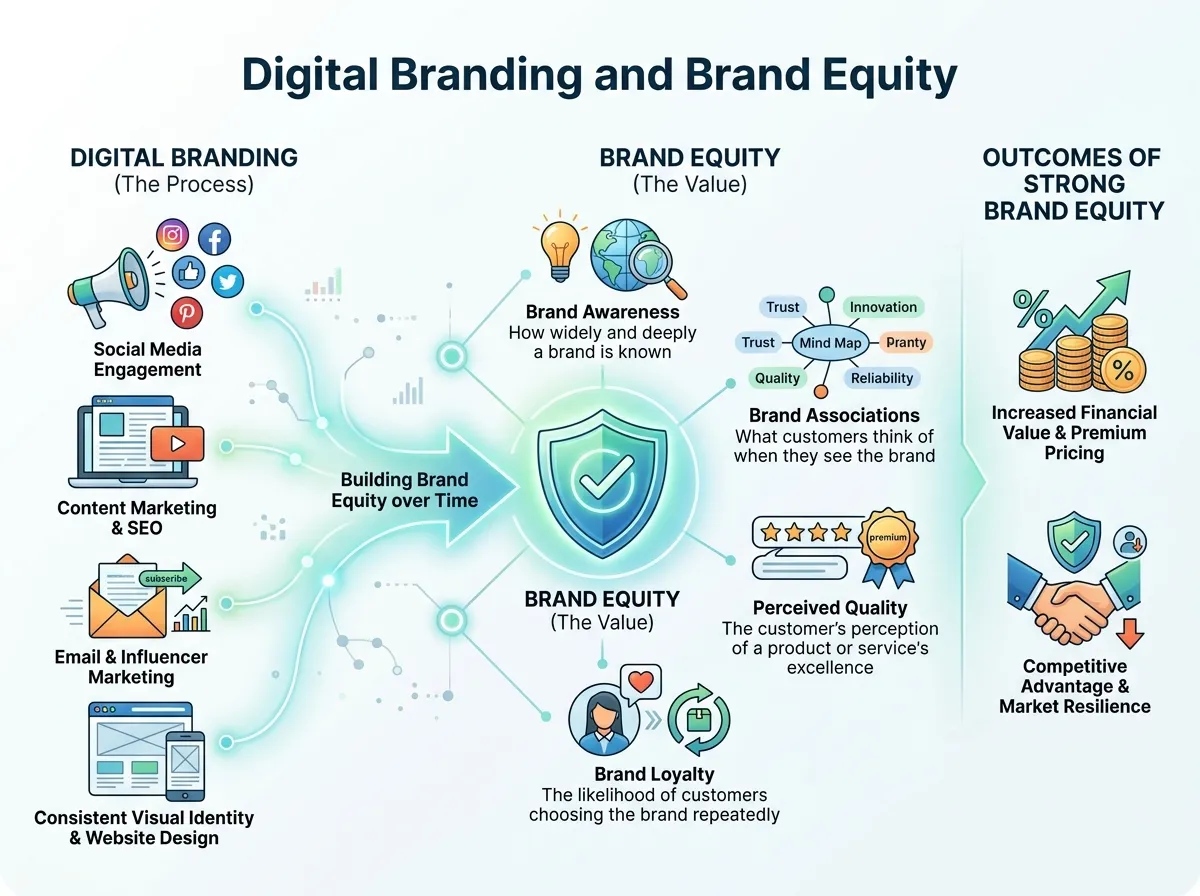
Digital channels have changed how brands build and maintain relationships with customers. A company’s website, social media presence, content, search visibility, online reviews, and digital advertising can all influence brand perceptions.
What is Digital Brand Strategy? explores how businesses can structure their digital branding efforts around a consistent strategy.
Digital branding also makes consistency more important. Customers can encounter a brand across many platforms within a short period. Differences in messaging, visuals, or customer experience can create confusion.
At the same time, digital channels provide businesses with opportunities to engage directly with customers. Comments, reviews, messages, communities, and interactive content can create two-way relationships that strengthen brand familiarity and trust.
Events and Brand Equity
Events can contribute to brand equity by creating memorable experiences and opportunities for direct interaction. Physical, virtual, and hybrid events can allow businesses to demonstrate their values and connect with customers in more personal ways.
Event marketing automation can help businesses maintain communication before and after events. Automated registration confirmations, reminders, follow-ups, surveys, and personalized communications can create a more connected experience.
Event Marketing Automation can provide additional insight into how automation can support event communication and marketing activities.
The event itself should remain aligned with the broader brand identity. When the experience reflects the brand’s positioning and customer expectations, it can become another touchpoint for building recognition and positive associations.
Common Challenges in Building Brand Equity
Building equity can be difficult when a business lacks a clear identity or frequently changes its messaging. Customers need consistency to develop strong associations.
Another challenge is focusing too heavily on short-term promotional campaigns. Discounts and temporary offers can generate attention, but they do not automatically create long-term brand value.
Poor customer experiences can also weaken equity. Even strong advertising may have limited long-term impact if customers consistently encounter product problems, poor support, or misleading communication.
Businesses may also struggle with measurement. Because brand equity includes perceptions and relationships, it cannot always be represented through a single financial or marketing metric.
A long-term approach is therefore important. Businesses should continually review customer feedback, market changes, performance data, and brand communication.
The Long-Term Value of Brand Equity
Strong brand equity can become an important business asset because it represents accumulated customer familiarity, trust, associations, and loyalty.
A recognizable brand may make marketing communication more efficient because customers already understand its identity. Positive customer relationships can also support retention and recommendations.
However, equity requires ongoing investment. Customer expectations change, new competitors enter markets, and digital communication channels continue to evolve.
Businesses should therefore treat brand equity as something that needs to be maintained rather than something that can be permanently completed. Consistent quality, relevant communication, customer-focused experiences, and clear positioning can help protect the value developed over time.
Conclusion
Brand equity represents the value created through customer awareness, recognition, perceptions, experiences, trust, and loyalty. It develops gradually through consistent branding and meaningful customer relationships.
A strong brand equity strategy should connect brand positioning with customer experience, content, communication, reputation, and long-term relationship building. Businesses should also use brand equity management and relevant metrics to understand how customers perceive their brand.
From brand awareness and equity to customer-based brand equity, every part of the customer relationship can influence how a brand is remembered and valued. By focusing on consistency, customer needs, positive experiences, and authentic communication, businesses can create a stronger foundation for long-term brand value.
FAQs About Brand Equity
1. What is brand equity?
Brand equity is the value associated with a brand based on customer awareness, recognition, perceptions, experiences, trust, and loyalty. It represents how the brand influences customer attitudes and behavior beyond the basic features of its products or services.
2. Why is brand equity important?
Brand equity can help businesses differentiate themselves, strengthen customer relationships, support recognition, encourage loyalty, and create long-term brand value. Strong equity can also influence how customers evaluate products and services.
3. What is a brand equity strategy?
A brand equity strategy is a structured approach to building and strengthening the value customers associate with a brand. It can include positioning, consistent messaging, customer experience, content marketing, reputation management, and measurement.
4. How do businesses build brand equity?
Businesses can build brand equity through consistent branding, reliable products or services, positive customer experiences, useful content, strong customer relationships, effective communication, and a clear market position.
5. What is customer-based brand equity?
Customer-based brand equity focuses on the value of a brand from the customer’s perspective. It considers factors such as brand awareness, associations, perceptions, judgments, experiences, and customer responses.
6. What is the difference between brand awareness and brand equity?
Brand awareness refers to how familiar customers are with a brand. Brand equity is broader and includes awareness along with perceptions, associations, experiences, loyalty, trust, and other factors that influence the value customers associate with the brand.
7. How does brand loyalty affect brand equity?
Brand loyalty can contribute to stronger brand equity because loyal customers may repeatedly purchase, recommend, and engage with a brand. Loyalty often develops through consistent positive experiences and perceived value.
8. How can brand equity be measured?
Businesses can measure brand equity using indicators such as awareness, recognition, customer preference, loyalty, retention, reviews, engagement, customer sentiment, and financial performance. Combining quantitative data with customer feedback provides a broader view.
9. What role does brand reputation play in brand equity?
Brand reputation can influence how much customers trust and value a business. Positive experiences, reliable products, transparent communication, and effective customer service can support reputation and contribute to stronger brand equity.
10. How long does it take to build brand equity?
There is no fixed timeline for building brand equity. It generally develops through repeated customer experiences and consistent branding over time. The pace can vary based on the market, audience, competition, product quality, marketing activity, and customer experience.