Brand Customer Experience: Building Stronger Connections and Lasting Loyalty

Brand customer experience is the overall impression customers form through every interaction with a business, from discovering its products to receiving post-purchase support. A positive experience builds trust, increases satisfaction, and encourages loyalty. By maintaining consistent communication, improving customer touchpoints, and focusing on customer needs, businesses can strengthen relationships and create a brand experience that meets expectations and stands out in competitive markets.
Brand customer experience plays an important role in how people recognize, evaluate, and remember a business. Customers do not form opinions about a brand through advertising alone. Their perceptions also develop through product quality, website usability, customer service, social media communication, purchasing processes, and the way a company responds to problems. Each interaction contributes to the overall experience and influences whether customers choose to return.
A strong brand creates a consistent impression across these interactions. When a company communicates clearly, delivers on its promises, and treats customers with respect, it builds credibility over time. In contrast, confusing messages, inconsistent service, and unmet expectations can weaken trust even when the product itself is good.
Brand customer experience is therefore more than a customer service function. It connects a company’s identity, marketing, operations, and customer relationships. Businesses that understand this connection can develop experiences that make customers feel recognized, supported, and confident in their decisions.
Understanding Brand Experience Management
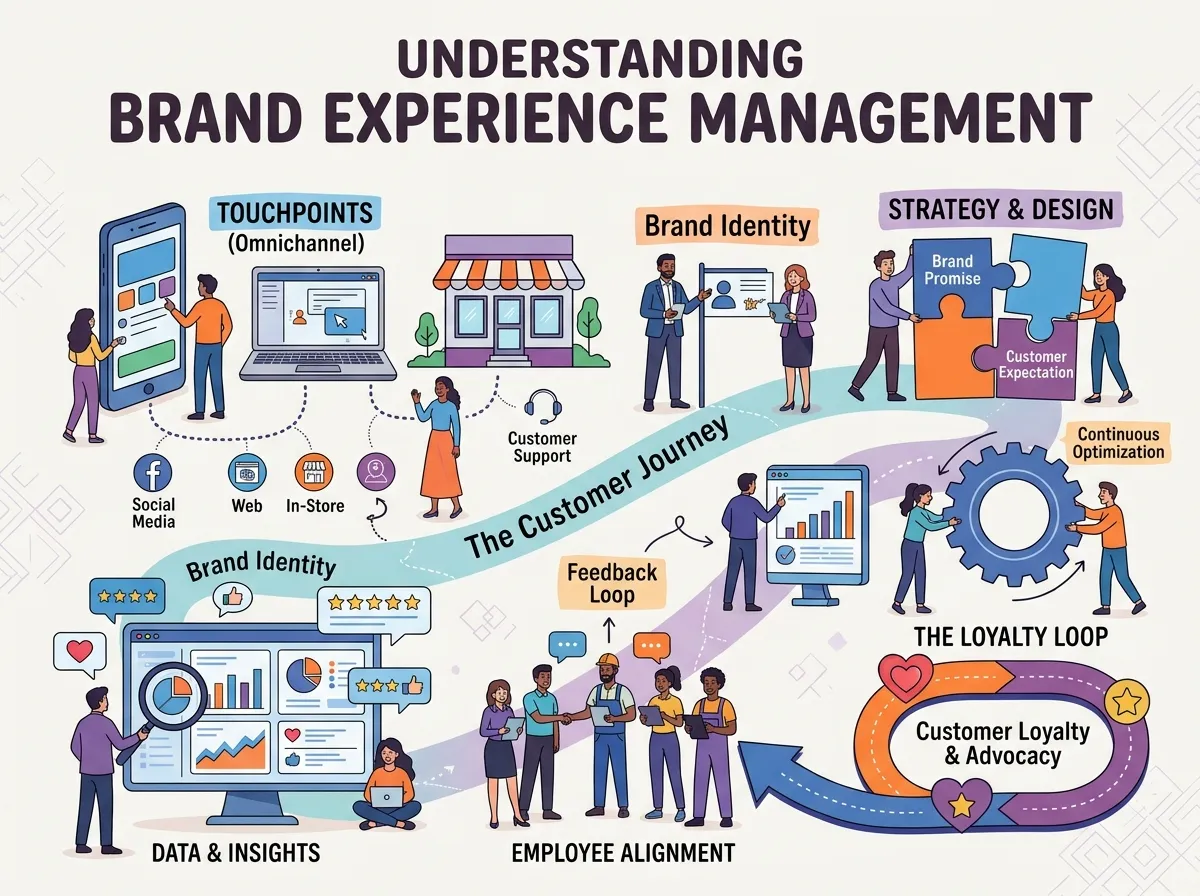
Brand Experience Management is the process of shaping and maintaining the experiences customers have with a brand throughout their relationship with a business. It involves coordinating communication, visual identity, product experiences, service quality, and customer interactions so that they support a recognizable brand promise.
Effective management begins with understanding what the brand represents and how customers experience it in practice. A company may position itself as reliable, convenient, or customer-focused, but those qualities must be reflected in its everyday operations. If a brand promises simplicity while customers struggle to navigate its website or resolve basic issues, the actual experience contradicts the intended identity.
Businesses can improve brand experience management by reviewing customer feedback, examining recurring complaints, and identifying differences between promised and delivered experiences. Marketing teams, sales representatives, support staff, and product teams should work toward shared expectations rather than treating customer interactions as separate responsibilities.
Consistency does not mean every interaction must be identical. Different customers may need different levels of support, and different channels may require different communication styles. The important factor is that each interaction reflects the same underlying values. When this alignment is maintained, customers can recognize the brand and understand what to expect from it.
Customer Brand Perception and Its Influence on Trust
Customer Brand Perception describes how people interpret a company’s identity, reputation, products, and behavior. It develops through direct experiences, recommendations, online reviews, advertising, and conversations with other customers. These impressions influence whether people consider a brand trustworthy, relevant, and worth choosing.
A business cannot completely control how customers perceive it, but it can influence perception through its actions. Honest communication, dependable product quality, accessible support, and transparent policies help create positive associations. Meanwhile, misleading claims or inconsistent service can create doubts that are difficult to overcome.
Understanding customer perception requires looking beyond what a company says about itself. Customer feedback, review patterns, brand sentiment, and common support requests can reveal whether the intended brand identity matches the experience people actually receive. These insights help businesses identify where their reputation is strong and where improvements are needed.
Marketing communication also contributes to perception. Customers often respond more positively when a brand explains its value clearly and communicates in a way that reflects their needs. Techniques related to neuromarketing in branding can help businesses understand how emotional associations, familiarity, and visual cues influence brand recognition and decision-making. Used responsibly, these insights can support clearer communication without relying on misleading promises or manipulative tactics.
Developing an Effective Brand Experience Strategy
A successful Brand Experience Strategy connects a company’s brand promise with the practical experiences customers receive. Instead of focusing only on promotional messages, it considers how the brand should feel and function throughout the entire customer relationship.
The process begins with a clear understanding of the target audience. Customers may value speed, personal assistance, product reliability, affordability, or flexibility. Businesses need to understand which factors matter most to their audience before deciding where to invest their resources. Customer interviews, surveys, purchasing data, and feedback analysis can provide useful information about these expectations.
The brand promise must then be translated into actions. A business that emphasizes convenience should make its purchasing process simple. A brand that highlights expertise should provide accurate information and knowledgeable support. When the promise is reflected in actual behavior, customers have stronger reasons to believe the brand’s claims.
A coherent strategy also requires coordination between departments. Advertising may create the first impression, sales communication may shape expectations, and customer support may determine whether those expectations are fulfilled. If each department communicates differently, the customer experience becomes fragmented.
Businesses can use a brand strategy template to organize their brand values, audience priorities, communication principles, and experience objectives. A structured approach helps teams connect strategic decisions with the customer interactions that bring the brand to life.
Customer Experience Optimization Across the Journey
Customer Experience Optimization focuses on identifying and improving the parts of the customer journey that create friction, confusion, or unnecessary effort. Even small obstacles can affect how customers evaluate a brand, particularly when they are comparing several similar businesses.
The customer journey usually includes awareness, consideration, purchase, onboarding, ongoing use, and post-purchase support. Each stage creates different expectations. During awareness, customers need clear and relevant information. During consideration, they may look for product details, comparisons, and evidence of reliability. At the purchase stage, they expect transparent pricing and a straightforward process.
After purchasing, customers need the product or service to deliver its promised value. Helpful onboarding, clear instructions, accessible assistance, and timely updates can reduce uncertainty and improve satisfaction. When customers encounter a problem, a responsive resolution process can protect trust and demonstrate that the business values the relationship beyond the initial sale.
Optimization requires businesses to identify where customers experience difficulty. Website analytics may reveal abandoned forms, while support records may show that customers repeatedly ask the same questions. Customer feedback may also indicate that return policies, delivery updates, or product instructions are unclear.
Improvements should focus on solving meaningful problems rather than adding unnecessary features. A simpler checkout process, more accurate product descriptions, or clearer support information may produce a better experience than an expensive redesign that does not address customer needs.
Strengthening the Brand-Customer Relationship
The Brand-Customer Relationship develops through repeated interactions and the trust customers place in a business. Although a single positive experience can encourage a purchase, long-term relationships usually depend on dependable performance and a sense that the company understands its customers.
Customers appreciate businesses that communicate honestly, respect their time, and respond constructively when something goes wrong. Personalization can also improve the relationship when it makes interactions more relevant. For example, businesses can provide product recommendations based on demonstrated interests or send useful updates related to a customer’s purchase.
However, personalization should be handled carefully. Customers may lose confidence when a company uses personal information in unexpected ways or sends excessive promotional messages. Clear privacy practices and meaningful communication help maintain a balance between relevance and respect.
Trust also depends on how a brand handles mistakes. Delayed deliveries, technical problems, and service failures can occur, but ignoring complaints or providing vague explanations can make the situation worse. Acknowledging the issue, explaining the available solution, and following through on commitments demonstrate accountability.
A strong brand-customer relationship is built when customers consistently see evidence that the business values their experience. Over time, that confidence can contribute to repeat purchases, positive recommendations, and a stronger reputation.
Creating a Better Customer Journey Experience

Customer Journey Experience describes how customers feel as they move through the different stages of interacting with a brand. It considers not only whether customers complete a transaction but also how easy, reassuring, and satisfying the process feels.
A well-designed journey reduces uncertainty between stages. Customers should be able to find information, understand their options, complete important tasks, and receive assistance without unnecessary complications. When the transition between marketing, sales, purchasing, and support is smooth, the brand feels more organized and dependable.
Businesses should pay particular attention to transitions between channels. A customer might discover a product through social media, visit the website for more information, contact support with a question, and later complete the purchase through a mobile device. If the information differs across these channels, the customer may need to repeat questions or reconsider the decision.
Journey mapping helps organizations understand these experiences from the customer’s perspective. It highlights the questions people ask, the actions they take, and the obstacles they encounter at each stage. This broader view can reveal problems that individual departments may overlook.
Improving the journey does not require every interaction to become highly personalized or automated. Customers often value simple, reliable processes more than complicated experiences. The objective is to make each stage clear, relevant, and connected to the next.
Brand Interaction Strategy and Meaningful Engagement
A Brand Interaction Strategy defines how a business communicates with customers across its available channels. These interactions may occur through websites, emails, social media, advertisements, physical locations, mobile applications, or direct conversations with employees.
The quality of these interactions influences whether customers view a brand as helpful and trustworthy. Clear messaging, appropriate response times, consistent visual presentation, and relevant information all contribute to a stronger experience. Customers should not feel that the company has a completely different identity whenever they move from one channel to another.
An effective interaction strategy also considers the purpose of each channel. Social media may be suitable for public conversations and quick updates, while email may work better for detailed information. Customer support channels should make it easy to explain a problem and receive a useful response.
Communication should be based on customer needs rather than the company’s desire to remain constantly visible. Excessive notifications, repetitive offers, and irrelevant messages can create frustration. Thoughtful timing and useful content are more likely to support meaningful engagement.
Businesses should also ensure that their communication encourages a genuine two-way relationship. Inviting feedback, answering questions, and using customer suggestions to improve products can make people feel that their opinions matter. When interactions are relevant and respectful, customers are more likely to develop a positive connection with the brand.
Maintaining Customer Experience Consistency
Customer Experience Consistency means delivering a dependable standard of quality and communication across different interactions. Customers want to know that a brand will meet its commitments whether they contact the company online, visit a physical location, or request assistance after a purchase.
Consistency begins with clear internal expectations. Employees need to understand the brand’s values, service standards, communication style, and approach to resolving customer concerns. Without shared expectations, individual departments may develop conflicting processes that create uneven experiences.
Consistent communication is equally important. Product descriptions, pricing information, promotional messages, and service policies should remain accurate across channels. If a website makes a promise that the support team cannot honor, customers may question the company’s reliability.
Maintaining consistency does not mean removing flexibility. Employees should be able to adapt their responses to individual circumstances while following the same core principles. This balance allows a business to provide personal assistance without weakening its overall identity.
Regular reviews can help identify inconsistencies before they become larger problems. Comparing customer feedback across channels, checking the accuracy of published information, and evaluating service outcomes can reveal areas where the experience needs improvement.
Brand Loyalty and Customer Satisfaction
Brand Loyalty and Customer Satisfaction are closely connected, but they represent different aspects of the customer relationship. Satisfaction reflects how well a product, service, or interaction meets expectations. Loyalty describes a customer’s willingness to continue choosing a brand over time.
A satisfied customer may still switch to another business if a competitor offers better value or greater convenience. Lasting loyalty generally requires a combination of dependable quality, relevant benefits, trust, and positive experiences that make continued engagement worthwhile.
Customer satisfaction can be strengthened by delivering products as promised, providing accurate information, and resolving issues efficiently. Loyalty develops when these experiences are repeated and customers gain confidence that the brand will continue to meet their needs.
Businesses should avoid assuming that repeat purchases automatically indicate strong emotional loyalty. Customers may return because switching is difficult, not because they feel connected to the brand. Feedback, repeat-purchase patterns, referral behavior, and customer retention trends can help organizations understand the strength of these relationships.
Companies can also encourage loyalty by recognizing returning customers, offering genuinely useful benefits, and maintaining communication after a transaction. These efforts are most effective when they support a good underlying experience rather than attempting to compensate for poor service.
The Importance of Brand Touchpoint Management
Brand Touchpoint Management involves identifying and coordinating the points where customers encounter a business. These touchpoints include advertisements, search results, product packaging, websites, sales conversations, invoices, delivery notifications, and customer support interactions.
Every touchpoint contributes to the overall impression of a brand. Some interactions create awareness, while others build confidence or influence purchasing decisions. A confusing payment page, for instance, can undermine the positive impression created by an effective advertising campaign.
Businesses need to understand which touchpoints matter most to their customers and how those interactions connect. Reviewing the entire experience can reveal gaps between departments, inconsistent information, and opportunities to reduce friction.
Touchpoint management also benefits from a clear understanding of the competitive environment. Competitive brand analysis can help businesses examine how other brands communicate their value, serve their audiences, and differentiate their experiences. These findings can inform improvement opportunities without encouraging companies to imitate competitors or abandon their own identity.
The objective is to create a connected experience in which each interaction supports the same brand promise. When customers receive accurate information and dependable service at important touchpoints, the business becomes easier to understand and trust.
Measuring and Improving Brand Customer Experience

Businesses need meaningful ways to evaluate whether their brand customer experience is improving. Customer satisfaction surveys, Net Promoter Score, customer effort measures, retention rates, repeat-purchase data, and complaint trends can provide different perspectives on performance.
No single metric captures the entire experience. Satisfaction scores may show how customers feel after an interaction, while retention data can indicate whether they continue choosing the brand. Qualitative feedback helps explain why these patterns occur and what changes customers would value.
Marketing performance can also offer useful context. Conversion data may reveal whether customers respond to a particular message or find the purchasing process easy to complete. Businesses can connect these findings with broader marketing conversion insights to understand how the experience influences customer decisions.
Measurement should lead to practical improvements. If customers frequently abandon a process because information is unclear, the business can revise the content and monitor whether completion rates improve. If complaints repeatedly concern slow support, it can investigate staffing, training, or workflow issues.
Continuous improvement works best when teams review evidence regularly, prioritize the most important customer problems, and evaluate the results of their changes. This approach keeps brand customer experience connected to real customer needs instead of relying on assumptions.
Conclusion
Brand customer experience is a central part of building a recognizable, trustworthy, and successful business. It connects brand identity with the everyday interactions that shape customer perceptions, satisfaction, and loyalty. Effective brand experience management, a clear strategy, consistent communication, and thoughtful touchpoint coordination help businesses deliver on their promises.
By understanding the customer journey, addressing friction, respecting customer preferences, and measuring meaningful outcomes, organizations can strengthen relationships and create experiences that encourage customers to return. The most effective approach is not necessarily the most complicated one. It is the approach that consistently makes the brand easier to understand, easier to interact with, and more dependable in the eyes of its customers.
Frequently Asked Questions
1. What is brand customer experience?
Brand customer experience is the overall impression customers form through their interactions with a business. It includes marketing communication, product quality, purchasing processes, customer service, and post-purchase support. Together, these experiences influence how customers perceive and remember a brand.
2. Why is brand customer experience important?
It helps businesses build trust, improve customer satisfaction, and encourage repeat purchases. A positive experience can also strengthen a company’s reputation and make customers more willing to recommend its products or services.
3. What is the difference between brand experience and customer experience?
Brand experience focuses on how customers perceive and emotionally connect with a brand, while customer experience covers the broader journey of interacting with the business. The two overlap because every customer interaction can influence brand perception.
4. How can businesses improve brand experience management?
Businesses can improve brand experience management by aligning their brand promises with actual service delivery, coordinating departments, analyzing customer feedback, and maintaining consistent communication across channels.
5. What role does customer brand perception play in purchasing decisions?
Customer brand perception influences how people evaluate a company’s credibility, quality, relevance, and value. Positive perceptions can increase confidence in a purchase, while negative perceptions may cause customers to consider alternatives.
6. How does a brand experience strategy improve customer loyalty?
A brand experience strategy helps ensure that customer interactions consistently reflect the company’s values and promises. When customers receive dependable quality and useful support, they have stronger reasons to continue choosing the brand.
7. Which metrics are useful for measuring brand customer experience?
Useful metrics include customer satisfaction scores, Net Promoter Score, customer effort scores, retention rates, repeat-purchase rates, complaint trends, and customer feedback. Businesses should combine quantitative measurements with qualitative insights for a more complete understanding.
8. How does customer experience consistency affect brand trust?
Consistency helps customers understand what to expect from a business. When communication, product quality, and service remain dependable across channels, customers are more likely to view the brand as reliable.
9. What is brand touchpoint management?
Brand touchpoint management is the process of coordinating the interactions through which customers encounter a brand. It helps businesses identify inconsistencies, improve important moments in the customer journey, and deliver a connected experience.
10. How can small businesses create a better brand customer experience?
Small businesses can focus on clear communication, reliable products, responsive customer service, simple purchasing processes, and honest policies. Listening to feedback and resolving recurring problems can improve the experience without requiring a large budget.