Emotional Marketing: Build Customer Connections & Loyalty

Emotional marketing helps brands connect with customers by appealing to feelings, values, memories, and personal experiences. By using emotional storytelling, authentic branding, relatable messages, and meaningful campaigns, businesses can create stronger customer relationships, improve brand recognition, and encourage long-term loyalty.
People do not make every purchasing decision based only on price, features, or practical benefits. Emotions often influence how customers perceive brands, remember advertising messages, and decide whether a product or service feels right for them. This is why emotional marketing has become an important part of modern brand communication.
Emotional marketing focuses on creating feelings that make customers connect with a brand on a deeper level. These feelings can include happiness, trust, excitement, nostalgia, belonging, inspiration, empathy, or even concern. When a marketing message successfully creates an emotional response, customers may be more likely to remember the brand and develop a stronger relationship with it.
A successful emotional marketing strategy does not simply try to make people feel something for the sake of getting attention. Instead, it connects emotions with a brand’s identity, customer needs, and overall message. When the approach is authentic, emotional marketing can strengthen brand loyalty while making campaigns more memorable.
What Is Emotional Marketing?
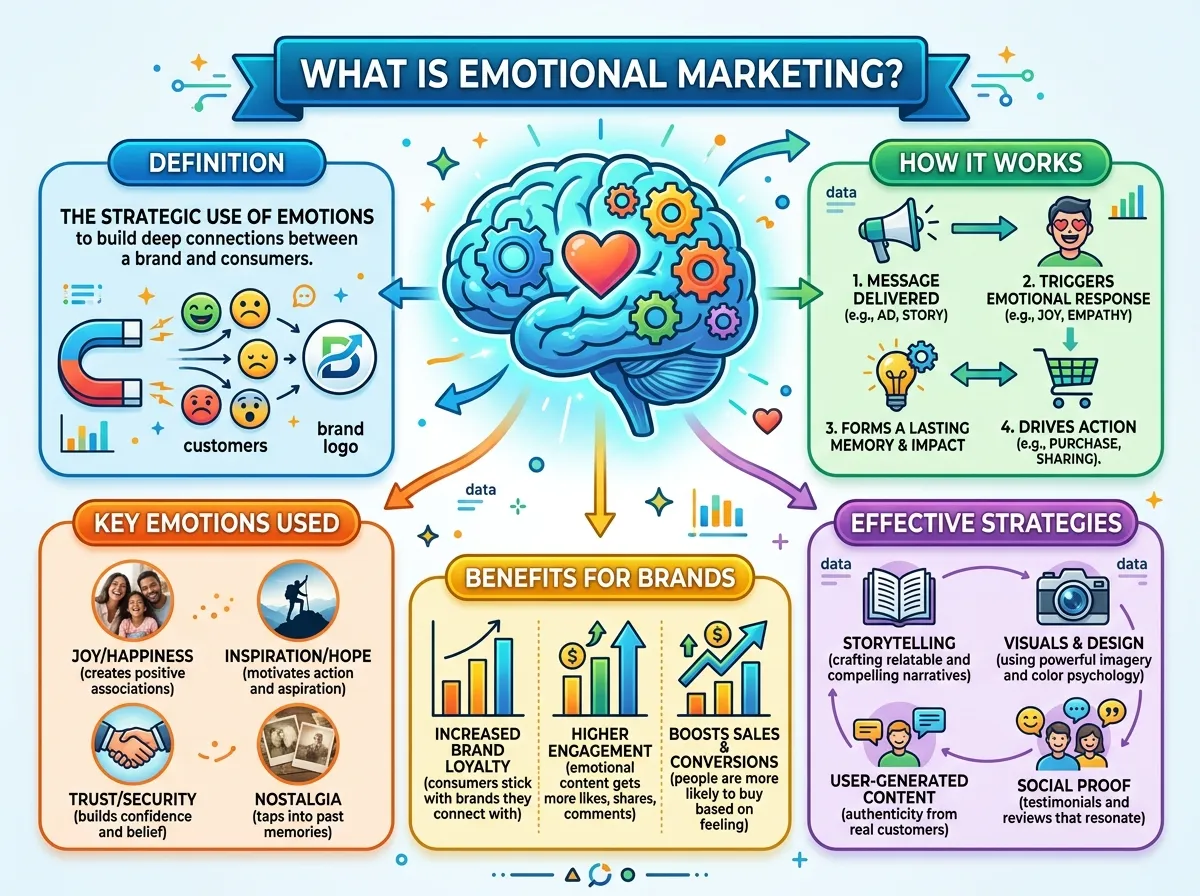
Emotional marketing is a marketing approach that uses human emotions to influence how customers perceive, remember, and respond to a brand. Rather than focusing entirely on product specifications, emotional campaigns communicate stories, experiences, values, and ideas that customers can personally relate to.
For example, a brand may focus on family, friendship, achievement, personal growth, community, or overcoming challenges instead of simply explaining what its product does. The product remains important, but the emotional meaning surrounding it becomes part of the customer experience.
The most effective emotional marketing techniques are usually connected to genuine customer experiences. A campaign that reflects something people already care about can feel more natural and memorable than advertising that relies entirely on promotional language.
Why Emotional Marketing Matters for Brands
Customers are exposed to a large amount of advertising every day. Many promotional messages compete for attention, making it difficult for brands to become memorable. Emotional communication provides an opportunity to create a stronger impression by giving customers something meaningful to remember.
An effective emotional branding strategy can help a business establish a recognizable personality and create consistency across its marketing channels. When customers repeatedly experience similar values and emotions from a brand, they may begin to associate those feelings with the company itself.
Emotional connections can also influence customer loyalty. When customers feel that a brand understands their needs, values, or aspirations, they may be more willing to choose that brand again. This relationship can become particularly valuable in competitive markets where several businesses offer similar products or services.
Brand structure also plays an important role in maintaining this consistency. A thoughtful approach to Brand Architecture can help businesses organize their brands and messaging while creating a clearer identity for different audiences.
Creating an Emotional Branding Strategy
A strong emotional branding strategy begins with understanding the people behind the purchasing decisions. Businesses need to know what their customers care about, what problems they experience, what motivates them, and what kinds of experiences they value.
This understanding allows brands to develop messages that feel relevant instead of generic. A company selling fitness products, for example, could focus on confidence, progress, personal achievement, and overcoming obstacles rather than communicating only product specifications.
Brand personality also affects emotional communication. A playful brand may use humor and excitement, while a premium company may emphasize confidence, exclusivity, or sophistication. Businesses can use a Brand Personality Assessment to better understand how their personality is perceived and how it can be expressed consistently.
The goal is to ensure that emotional messaging feels like a natural extension of the brand rather than an advertising technique added afterward.
Emotional Appeal in Marketing
Emotional appeal in marketing involves creating messages that connect with feelings rather than relying entirely on logic. Different audiences may respond to different emotional triggers, so businesses should understand which emotions are most relevant to their customers.
Happiness can be effective for brands that want to associate their products with positive experiences. Trust is particularly important for financial, healthcare, technology, and professional services. Inspiration can work well for education, fitness, personal development, and lifestyle brands.
Nostalgia can also create powerful associations by reminding customers of familiar experiences, traditions, or memories. Meanwhile, empathy can help businesses demonstrate that they understand customer challenges.
The most effective emotional appeals usually support a clear brand message. Emotion should strengthen the meaning of the campaign instead of distracting customers from what the brand actually offers.
Emotional Storytelling in Marketing
Stories are naturally suited to emotional communication because they give audiences context, characters, challenges, and outcomes. Emotional storytelling in marketing allows brands to communicate their values through experiences rather than simply making claims.
A story about a customer overcoming an obstacle can communicate the usefulness of a product while also creating an emotional connection. Similarly, a story about a company’s purpose can help customers understand why the business exists beyond making sales.
Strong storytelling often focuses on relatable experiences. The customer does not necessarily need to see themselves in exactly the same situation. Instead, they should recognize an emotion, challenge, goal, or value that feels familiar.
This approach can make marketing messages easier to remember because customers are responding to a narrative rather than processing another straightforward sales statement.
Building an Emotional Connection With Customers
An emotional connection with customers develops over time. One advertisement may create an initial reaction, but consistent experiences are usually necessary to build long-term relationships.
Every customer interaction can contribute to this connection, including website content, social media communication, customer service, packaging, email campaigns, and advertising. When these experiences consistently communicate the same values, customers can develop stronger expectations and associations around the brand.
Authenticity is especially important. Customers may become skeptical when brands use emotional subjects purely as promotional tools. Businesses should therefore make sure that emotional messaging reflects their actual behavior and values.
A company that communicates empathy in its advertising but provides poor customer service creates a disconnect. In contrast, when the customer experience supports the emotional message, the relationship becomes more credible.
Consumer Emotions in Marketing
Understanding consumer emotions in marketing requires more than identifying whether people feel positive or negative. Different emotions can produce different reactions, and the same emotional message may affect audiences differently depending on context.
For example, excitement can encourage immediate engagement, while trust may support long-term decision-making. Curiosity can encourage people to explore additional information, while belonging can strengthen community and loyalty.
Businesses can learn about these emotional responses through customer feedback, audience research, reviews, social conversations, and campaign performance. This information can help marketers understand what messages resonate and which ones feel disconnected.
Emotional insights should complement other forms of customer research rather than replace them. Combining emotional understanding with demographic, behavioral, and purchasing information creates a more complete picture of the target audience.
Emotional Marketing Campaigns

Successful emotional marketing campaigns usually have a clear connection between the brand, audience, and emotional theme. The strongest campaigns do not simply attach an emotional story to a product. They make the emotion relevant to the brand’s purpose.
A campaign centered on community, for instance, should demonstrate how the brand genuinely contributes to that community. A campaign focused on personal achievement should show how the brand supports customers in reaching meaningful goals.
Visual content, video, social media, email, influencer partnerships, and other channels can all support emotional campaigns. However, the platform should match the audience and the type of story being communicated.
Influencer partnerships can be particularly effective when creators already have authentic relationships with their audiences. Measuring The ROI of Influencer Marketing can help businesses understand whether emotional creator partnerships are contributing to meaningful brand and business outcomes.
Emotional Advertising Strategy
An emotional advertising strategy can be used across different advertising formats, including video ads, social media advertisements, display campaigns, search campaigns, and sponsored content.
Video is particularly useful for emotional advertising because it combines visuals, sound, expressions, dialogue, and storytelling. These elements can create a stronger sense of atmosphere than text alone.
However, emotional advertising does not necessarily require dramatic storytelling. A simple message, relatable situation, humorous moment, or authentic customer experience can create a strong response when it is relevant to the audience.
The key is balance. Emotional advertising should still make the brand, product, or service clear. If customers remember the story but cannot remember which company created it, the campaign may have generated attention without achieving its branding objective.
Using Emotional Marketing Techniques Effectively
Different emotional marketing techniques can support different campaign objectives. Storytelling can help brands communicate purpose and experiences. Personalization can make messages feel more relevant. Social proof can create confidence and trust. Humor can increase memorability and engagement when appropriate.
Visual identity is another important factor. Colors, imagery, typography, photography, and video style can influence how people interpret a brand’s personality.
Consistency matters because emotional associations become stronger when customers repeatedly encounter recognizable signals. A brand that constantly changes its tone may find it difficult to establish a clear emotional identity.
Emotional Marketing Examples in Practice
There are many emotional marketing examples across industries. A family-oriented brand may build campaigns around togetherness and shared memories. A fitness company may focus on personal transformation and confidence. A nonprofit may emphasize empathy and community impact. A technology company may focus on innovation, possibility, or empowerment.
Retail brands often use excitement, anticipation, and belonging around major launches or seasonal campaigns. Travel companies may use freedom, adventure, discovery, and memorable experiences. Financial brands may emphasize security, confidence, and future planning.
The strongest examples share one characteristic: the emotion is connected to something meaningful about the customer experience. The campaign does not rely on emotion alone. Instead, emotion gives the product or service a deeper context.
Emotional Marketing and Competitive Positioning
Emotional marketing can also help brands differentiate themselves when competitors offer similar products or services. Functional features can often be copied, while a distinctive brand personality and emotional relationship can be more difficult to replicate.
A Competitive Brand Analysis can help businesses understand how competitors communicate, what emotional themes they use, and where opportunities exist for differentiation. By identifying gaps in the market, brands can create emotional positioning that feels distinctive rather than repeating familiar industry messages.
This is especially important in crowded industries where customers have many similar choices. A clear emotional identity can give customers another reason to remember and prefer a particular brand.
Measuring the Effectiveness of Emotional Marketing
Although emotions can feel difficult to measure, businesses can evaluate emotional marketing through a combination of qualitative and quantitative signals. Engagement, brand searches, social interactions, customer feedback, repeat purchases, conversions, and brand sentiment can all provide useful information.
Customer comments can be particularly valuable because they reveal how people describe a campaign or brand in their own words. Businesses can look for patterns in language, sentiment, and recurring associations.
Long-term measurements can also reveal whether emotional campaigns contribute to stronger brand loyalty. A campaign may not produce immediate sales but can still increase brand awareness, recognition, or consideration.
The most useful evaluation approach connects emotional indicators with business objectives. This allows marketers to understand not only whether audiences reacted emotionally but also whether that reaction supported meaningful business outcomes.
The Future of Emotional Marketing
As marketing becomes increasingly personalized and data-driven, emotional marketing remains valuable because people continue to respond to stories, relationships, identity, and experiences. Technology can help brands deliver more relevant messages, but relevance still depends on understanding human motivations.
Brands that combine data with genuine empathy can create experiences that feel both personalized and authentic. The challenge is to avoid making emotional communication feel manipulative or overly calculated.
The future of emotional marketing will therefore depend on authenticity, consistency, relevance, and a strong understanding of customer expectations. Businesses that can connect their products with meaningful customer experiences are more likely to build relationships that extend beyond individual transactions.
Conclusion
Emotional marketing gives brands an opportunity to connect with customers through feelings, stories, values, and experiences. A strong emotional marketing strategy can make campaigns more memorable while supporting stronger brand recognition, customer loyalty, and long-term relationships.
From emotional storytelling and advertising to brand personality and customer experience, emotional communication can influence how people perceive a business. The most successful approach is not about creating emotion artificially. It is about understanding customers and communicating something that genuinely matters to them.
When emotional messaging is supported by an authentic brand identity and consistent customer experience, businesses can create connections that go beyond a single purchase and become an important part of long-term brand growth.
Frequently Asked Questions
1. What is emotional marketing?
Emotional marketing is a marketing approach that uses feelings, experiences, values, and stories to connect with customers. Instead of focusing only on product features, it communicates messages designed to create emotions such as trust, happiness, excitement, nostalgia, empathy, or inspiration.
2. Why is emotional marketing important?
Emotional marketing is important because emotions can influence how customers remember brands and evaluate purchasing decisions. When customers develop a positive emotional association with a business, they may be more likely to engage with the brand, remember its campaigns, and remain loyal over time.
3. What are common emotional marketing techniques?
Common emotional marketing techniques include storytelling, humor, nostalgia, personalization, empathy, inspirational messaging, community-focused campaigns, customer stories, and visual communication. The best technique depends on the brand, audience, industry, and campaign objective.
4. How does emotional branding differ from traditional branding?
Traditional branding may focus heavily on identity, positioning, recognition, and functional benefits, while emotional branding places greater emphasis on feelings and relationships. Emotional branding connects brand characteristics with experiences and emotions that customers can recognize and relate to.
5. What emotions work best in marketing?
There is no single emotion that works best for every brand. Happiness, trust, excitement, inspiration, nostalgia, curiosity, empathy, and belonging can all be effective when they are relevant to the audience. The appropriate emotion should support the brand’s message and customer expectations.
6. How does emotional storytelling help marketing?
Emotional storytelling gives customers a narrative that they can understand and remember. Stories can communicate challenges, motivations, values, and outcomes in a way that feels more personal than a straightforward promotional message. This can help strengthen brand recognition and engagement.
7. Can emotional marketing increase customer loyalty?
Yes, emotional marketing can contribute to customer loyalty when the emotional message is supported by a positive customer experience. Customers may develop stronger relationships with brands that consistently demonstrate values and experiences that matter to them.
8. Is emotional marketing suitable for B2B businesses?
Yes. B2B purchasing decisions involve people, and business buyers can still respond to emotions such as trust, confidence, security, achievement, and belonging. B2B brands can use customer stories, leadership content, case studies, and purpose-driven communication to create meaningful emotional connections.
9. How can businesses measure emotional marketing?
Businesses can measure emotional marketing through engagement, customer feedback, sentiment, brand searches, social interactions, repeat purchases, conversions, and other brand-performance indicators. Combining quantitative data with qualitative customer feedback provides a stronger understanding of campaign impact.
10. What makes an emotional marketing campaign successful?
A successful emotional marketing campaign connects a genuine customer emotion with a clear brand purpose. It should feel authentic, relevant, memorable, and consistent with the overall customer experience. The emotional message should also make the brand or product meaningful rather than becoming an unrelated story.