Brand Licensing Rights: Protecting IP and Partnerships

Brand licensing rights determine how businesses, partners, and third parties can legally use a brand’s name, logo, trademarks, and other intellectual property. Clear licensing agreements establish ownership, permitted activities, payment terms, quality standards, and restrictions. Effective rights management protects brand identity while creating opportunities for commercial partnerships, product development, and market expansion. By understanding licensing terms and maintaining proper oversight, organizations can balance commercial growth with brand protection.
The Value Behind a Brand Name

A recognizable brand represents far more than a name or visual identity. It reflects customer expectations, market reputation, intellectual property, and the trust a business has developed over time. When another company wants to use that identity on products, promotional materials, digital platforms, or commercial services, the arrangement requires clear boundaries. This is where brand licensing rights become important.
Brand licensing allows a business to authorize another party to use specific intellectual property under agreed conditions. The arrangement can help a brand reach new audiences, enter unfamiliar markets, and generate revenue without managing every product or service directly. For the licensee, it offers an opportunity to benefit from an established identity while developing its own commercial offering.
However, granting permission to use a brand also introduces potential risks. Unauthorized applications, poor-quality products, misleading promotions, and unclear ownership terms can damage reputation or create legal disputes. A successful licensing relationship therefore depends on more than signing an agreement. Both parties need a shared understanding of what is permitted, how the brand must be represented, and what happens when the agreement ends.
Understanding licensing rights helps businesses protect their intellectual property while using it strategically. It creates a foundation for partnerships that support growth without sacrificing the consistency and credibility that make a brand valuable.
What Brand Licensing Rights Actually Cover
Brand licensing rights define the scope of permission granted to another party to use protected brand assets. These assets may include trademarks, logos, business names, slogans, product designs, characters, visual elements, and other intellectual property, depending on what the owner possesses and what the agreement covers.
The rights are not automatically unlimited. A company might authorize a manufacturer to place its logo on a particular product line while prohibiting use of that logo in unrelated advertising. Another agreement might allow a distributor to promote products in a specific territory but restrict sales through certain channels.
These distinctions matter because permission for one activity does not necessarily authorize every other use. A partner allowed to reproduce a logo on packaging may not have the right to modify it, register a similar trademark, sublicense it to another business, or use it after the agreement expires.
Licensing rights should also be distinguished from ownership. In a typical licensing arrangement, the intellectual property owner retains ownership while allowing another party to use specified assets under agreed conditions. The licensee receives permission within the defined scope, not automatic ownership of the underlying brand.
The exact legal position depends on the relevant intellectual property, contract wording, and applicable jurisdiction. For this reason, businesses should identify the assets being licensed and describe the permitted uses precisely instead of relying on broad statements that leave room for interpretation.
The Business Logic Behind Brand Licensing
Brand licensing can turn intellectual property into a commercial asset without requiring the owner to operate every part of a new business opportunity. A company with a well-established reputation might license its brand to a manufacturer that has the production capabilities, distribution relationships, or market knowledge needed to develop a new product category.
The arrangement can create value for both sides. The owner may receive royalties, fixed licensing fees, or other agreed compensation. The licensee can benefit from consumer recognition and a more established market identity than it might have achieved independently.
Licensing can also support international expansion. A local partner may understand regional consumer preferences, distribution networks, and commercial practices better than the brand owner. With suitable territorial restrictions and quality controls, licensing can make expansion more manageable.
Yet commercial opportunity should not be confused with guaranteed success. An unsuitable partner can misuse brand assets, produce inconsistent products, or create customer expectations that the business cannot meet. The potential financial return must therefore be evaluated alongside the operational and reputational risks.
Strong licensing arrangements connect commercial objectives with clear rights, measurable obligations, and ongoing oversight. This balance allows businesses to explore new revenue opportunities while retaining appropriate control over their brand identity.
Building Effective Brand Licensing Agreements
A brand licensing agreement turns a commercial understanding into a documented set of rights and responsibilities. It should explain what is being licensed, who can use it, how the permission operates, and the conditions that apply throughout the relationship.
The licensed assets need to be identifiable. This may involve specifying trademark registrations, approved logos, product categories, design files, or other protected materials. The agreement should also describe the authorized activities, such as manufacturing, advertising, distribution, merchandising, or digital promotion.
Territory and duration are equally important. A license might apply to one country, several markets, or a defined online sales territory. Its duration may be fixed, renewable, or subject to performance conditions. If the parties intend to grant exclusive rights, they should define what exclusivity means and whether the owner retains any rights to use the brand independently.
Financial provisions typically explain royalty calculations, payment schedules, reporting obligations, minimum guarantees where applicable, and the handling of returns or other adjustments. The agreement may also establish procedures for reviewing sales records and verifying payments.
Quality control deserves particular attention. Since customers associate licensed products with the original brand, the owner may need approval rights over product designs, packaging, promotional materials, and manufacturing standards. The agreement should explain how samples are submitted, how changes are approved, and how noncompliant products are handled.
Finally, termination provisions should address expired permissions, unsold inventory, remaining promotional materials, and the removal of brand assets from relevant platforms. Clear terms reduce uncertainty and help both parties understand their responsibilities from the beginning.
Trademark Licensing Rights and Intellectual Property Protection

Trademarks help distinguish a business’s products or services from those of other organizations. They may include names, logos, symbols, slogans, or other identifiers that qualify for protection under applicable law. When these assets are licensed, the agreement should preserve their distinctiveness and prevent uses that could mislead consumers.
Trademark licensing rights define how another party may use the licensed marks. These rights can be limited by product type, territory, sales channel, advertising format, or duration. The agreement may also require the licensee to follow brand standards and avoid changes that weaken the mark’s recognizable identity.
Trademark ownership and protection vary across jurisdictions. Businesses should verify relevant registrations, renewal requirements, and territorial coverage before entering licensing arrangements. A trademark registered in one country may not provide the same protection in another, making international licensing particularly important to review carefully.
Other intellectual property may require separate consideration. Copyright can protect qualifying creative materials, including certain illustrations, photographs, videos, and designs. Patents may apply to inventions, while design rights can protect eligible product appearances. A brand licensing agreement should not assume that permission to use one asset automatically covers every other right associated with a product or campaign.
Businesses exploring emerging markets and digital environments may also need to consider how brand identity operates across new platforms. Discussions about Web3 Branding illustrate why brands should consider the context in which their identity is used, particularly when digital assets, virtual environments, or decentralized platforms introduce unfamiliar forms of commercial activity.
A clear understanding of intellectual property ownership makes it easier to grant appropriate permissions, prevent unauthorized use, and preserve the commercial value of the brand.
Brand Usage Rights Across Marketing and Digital Channels
A licensing arrangement may extend beyond physical products. Partners might use a brand’s identity in websites, social media campaigns, advertisements, email promotions, marketplace listings, packaging, or event materials. Each channel can introduce different requirements and potential risks.
Brand usage rights should therefore explain how approved assets may appear across relevant communication channels. These rules can address logo placement, color variations, minimum image quality, surrounding text, prohibited modifications, and the relationship between the licensed brand and the licensee’s own identity.
Digital environments require particular attention because content can be copied, shared, edited, and distributed rapidly. A licensee may publish approved campaign materials on one platform but unintentionally reuse them elsewhere without authorization. Similarly, a promotional partnership may end while old graphics remain visible on websites or social profiles.
Businesses can reduce these problems by maintaining approved asset libraries, clear usage instructions, and a documented review process. Partners should know where to obtain current logos, which versions are authorized, and whom to contact when a proposed use falls outside the existing agreement.
Naming and identity decisions also affect how licensing assets are perceived. Before extending a brand into new products or partnerships, businesses can benefit from careful Brand Naming Research to evaluate distinctiveness, suitability, and potential conflicts. This is especially relevant when a licensed product line introduces a new name alongside an existing trademark.
Consistent usage rules protect recognition across channels and help prevent individual partners from developing incompatible interpretations of the same identity.
Understanding Brand Licensing Terms and Financial Structures
Licensing terms determine the commercial conditions under which brand assets can be used. Although agreements vary considerably, several common financial structures influence how the parties share costs, revenue, and risk.
A royalty-based arrangement typically pays the brand owner a percentage of qualifying sales or another defined financial measure. A fixed-fee arrangement instead uses an agreed payment for a specified license or period. Some agreements combine different approaches, such as an initial fee, ongoing royalties, and a minimum payment requirement.
The wording used to calculate payments is critical. The parties should define the relevant sales base, permitted deductions, reporting frequency, currency, payment deadlines, and procedures for correcting errors. Vague language can create disputes when the licensee and owner interpret revenue or deductions differently.
Financial terms also need to reflect the commercial realities of the licensed product. A licensee may incur manufacturing, marketing, distribution, and compliance costs before the arrangement becomes profitable. The brand owner, meanwhile, needs reasonable visibility into sales and enough information to assess whether the license is delivering the expected return.
Performance obligations may form part of the agreement. For example, a licensee could be required to meet minimum sales thresholds, launch products by a particular date, or maintain specified distribution standards. If these conditions are not achieved, the agreement may allow renegotiation, a change in exclusivity, or termination.
The most effective terms create a workable commercial relationship rather than simply maximizing short-term payments. Both parties should understand the financial model and have a reliable way to verify compliance with it.
Licensing Permission Management and Brand Asset Control
As organizations work with more distributors, agencies, manufacturers, and commercial partners, tracking permissions can become difficult. Different partners may hold separate licenses with different expiration dates, approved products, territories, and usage restrictions.
Licensing permission management brings this information into a structured system. Instead of relying exclusively on contracts stored in separate folders, businesses can maintain a central record of who has permission to use each asset, the purpose of the authorization, and the conditions attached to it.
A permission register can include the licensee’s name, agreement reference, covered assets, approved channels, territory, duration, renewal dates, and relevant approval contacts. Where appropriate, it can also record royalty reporting deadlines and compliance review dates.
Asset management is another essential component. Partners should receive current, approved versions of brand materials rather than locating logos or graphics independently online. A centralized library can identify authorized files and prevent outdated designs from circulating after a brand refresh.
Businesses should also document exceptions. A one-time permission for a campaign, for example, should not be interpreted as ongoing authorization for future projects. Written approvals help establish the boundaries of such exceptions and make them easier to review later.
These practices connect closely with broader Brand Permissions management, where clear authorization procedures help businesses protect brand assets and maintain consistent use. The objective is to make permission status visible, reduce accidental misuse, and ensure that every partner operates within the agreed scope.
Commercial Brand Licensing and Partnership Opportunities
Commercial brand licensing can support expansion into new product categories, distribution networks, and customer segments. It is frequently used when one company owns valuable intellectual property while another has the manufacturing, retail, entertainment, or service capabilities required to commercialize it.
The arrangement can be particularly useful when direct expansion would require significant investment. Rather than building new production facilities or distribution operations, the brand owner may work with a licensee that already possesses the necessary infrastructure.
However, selecting a partner involves more than reviewing its financial offer. Businesses should consider the potential licensee’s reputation, operational capacity, quality standards, market knowledge, and willingness to follow brand requirements. The partner’s conduct can influence how customers perceive the licensed brand, even when the owner does not manage day-to-day operations.
The intended audience and customer experience should also remain consistent with the brand’s positioning. A partnership that generates short-term revenue but confuses customers or weakens perceived quality may undermine longer-term brand value.
This is where brand rituals and recurring customer experiences can become relevant. Consistent service, packaging, communication, and product presentation help customers recognize what the brand represents. The principles behind Brand Rituals show why repeatable experiences can strengthen familiarity and loyalty. Licensed products should support, rather than contradict, the expectations customers already associate with the brand.
A successful commercial license creates value for both parties while preserving the identity and reputation that make the partnership attractive in the first place.
Brand License Compliance and Ongoing Oversight
Signing an agreement establishes the rules, but ongoing oversight helps ensure that the parties continue to follow them. Brand license compliance involves checking whether the licensee uses authorized assets, meets contractual obligations, follows quality requirements, and respects applicable legal restrictions.
Reviews may cover product samples, packaging, advertising materials, sales records, distribution channels, and public-facing digital content. The appropriate level of oversight depends on the nature of the license, the risks involved, and the requirements written into the agreement.
A documented approval process helps prevent unauthorized materials from reaching customers. When a licensee proposes a new design or promotional campaign, the responsible team should be able to identify who reviews the material, what standards apply, and how approval is recorded.
Monitoring should also consider changes in circumstances. A partner may expand into a new territory, launch a different product category, or begin using the brand on a new platform. These changes may fall outside the original license and require written authorization or an amendment.
If a problem occurs, the agreement should provide a clear way to respond. Depending on the circumstances and applicable law, the response may involve requesting corrective action, suspending a particular use, resolving a payment discrepancy, or pursuing contractual remedies. Not every mistake requires the same response, so procedures should be proportionate to the issue.
Consistent oversight protects both parties. The licensee gains clarity about acceptable practices, while the brand owner can identify problems before they become widespread. It also creates a record of approvals, corrections, and decisions that may be important if a dispute arises.
Common Risks in Brand Rights Management
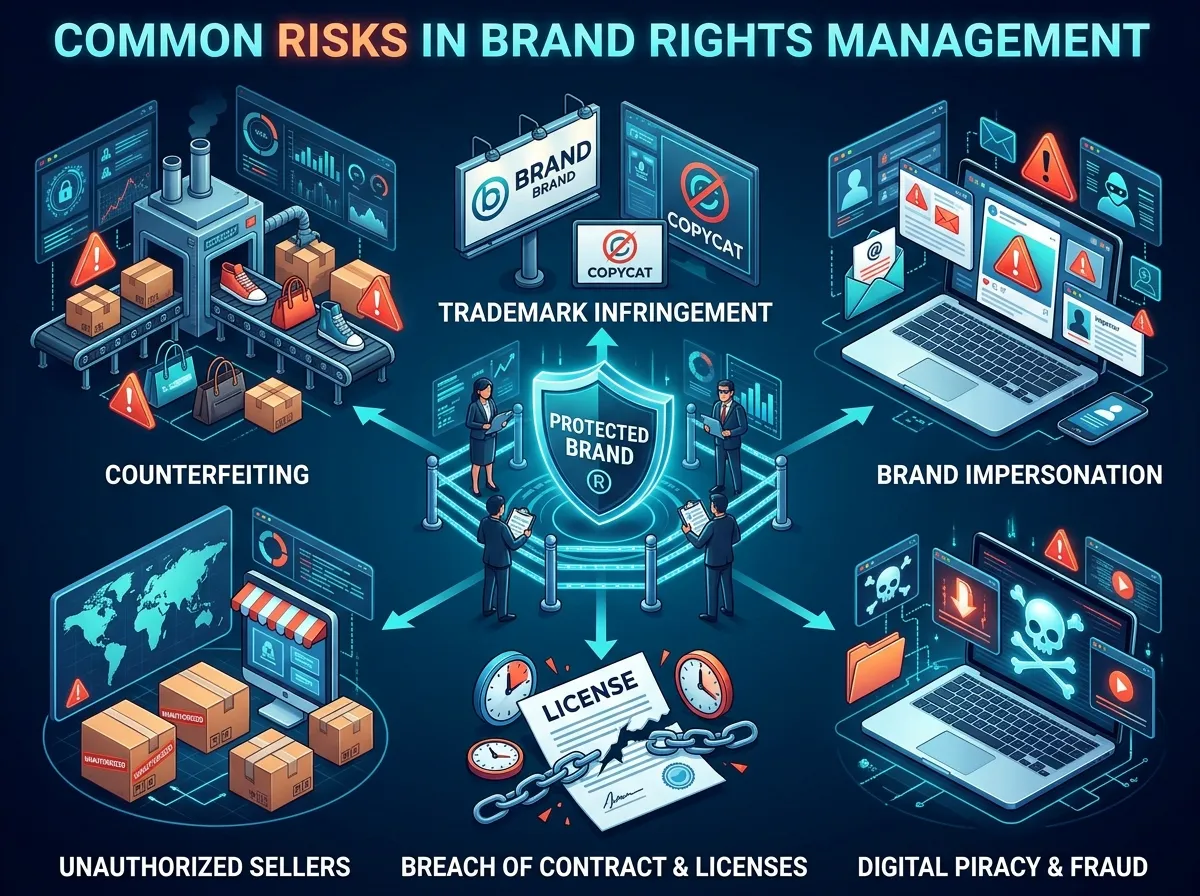
Poorly defined permissions can create problems even when both parties initially intend to cooperate. One common risk is scope expansion, where a licensee uses brand assets for products, markets, or promotional activities that were not included in the original agreement.
Another risk involves outdated permissions. A former partner may continue displaying a logo or using a brand name after its license expires, especially if digital content and marketplace listings are not reviewed. A documented expiration and removal process helps reduce this possibility.
Quality inconsistency can also undermine brand value. If licensed products fail to meet reasonable standards, customers may blame the brand owner rather than the independent manufacturer. Clear specifications and proportionate quality reviews help address this risk.
Financial disagreements may arise when sales calculations, reporting duties, or deductions are not sufficiently defined. Detailed payment provisions and appropriate verification rights make these issues easier to resolve.
Businesses should also consider unauthorized sublicensing, misleading endorsements, misuse of customer data, and conflicts with third-party intellectual property. Each risk requires attention to the particular agreement and the relevant legal environment.
Effective brand rights management combines legal clarity with practical administration. Contracts define the boundaries, permission records track the arrangements, and regular oversight helps identify when actual usage no longer matches what was authorized.
Conclusion
Brand licensing rights allow businesses to commercialize their intellectual property while maintaining ownership and establishing clear conditions for use. When agreements define the licensed assets, permitted activities, financial terms, quality standards, and duration, both parties have a stronger foundation for a productive partnership.
Effective management also requires attention to trademark protection, digital usage, permission records, compliance reviews, and the removal of assets when authorization ends. These responsibilities become increasingly important as brands work with multiple partners across products, territories, and communication channels.
The strongest licensing relationships balance commercial opportunity with consistent brand representation. By treating licensing as an ongoing business relationship rather than a one-time contract, organizations can protect their reputation, reduce avoidable disputes, and create sustainable value from their intellectual property.
Frequently Asked Questions
1. What are brand licensing rights?
Brand licensing rights are permissions granted by an intellectual property owner that allow another party to use specified brand assets under defined conditions. These conditions may cover products, territories, marketing channels, duration, and payment obligations.
2. What is the purpose of a brand licensing agreement?
A brand licensing agreement documents the rights and responsibilities of the owner and licensee. It establishes permitted uses, financial terms, quality requirements, approval procedures, and conditions for renewal or termination.
3. Do brand licensing rights transfer ownership?
Generally, no. A license typically grants permission to use specified intellectual property while the owner retains ownership. The actual rights depend on the contract and applicable law.
4. What is the difference between trademark ownership and trademark licensing?
Trademark ownership concerns the legal ownership of a protected mark. Trademark licensing allows another party to use that mark under agreed conditions without necessarily transferring ownership.
5. What should brand licensing terms include?
Important terms include the licensed assets, authorized uses, territory, duration, exclusivity, royalties or fees, quality standards, approval procedures, reporting obligations, and termination conditions.
6. How can businesses protect brand assets during licensing?
Businesses can use written agreements, approved asset libraries, clear usage standards, permission registers, access controls, and regular compliance reviews to manage authorized use and reduce misuse.
7. What is commercial brand licensing?
Commercial brand licensing is an arrangement in which a business permits another party to use its brand assets for commercial purposes, such as manufacturing products, marketing services, or distributing licensed merchandise.
8. Why is brand license compliance important?
Compliance helps ensure that licensees follow contractual requirements, use approved assets, maintain expected quality, and respect applicable legal obligations. It also helps protect brand reputation and customer trust.
9. Can a brand owner restrict where a licensee uses its brand?
Yes, a licensing agreement can define territorial, product-specific, channel-specific, and time-based restrictions. The enforceability and scope of those restrictions depend on the agreement and relevant law.
10. What happens when a brand licensing agreement expires?
The licensee may need to stop using the licensed assets, remove relevant promotional materials, and comply with any provisions concerning remaining inventory or existing sales. The precise obligations depend on the contract and applicable legal requirements.