Marketing Conversion: Turning Customer Interest Into Business Growth
Marketing Conversion measures how effectively marketing activities turn audience interest into meaningful actions, such as purchases, inquiries, and registrations. Businesses can improve results through conversion optimization, lead qualification, customer journey analysis, accurate tracking, and relevant messaging. By connecting conversion metrics with customer quality and revenue, companies can make better marketing decisions and support sustainable growth.
Marketing success is not measured only by how many people visit a website, open an email, or interact with an advertisement. These activities create awareness, but their real business value depends on what happens next. When a potential customer takes a meaningful action, such as submitting an inquiry, requesting a quotation, signing up for a service, or completing a purchase, marketing begins to produce a measurable outcome. This process is known as Marketing Conversion.
A strong conversion approach connects customer needs with relevant messages, useful experiences, and clear opportunities to take action. It helps businesses understand which marketing activities influence customer decisions and where potential buyers lose interest. Instead of focusing entirely on traffic or impressions, companies can evaluate whether their marketing efforts are encouraging people to move closer to a purchase.
Marketing conversion also provides a connection between marketing investment and commercial performance. When businesses understand how audiences respond to different campaigns, they can improve their messaging, refine their websites, and make better decisions about where to allocate resources. The result is a more purposeful marketing operation that focuses on meaningful customer actions rather than activity alone.
Why Some Marketing Efforts Generate Attention but Few Conversions

A campaign can attract thousands of visitors and still produce disappointing results. This often happens when the message that attracts an audience does not match the experience people encounter after clicking. An advertisement may promise a solution, for example, but the landing page may provide vague information, complicated pricing, or no clear explanation of the next step.
Customer hesitation can also develop when businesses ask for too much too soon. A first-time visitor may not be ready to schedule a sales call or provide extensive personal information. Someone comparing service providers may simply want to understand pricing, review customer experiences, or explore available options before making a commitment.
Understanding these differences is central to effective digital marketing conversions. Customers arrive with varying levels of awareness, urgency, and trust. A useful conversion experience acknowledges those differences instead of presenting every visitor with the same demand.
Businesses should examine whether their messages accurately reflect their offerings, whether the information customers need is easy to find, and whether the requested action feels appropriate. Sometimes, the solution is not to increase advertising spending but to remove a point of confusion that prevents interested visitors from proceeding.
Trust can be equally important. Customers may hesitate when a company has unclear policies, inconsistent messaging, or limited evidence of its credibility. A thoughtful approach to business reputation management can support conversion efforts by helping businesses maintain credible communications, respond to customer concerns, and reinforce confidence before a purchasing decision.
Finding the Moments That Influence Customer Decisions
Customer decisions rarely happen in isolation. A person may discover a business through search results, read a blog post, compare its services with competitors, review customer feedback, and return several days later to make an inquiry. Each interaction can influence whether the customer continues or abandons the process.
This is why conversion path analysis is valuable. It examines the sequence of interactions customers experience before completing a desired action. Rather than evaluating a landing page or advertisement independently, businesses can investigate how different touchpoints contribute to the overall journey.
Consider a company offering professional software. A visitor might first arrive through an educational article, then download a resource, receive a follow-up email, and finally request a product demonstration. If the company only measures demonstration requests, it may overlook the educational content and email communication that helped create the opportunity.
Path analysis can reveal where customers encounter friction. If many visitors read a service page but rarely continue to the inquiry form, the page may not answer important questions. If users begin a form but fail to submit it, the process may be too lengthy or request unnecessary details. If email recipients repeatedly visit a pricing page without contacting sales, they may need clearer information about plans or implementation.
These patterns help marketers investigate specific problems instead of making broad assumptions about customer behavior. They also show why a conversion should be understood as the outcome of a connected experience, not simply the result of one promotional message.
Improving Conversion Rates Without Sacrificing Customer Experience
Marketing conversion optimization focuses on improving the proportion of people who complete a desired action. The process involves identifying obstacles, developing explanations for customer behavior, testing potential improvements, and measuring the results.
The first step is to define what a successful conversion means for the business. For an online retailer, it may be a completed purchase. For a consultancy, it could be a qualified inquiry. A software company might measure free-trial registrations, while a professional service provider may focus on booked consultations. These actions have different levels of commercial value, so the selected metric should reflect the purpose of the marketing activity.
Once the goal is clear, marketers can examine the experience surrounding it. A landing page might benefit from a more specific headline, stronger evidence of product value, or a clearer explanation of what happens after a form is submitted. An online store may need more transparent delivery information or fewer checkout steps. A service website may improve results by explaining its process and expected outcomes before asking visitors to make contact.
Conversion rate improvement should not rely on design preferences alone. A change that looks attractive may not address the reason customers hesitate. Businesses can use controlled experiments, customer feedback, session-level behavior data, and form completion statistics to evaluate potential improvements.
Testing one meaningful change at a time can make the results easier to interpret. For example, a company could compare two versions of a landing page that differ in their main headline or call to action. It should then evaluate whether the observed improvement is supported by sufficient data rather than declaring success after a small, unreliable change.
Importantly, a higher conversion rate does not automatically mean better business performance. A page might generate more inquiries while attracting people who are unlikely to purchase. Effective optimization considers lead quality, revenue, customer satisfaction, and the longer-term value of the customers acquired.
Connecting the Marketing Funnel With Real Customer Intent
A marketing funnel provides a useful way to understand how prospects progress from initial awareness to consideration and eventual purchase. However, customers do not always follow a perfectly linear sequence. Some move quickly from a search result to a purchase, while others revisit a website several times before contacting the business.
Marketing funnel conversion depends on matching information and opportunities to the customer’s stage of decision-making. Early-stage visitors generally benefit from educational content that explains a problem or introduces possible solutions. People comparing alternatives may need product details, customer testimonials, pricing information, or comparisons that help them assess their options. Those who are ready to purchase often need a straightforward path to complete the transaction or speak with the right representative.
Problems arise when companies use the same message for everyone. A visitor researching general industry information may find an immediate sales pitch intrusive, while a prospect who has already compared providers may find introductory content too basic. Relevant communication makes it easier for each audience to take the next appropriate step.
This requires coordination between marketing, sales, and customer service. Marketing teams need to understand which inquiries represent genuine opportunities, while sales teams should provide feedback about the concerns and questions that arise during conversations. These insights can help marketers improve content and refine the way prospects are qualified.
Businesses can also use data-driven inbound marketing to connect audience behavior with measurable outcomes. By examining engagement, lead quality, and progression through the funnel, teams can identify which content attracts relevant prospects and which interactions are associated with meaningful business results.
Turning More Leads Into Customers
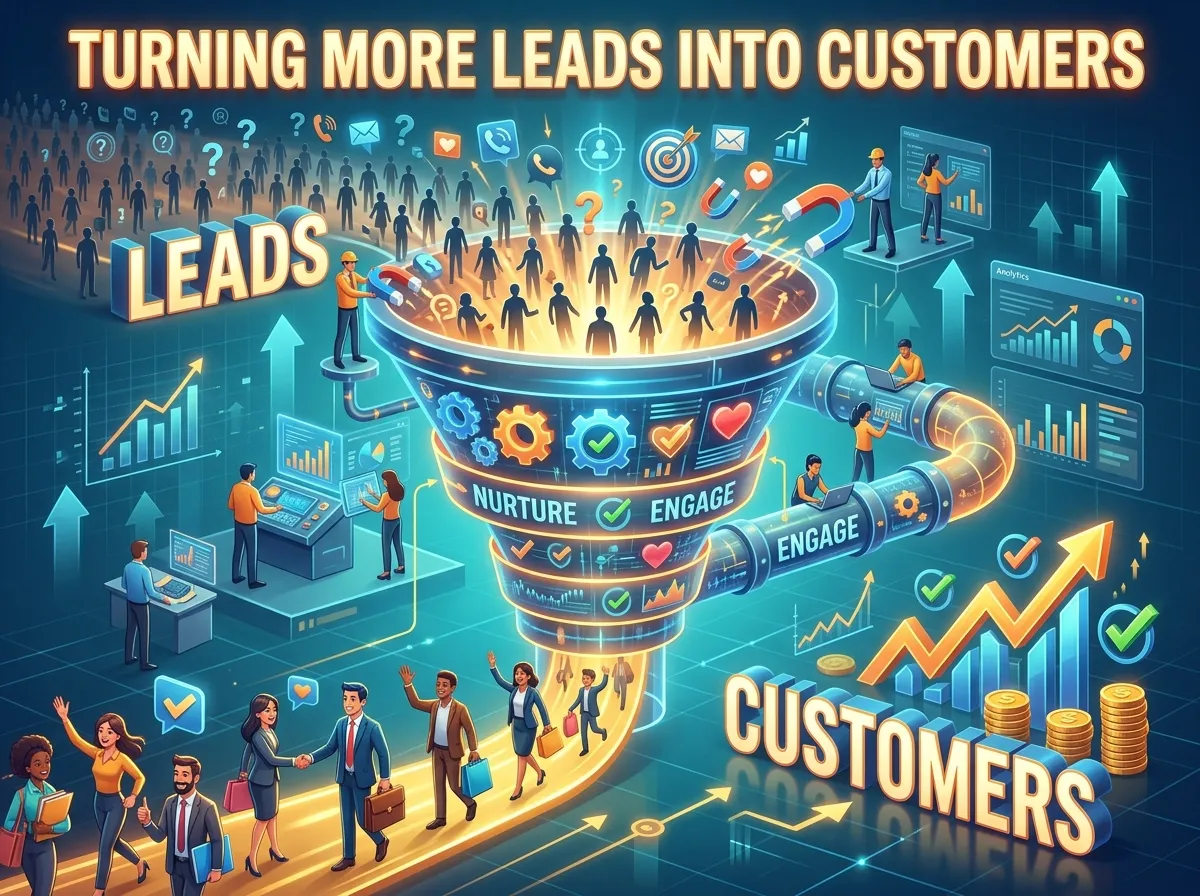
Generating leads is only one part of the conversion process. Some prospects submit a form but never respond to follow-up messages. Others remain interested but need additional information before they can make a decision. Businesses that treat every new contact as an immediate sales opportunity may overlook the different reasons people delay or decline a purchase.
Lead conversion strategies should reflect the quality, needs, and readiness of each prospect. Someone who requests a product demonstration may be prepared for a direct sales conversation, while a person downloading an introductory resource may still be exploring the problem. The follow-up experience should reflect that distinction.
Timely communication can help maintain interest, particularly when it responds to the reason a prospect originally engaged. A business might provide a relevant case study, explain a service’s expected benefits, answer a frequently asked question, or offer a consultation when the prospect shows stronger purchase intent.
The quality of the lead also matters. Marketing teams should not judge performance only by the number of contacts collected. A smaller group of relevant prospects may produce more revenue than a large list of people who have little interest in the offering. Clear qualification criteria can help sales teams prioritize opportunities without treating every inquiry as equally valuable.
The relationship between conversions and profitability deserves attention as well. A company may increase the number of customers it acquires but spend so much on advertising, incentives, and follow-up that the additional business produces limited returns. Evaluating the ROI of brand strategy alongside conversion performance can help organizations understand how brand investment, customer confidence, and commercial outcomes relate to one another.
Tracking Conversions Across Campaigns and Channels
Marketing decisions become more reliable when businesses can connect customer actions with the campaigns and interactions that influenced them. Customer conversion tracking helps measure these actions across websites, advertising platforms, email campaigns, and other marketing channels.
A basic tracking setup might record purchases, form submissions, booked appointments, or trial registrations. More advanced measurement can distinguish between different types of leads, identify qualified opportunities, and connect marketing activity with revenue when the necessary systems and data are available.
Accurate tracking begins with clear definitions. If one platform counts every form submission as a conversion while another records only completed sales, their reports cannot be compared directly without understanding the difference. Teams should establish consistent event names, conversion rules, and reporting periods so that performance measurements remain meaningful.
Attribution also requires careful interpretation. A customer may click a paid advertisement after discovering the company through organic search and reading an email. Different attribution models may assign credit to different interactions. No single model necessarily captures the full influence of every touchpoint, especially when customers switch devices or interact through offline channels.
Privacy should remain part of the measurement process. Businesses need to use appropriate consent practices, limit unnecessary data collection, protect customer information, and follow applicable privacy requirements. Effective measurement should improve business understanding without collecting more personal information than necessary.
With dependable tracking in place, marketers can compare channels according to the outcomes they generate. A campaign that attracts inexpensive traffic may not be as valuable as one that generates fewer but more qualified prospects. The most useful reporting connects marketing activity with meaningful actions and, where possible, downstream revenue.
Measuring Campaign Effectiveness Beyond Clicks
Marketing campaign effectiveness cannot be judged solely by impressions, clicks, or engagement. These metrics can explain how audiences respond to promotional content, but they do not necessarily reveal whether a campaign contributes to the company’s commercial objectives.
A more complete evaluation considers the relationship between campaign spending, conversions, lead quality, sales, and customer value. For example, two advertising campaigns may generate the same number of inquiries, but one could produce more qualified opportunities and a stronger sales pipeline. Looking only at inquiry volume would hide that difference.
Campaign analysis should also account for the time it takes customers to make decisions. A low-cost purchase may happen during the first session, while a business-to-business contract may require several weeks of research and discussion. Comparing both campaigns over an identical short window could lead to misleading conclusions.
Businesses should establish realistic targets before a campaign begins. These targets can include qualified lead volume, conversion rate, cost per acquisition, revenue contribution, or another outcome that reflects the campaign’s purpose. Reviewing results against these expectations helps teams identify which activities deserve further investment.
Financial planning adds another important perspective. Conversion improvements should be assessed in relation to the resources required to achieve them, including advertising costs, technology, content production, and sales support. Coordinating these decisions with business revenue planning helps organizations determine whether conversion growth is likely to support sustainable revenue rather than simply increase activity.
Building a Website That Makes the Next Step Clear
A website often serves as the place where customer interest becomes a measurable action. Even when a visitor arrives through social media, email, or a paid advertisement, the website may need to provide the information that supports a final decision.
Website conversion performance depends on clarity, relevance, usability, and trust. Visitors should quickly understand what the business offers, who it serves, and why the offering may be useful. Important information should be accessible without requiring unnecessary searching, while the next action should be easy to identify.
Mobile usability is particularly important because visitors may browse on smaller screens or under less convenient conditions. Text that is difficult to read, buttons that are hard to tap, slow-loading pages, and forms that require excessive typing can interrupt the experience. A technically functional website may still create unnecessary friction if its design does not accommodate how people actually use it.
Trust signals can further support decision-making. Accurate business information, transparent pricing where appropriate, relevant testimonials, clear contact details, and straightforward policies help visitors evaluate whether a company is credible. These elements should reflect genuine business practices rather than unsupported claims.
The website should also communicate what happens after a conversion. A customer submitting an inquiry should receive a clear confirmation, while someone making a purchase should understand the next steps for payment, delivery, or service access. This continuity reduces uncertainty and creates a more professional experience.
Making Customer Journeys Easier to Complete
Customer journey optimization considers the entire experience surrounding a conversion, including the interactions that happen before and after the main action. A prospect may have a positive experience with an advertisement but become frustrated by an unclear pricing page. A customer may complete a purchase successfully but lose confidence if confirmation messages and delivery updates are missing.
Journey improvement requires businesses to look beyond individual marketing channels. The experience should remain consistent when customers move between a website, email, a sales representative, and customer support. Conflicting information or repeated requests for the same details can create friction even when each individual touchpoint appears reasonable.
Feedback can reveal problems that analytics alone cannot explain. A high form abandonment rate indicates that something may be discouraging users, but direct feedback may reveal that the form asks for information customers do not yet have. Similarly, a prospect who repeatedly delays a purchase may need clarification about implementation, pricing, or ongoing support.
Organizations should prioritize changes according to their likely effect on customer outcomes and the effort required to implement them. Resolving a major checkout error is generally more urgent than making a minor visual adjustment to a page that already performs well. Small improvements can still matter, but their value should be assessed in the context of the wider customer journey.
Conversion is also not the end of the relationship. Onboarding, customer service, product quality, and ongoing communication influence whether customers return, renew, or recommend the business. A successful conversion strategy therefore connects acquisition with the experience that follows the purchase.
Making Marketing Conversion a Continuous Business Process
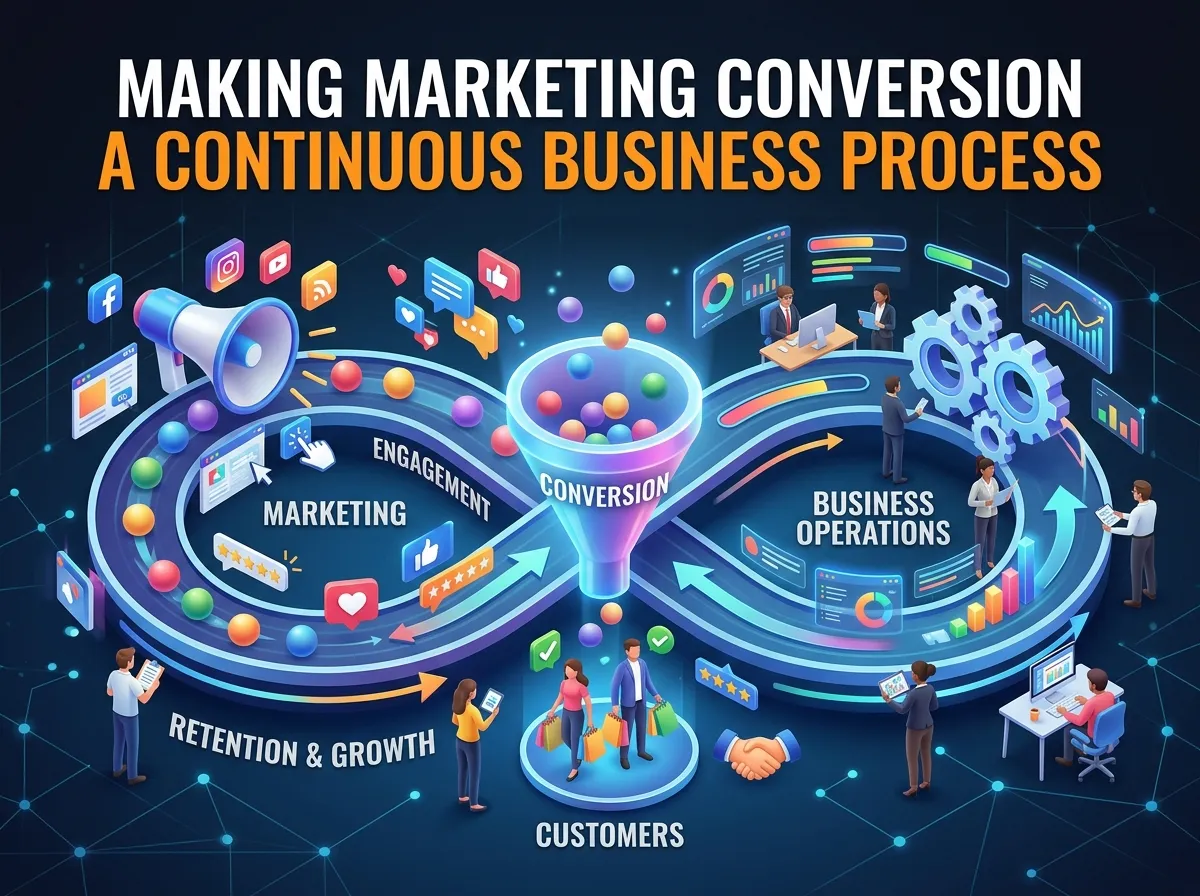
Marketing conversion is most effective when it becomes part of regular decision-making rather than a one-time optimization project. Customer expectations evolve, competitors change their offers, and new channels introduce different ways for people to discover and evaluate businesses. A page or campaign that performs well today may require adjustment as these conditions change.
Organizations can establish a consistent review process that brings together conversion data, customer feedback, campaign results, and sales insights. The purpose is not to change everything whenever a metric fluctuates. Instead, teams should identify meaningful patterns, investigate likely causes, test practical improvements, and evaluate the results over an appropriate period.
Successful conversion work also depends on shared accountability. Marketing teams influence the quality of incoming prospects, sales teams help turn qualified opportunities into customers, and service teams affect the experience after purchase. When these teams exchange useful information, businesses can identify problems that would remain hidden if each department measured success independently.
Ultimately, Marketing Conversion is about making it easier for the right customers to take the right action at the right time. By combining relevant communication, a clear customer journey, reliable tracking, and thoughtful performance analysis, businesses can improve conversion outcomes while preserving customer trust. The strongest results come not from pressuring every visitor to act immediately, but from removing barriers and providing the information and confidence people need to make informed decisions.
Frequently Asked Questions
1. What is Marketing Conversion?
Marketing Conversion is the process of turning a prospect’s interaction with a marketing activity into a desired action. This may include making a purchase, submitting a contact form, booking a consultation, downloading a resource, or registering for a service. The specific conversion depends on the company’s goals and the audience’s stage in the buying process.
2. Why is Marketing Conversion important for businesses?
Marketing Conversion helps businesses understand whether their marketing efforts are producing meaningful results. It connects audience engagement with actions that can contribute to sales, customer acquisition, and revenue. Measuring conversions also helps companies identify ineffective campaigns, improve customer experiences, and allocate resources more carefully.
3. How can a company improve its marketing conversion rate?
A company can improve its conversion rate by making its message more relevant, simplifying forms and checkout processes, strengthening trust signals, and clarifying the next step for visitors. Testing different page elements and reviewing customer behavior can reveal which changes are effective. Improvements should be evaluated alongside lead quality and revenue rather than conversion volume alone.
4. What is the difference between a conversion and a conversion rate?
A conversion is a completed action, such as a purchase or form submission. A conversion rate is the percentage of eligible visitors or interactions that result in that action. For example, if 50 out of 1,000 eligible visitors complete a purchase, the conversion rate is 5%, assuming the same measurement period and definition are used.
5. What is marketing funnel conversion?
Marketing funnel conversion describes how prospects progress through different stages of the buying process, from initial awareness to consideration and purchase. Businesses can improve funnel performance by providing information that matches customer intent at each stage and identifying where prospects stop progressing.
6. Which metrics are useful for measuring Marketing Conversion?
Common metrics include conversion rate, cost per conversion, customer acquisition cost, qualified lead rate, purchase completion rate, revenue per customer, and return on marketing investment. The most relevant measures depend on the campaign’s objective. Businesses should combine activity metrics with indicators of customer quality and financial performance.
7. How does customer conversion tracking work?
Customer conversion tracking records when people complete predefined actions, such as purchases, registrations, or inquiry submissions. Tracking tools connect these events with available information about campaigns and customer interactions. Accurate implementation requires consistent event definitions, appropriate privacy practices, and regular checks to ensure that reported conversions are reliable.
8. What role does a website play in conversion performance?
A website helps visitors understand an offer, evaluate its value, and complete the next step. Clear messaging, useful information, mobile usability, fast page loading, transparent policies, and simple forms can reduce friction. The website should also provide clear confirmation and next-step information after a visitor converts.
9. How are Marketing Conversion and revenue related?
Conversions can contribute to revenue when they lead to purchases or qualified sales opportunities. However, more conversions do not always produce more profit. Businesses should evaluate conversion quality, acquisition costs, sales outcomes, and customer value to understand whether marketing improvements support sustainable financial performance.
10. How often should businesses review conversion performance?
Businesses should monitor important conversion metrics regularly and conduct deeper reviews according to campaign duration, sales cycle, and traffic volume. Frequent monitoring can identify technical problems or sudden changes, while longer review periods help reveal meaningful trends. Decisions should be based on sufficient evidence rather than reacting to every short-term fluctuation.