Marketing Intent Data: Understanding Customer Signals
Marketing Intent Data helps businesses understand what potential customers are actively researching, considering, or preparing to purchase. Instead of relying only on demographic information or past interactions, intent data focuses on behavioral signals that can indicate a prospect’s current interests and buying journey. When businesses combine intent information with content, CRM, advertising, and lead generation strategies, they can create more relevant marketing experiences and identify opportunities at the right time.
What Is Marketing Intent Data?
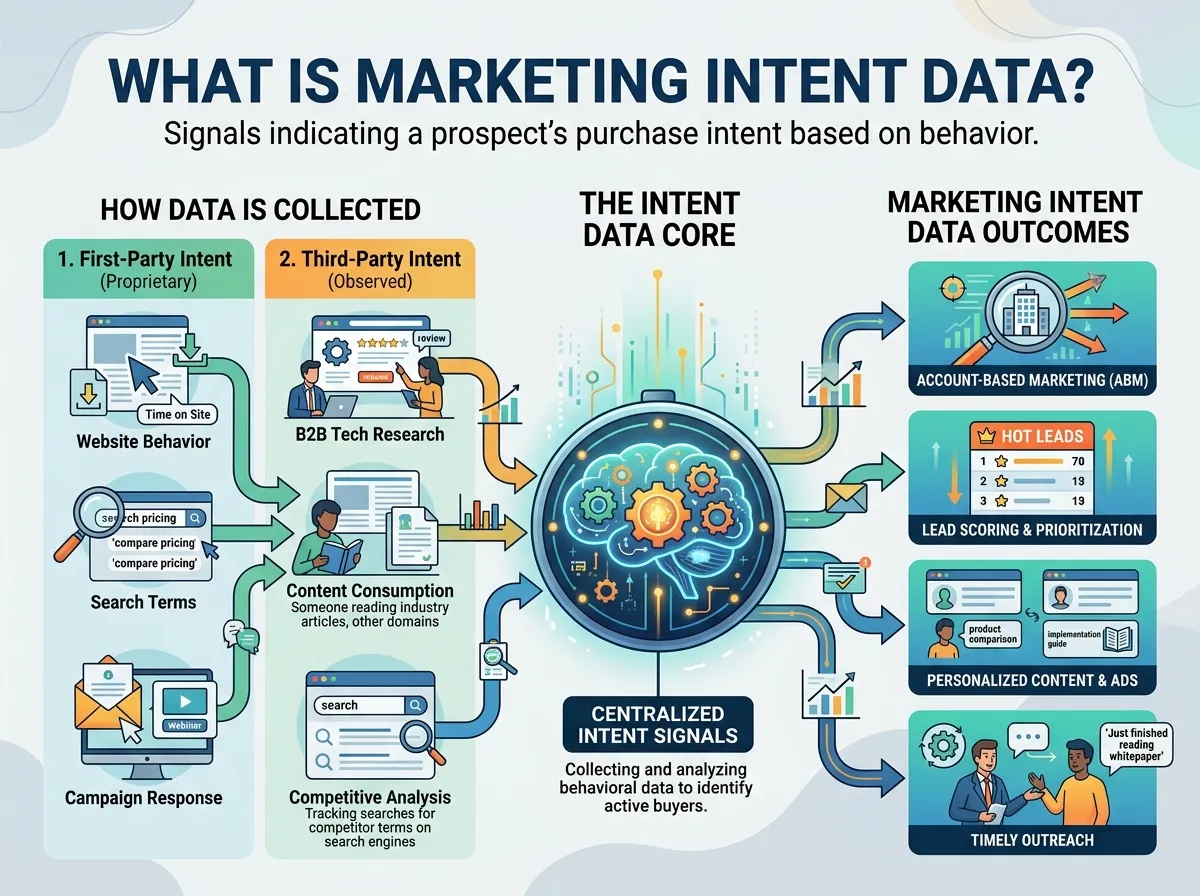
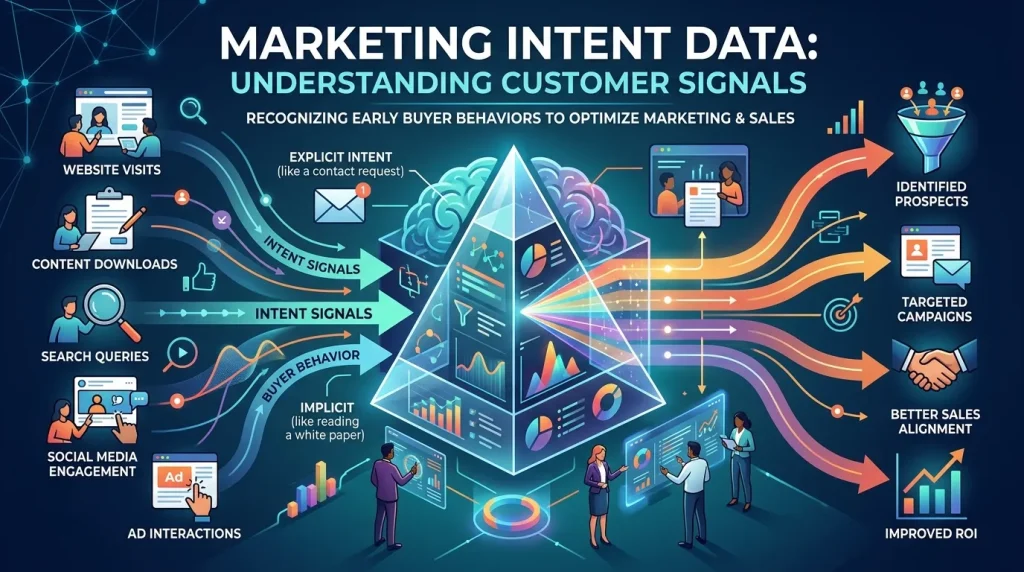
Marketing Intent Data refers to information that shows a potential customer’s interest in a particular product, service, topic, or business solution. These signals can come from website visits, content consumption, search behavior, downloads, product comparisons, webinar registrations, advertising interactions, and other digital activities.
Traditional marketing often focuses on who a customer is, such as their job title, company size, location, or industry. Intent data adds another layer by showing what that customer may currently be interested in. A person who repeatedly visits pages about a specific solution, reads related articles, and compares available options may demonstrate stronger buying interest than someone who simply matches a target demographic.
This makes intent information valuable for businesses that want to understand customer behavior more accurately. Instead of treating every prospect in the same way, marketers can use behavioral information to create more relevant communication and prioritize opportunities based on demonstrated interest.
Why Marketing Intent Data Matters
Customers rarely move from discovering a brand to making a purchase immediately. They may spend considerable time researching problems, comparing solutions, reading educational content, checking reviews, and evaluating providers. During this process, they generate behavioral signals that can provide useful context for marketers.
A well-developed Marketing Intent Data Strategy allows businesses to organize these signals and connect them with broader marketing activities. For example, a company may notice that an account is increasingly engaging with content related to a specific service. That information can influence content recommendations, advertising audiences, email campaigns, or sales outreach.
Intent data can also improve marketing efficiency. Rather than distributing the same message to a large audience, marketers can identify groups showing stronger interest and tailor communication around their current needs. This can support better audience segmentation and potentially reduce wasted marketing activity.
Another important benefit is timing. A customer who has just begun researching a topic may need educational information, while someone comparing providers may be looking for pricing, product specifications, demonstrations, or customer evidence. Understanding these differences helps businesses align their messaging with the customer’s stage of consideration.
Understanding Buyer Intent Data
Buyer Intent Data focuses specifically on behavioral information that can indicate a person or organization is moving toward a purchasing decision. It can include repeated visits to product pages, searches for commercial terms, comparisons between providers, requests for information, pricing-page activity, or engagement with purchase-related content.
Not every signal means that someone is ready to buy. A visitor may research a topic for educational purposes, conduct market research, or simply explore an unfamiliar subject. Therefore, intent information should generally be interpreted as evidence of interest rather than absolute proof of purchase readiness.
The strength of a signal can also depend on frequency, recency, and context. Someone who visits a product page once may demonstrate limited interest, whereas an organization repeatedly researching the same solution over several weeks may provide a stronger indication of active consideration.
Businesses can combine multiple behavioral signals to develop a more complete picture. When intent data is connected with CRM information, account information, engagement history, and lead activity, marketers can distinguish between casual interest and more meaningful engagement.
How Intent Data Marketing Supports Customer Engagement
Intent Data Marketing uses behavioral information to make marketing activities more relevant to the audience. The objective is not simply to collect more customer data but to understand what that information means within the customer journey.
For instance, a visitor researching marketing automation may initially receive educational content explaining the benefits and applications of automation. If that visitor later interacts with comparison content or pricing information, the business may adjust its communication to address evaluation-stage questions.
This approach can make content distribution more contextual. Instead of showing identical campaigns to everyone, marketers can organize audiences according to their demonstrated interests. Different segments can receive different articles, emails, advertisements, case studies, or product information based on their engagement patterns.
Intent information can also help coordinate marketing and sales. Marketing teams can share relevant signals with sales teams so representatives have greater context when approaching qualified prospects. This can make conversations more focused because the outreach is connected to observed areas of interest rather than being entirely generic.
Customer Intent Signals and Their Meaning
Customer Intent Signals are the observable behaviors that indicate what a potential customer may be interested in. These signals vary significantly depending on the business model, industry, customer journey, and product category.
Website behavior is one common source. Visits to product pages, service pages, pricing pages, comparison pages, and frequently asked questions can reveal different levels of interest. Content interactions can provide another source of information. Repeatedly consuming articles, reports, webinars, or research related to one subject may indicate that the topic has become important to the visitor.
Search behavior can also provide useful context. Commercial searches often indicate a different level of intent from broad informational searches, although search terms should not be interpreted in isolation.
Engagement with emails, advertisements, webinars, demonstrations, and downloadable resources can add further signals. The most useful analysis usually considers several activities together rather than relying on a single action.
B2B Intent Data and Account-Level Insights
B2B Intent Data can be particularly useful because business purchases often involve multiple stakeholders and longer decision-making processes. A company may have several employees researching the same category before anyone submits a form or contacts a sales representative.
Account-level intent information can help marketers identify organizations demonstrating increased interest in a particular subject. This can complement account-based marketing by helping teams understand which target accounts are actively engaging with relevant topics.
For example, an organization may have employees repeatedly consuming content about a particular business solution. Combined with firmographic information and existing CRM records, this activity may help marketers determine whether the account deserves additional attention.
B2B intent data can also support personalization. Content and campaigns can be adjusted according to industry challenges, business needs, solution interests, or stages of research. However, responsible data use remains important. Marketers should ensure that their collection and use of behavioral information follows applicable privacy requirements and their own data policies.
Purchase Intent Data and the Customer Journey
Purchase Intent Data provides insight into behaviors that may occur closer to a buying decision. These behaviors can include product comparisons, pricing-page visits, demo requests, product documentation downloads, or searches that contain strong commercial intent.
Understanding purchase intent can help marketers differentiate between awareness-stage and decision-stage audiences. Someone reading an introductory article may need educational material, while someone comparing service packages may need more specific information about features, pricing, implementation, or results.
This distinction can improve content relevance. Customers generally respond better when the information they receive matches the questions they are currently trying to answer.
Purchase intent data can also help businesses identify potential opportunities that might otherwise remain hidden. Some prospects may research extensively without completing a form or directly contacting a company. Behavioral signals can provide additional context around this anonymous or low-profile research activity.
Using Marketing Intent Signals for Personalization
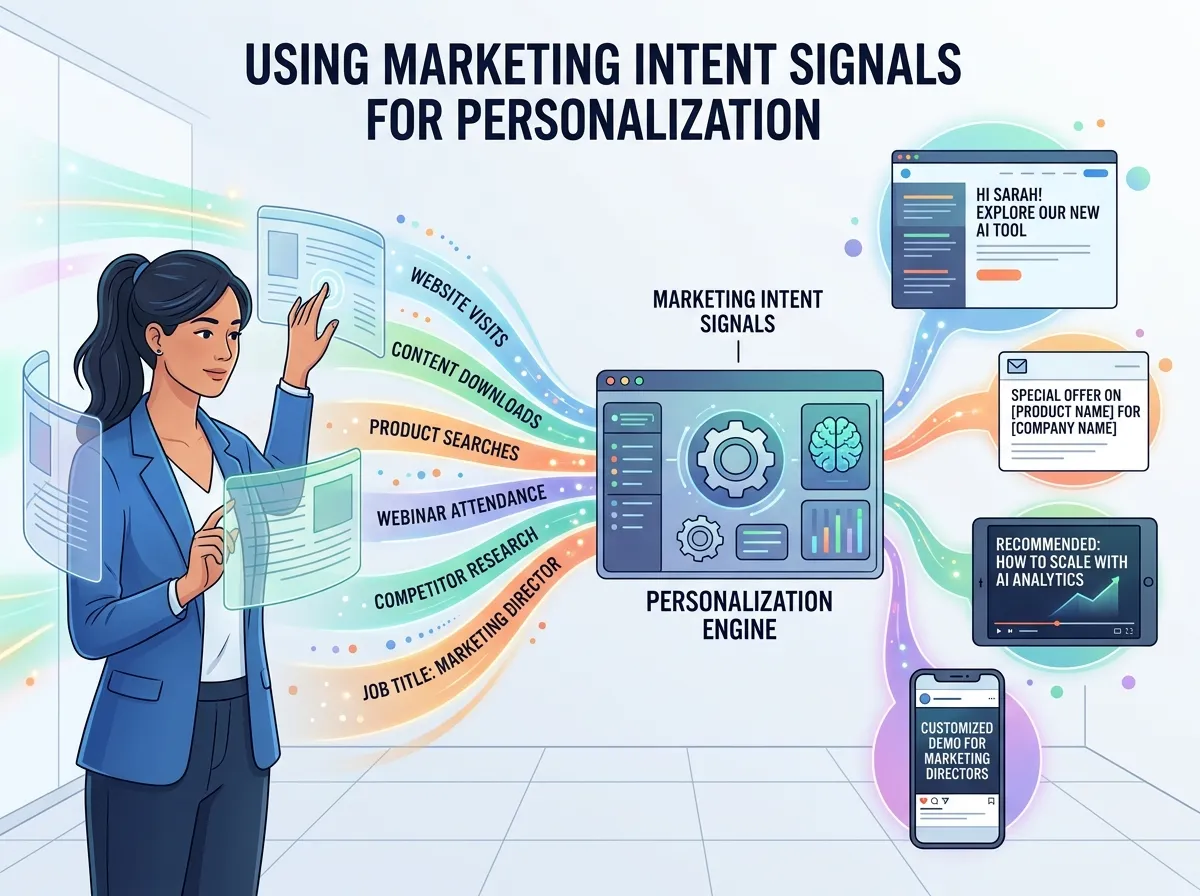
Marketing Intent Signals can support more personalized marketing when they are connected to meaningful customer segments. Personalization does not necessarily mean creating an entirely different campaign for every individual. It can involve presenting different content, messaging, or offers to groups based on shared behavioral patterns.
A business might create one audience for people researching general educational topics, another for visitors comparing solutions, and another for prospects showing strong commercial engagement. Each audience can receive communication that addresses its current interests.
Intent-based personalization can extend across several channels. Websites can recommend relevant resources, email campaigns can provide subject-specific content, and advertising platforms can be used to reach audiences based on appropriate behavioral criteria.
The quality of personalization depends heavily on the quality of the underlying data. Inaccurate, outdated, or poorly interpreted signals can result in irrelevant messaging. Businesses therefore need reliable processes for collecting, organizing, and interpreting intent information.
Building an Intent-Based Marketing Strategy
An Intent-Based Marketing Strategy connects customer behavior with marketing decisions. Rather than treating intent data as an isolated analytics category, businesses can incorporate it into segmentation, content planning, lead qualification, advertising, account-based marketing, and sales coordination.
The strategy should begin with a clear understanding of the behaviors that matter most for the business. Different industries will have different indicators of interest. For one business, repeated visits to product pages may be important. For another, webinar attendance or technical documentation downloads may provide stronger signals.
Once relevant behaviors are identified, businesses can establish appropriate methods for organizing the information. CRM systems, marketing automation platforms, analytics tools, and customer data platforms can help connect behavioral activity with existing customer records.
The next consideration is how teams will respond to different levels of intent. Strong signals might trigger more direct sales or product communication, while early-stage signals may lead to educational content and nurturing campaigns.
Intent data becomes more valuable when marketing and sales teams share a common understanding of what different signals represent. This alignment can help prevent every website visit or content download from being treated as a sales-ready lead.
Customer Buying Intent and Lead Qualification
Customer Buying Intent can contribute to lead qualification by adding behavioral context to traditional qualification criteria. Demographic and firmographic information can show whether a prospect fits the target market, while intent signals can provide clues about current interest.
A lead from a target company may not be ready for direct outreach if its engagement remains limited. Conversely, a prospect that repeatedly interacts with high-intent content may warrant closer attention even if the initial form information is limited.
Combining intent signals with lead scoring can create a more dynamic qualification process. Recency, frequency, content type, engagement depth, and account relevance can all contribute to a broader assessment of lead activity.
Businesses should avoid treating intent scores as absolute measures of buying readiness. Scores are indicators that require context. Human judgment, customer conversations, and other business information remain important when evaluating potential opportunities.
Intent Data for Lead Generation
Intent Data for Lead Generation can help marketers identify potential prospects based on demonstrated interest rather than relying entirely on broad audience targeting. When used effectively, it can support more focused campaigns and stronger alignment between content and audience needs.
For example, marketers can identify topics receiving increased engagement and create content around those interests. Paid campaigns can also be adjusted to address audiences demonstrating relevant activity. Lead nurturing programs can use intent signals to determine which subjects should be emphasized in future communication.
Intent data can be especially valuable when combined with a broader data-driven marketing approach. Businesses can evaluate which signals correlate with meaningful engagement, conversions, and revenue, then refine their targeting based on those observations. Related approaches to measurement and customer-focused marketing can be explored through Data-Driven Inbound Marketing.
Marketing Intent Data and Competitive Research
Intent information can also provide useful context for understanding market activity. When businesses observe increasing interest around particular topics, technologies, services, or problems, they can examine how competitors position themselves around those areas.
Competitive research should not rely exclusively on intent data. It can be combined with market research, customer feedback, competitor content, search behavior, and other sources of information.
A structured Competitive Brand Analysis can help businesses understand competitor positioning, messaging, differentiation, and market presence. Intent signals can then provide an additional behavioral perspective on the subjects that appear important to potential customers.
Improving Marketing Through Intent Data
The value of Marketing Intent Data depends on how effectively a business turns information into relevant action. Collecting large quantities of behavioral information does not automatically produce better marketing. The data needs to be accurate, understandable, appropriately segmented, and connected to business objectives.
Data quality is particularly important because incorrect assumptions can create poor customer experiences. Marketers should regularly review their signals and determine whether they genuinely correspond with meaningful engagement.
It is also useful to distinguish between interest and intent. Someone can be highly interested in a topic without having any immediate intention to purchase. This distinction prevents businesses from over-targeting customers who are simply conducting research.
Privacy and transparency should also remain part of the process. Businesses should handle behavioral information responsibly, respect applicable privacy requirements, and avoid creating customer experiences that feel intrusive.
Simplifying Intent Data for Better Marketing Decisions
Intent data can become complicated when organizations collect information from many different channels. Website analytics, CRM records, advertising platforms, email systems, content platforms, and other sources can produce large amounts of behavioral information.
Simplifying how this information is interpreted can make it easier for marketing teams to act on meaningful signals. Instead of tracking every possible behavior, teams can focus on signals that are relevant to their customer journey and business goals.
A broader approach to simplifying brand communication and customer experiences can be seen in Brand Simplification. The same principle can be applied to intent analysis: clearer information structures can help teams understand what matters without becoming overwhelmed by unnecessary data.
The Role of Intent Data in Modern Marketing
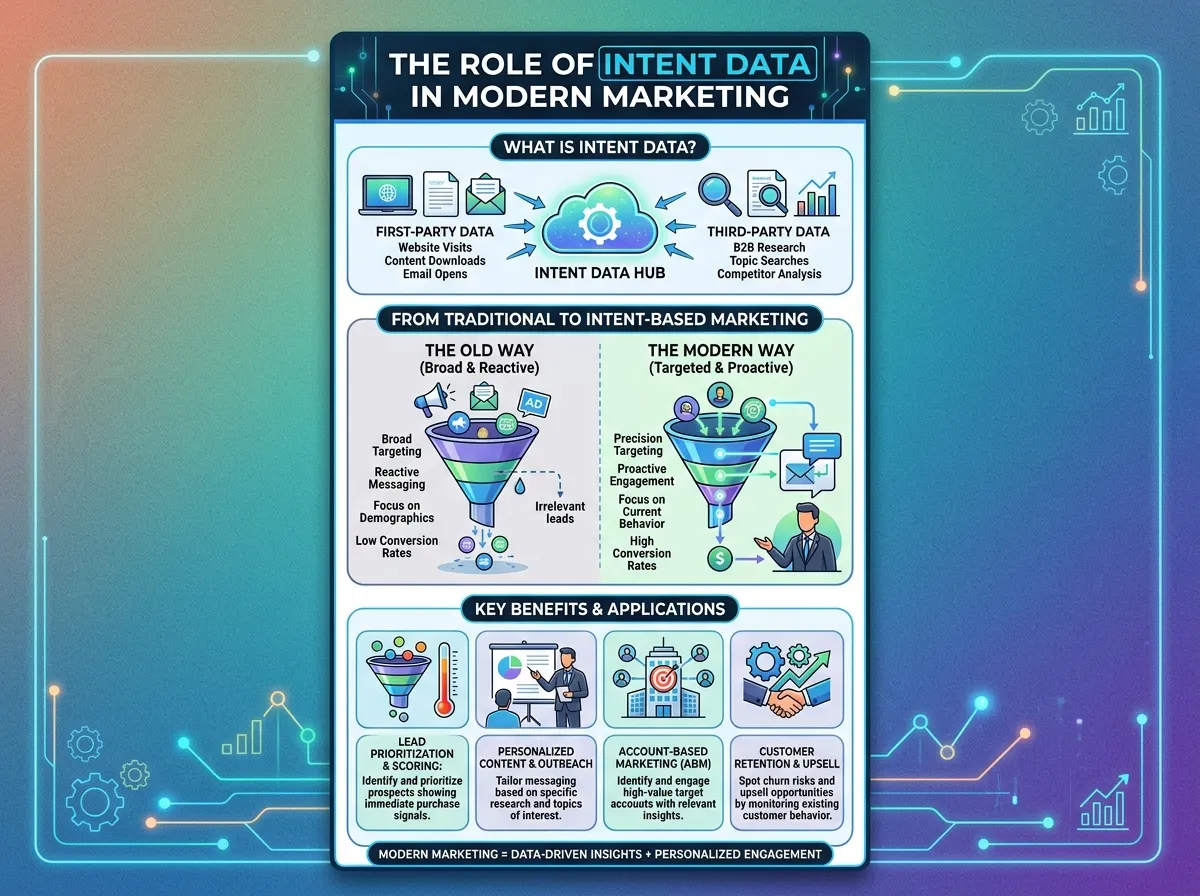
Marketing Intent Data provides another layer of understanding between customer activity and marketing decisions. Demographic information can explain who a prospect is, while behavioral data can provide clues about what that prospect is researching and considering.
When intent information is combined with content marketing, CRM data, analytics, lead generation, and customer journey insights, businesses can create more context-aware marketing programs. The goal is not to predict every customer decision perfectly but to use available behavioral evidence to make more informed marketing decisions.
Emerging digital environments are also creating new forms of customer interaction and behavioral information. Businesses exploring virtual experiences and new digital brand environments can learn more from Mastering Metaverse Branding, where customer engagement can take place across increasingly interactive digital experiences.
Conclusion
Marketing Intent Data helps businesses understand customer interests through observable behaviors and engagement patterns. From Buyer Intent Data and B2B Intent Data to Purchase Intent Data and Customer Intent Signals, these insights can provide valuable context for segmentation, personalization, lead qualification, and content decisions.
The strongest results come from interpreting intent signals carefully rather than treating them as guaranteed predictions of customer behavior. When businesses combine reliable intent information with customer data, relevant content, responsible personalization, and coordinated marketing and sales activities, they can create more timely and meaningful customer experiences.
Frequently Asked Questions
1. What is Marketing Intent Data?
Marketing Intent Data is information about behaviors that indicate a potential customer’s interest in a topic, product, service, or solution. It can come from website activity, content engagement, searches, downloads, advertising interactions, and other digital behaviors.
2. Why is Marketing Intent Data important?
Marketing Intent Data can help businesses understand what customers are researching and considering. This information can support audience segmentation, personalization, lead qualification, content planning, and more relevant marketing communication.
3. What is Buyer Intent Data?
Buyer Intent Data refers to behavioral information that may indicate a prospect is considering a purchase. Examples include repeated product-page visits, pricing-page activity, comparison research, demo requests, and engagement with purchase-related content.
4. How does B2B Intent Data work?
B2B Intent Data helps businesses identify organizations showing interest in particular topics, products, or solutions. It can be combined with account information, CRM data, and engagement history to provide additional context for B2B marketing and sales activities.
5. What are common Customer Intent Signals?
Common Customer Intent Signals include website visits, product-page activity, pricing-page visits, content downloads, searches, webinar participation, email engagement, product comparisons, and requests for additional information.
6. Is Purchase Intent Data the same as customer intent?
They are related but not identical. Customer intent can cover a broad range of interests and behaviors, while Purchase Intent Data generally focuses on signals that may occur closer to a purchasing decision.
7. Can Marketing Intent Data improve lead generation?
Yes. Intent data can help marketers identify audiences demonstrating relevant interest and create campaigns around those interests. When combined with lead qualification and other customer information, it can support more focused lead-generation activities.
8. How can companies use intent data for personalization?
Companies can use intent signals to group audiences according to their interests and engagement levels. They can then provide more relevant content, advertising, email communication, or product information based on the subjects customers are actively researching.
9. Does intent data guarantee that someone will buy?
No. Intent data indicates behavior and interest, not guaranteed purchase decisions. A person or organization may research a product for many reasons without eventually making a purchase, so intent signals should be interpreted alongside other information.
10. What is an Intent-Based Marketing Strategy?
An Intent-Based Marketing Strategy uses customer behavioral signals to inform marketing decisions. It can connect intent information with segmentation, content, advertising, lead qualification, nurturing, and sales activities to make communication more relevant to customer interests.