Brand Clearance: Protecting Your Brand Before It Enters the Market

Brand clearance is an important step in establishing a distinctive and legally safer brand identity. Before investing in a business name, logo, product identity, or marketing campaign, businesses need to examine whether their proposed brand elements are already being used or protected by others. Through trademark clearance, brand name searches, availability checks, and trademark risk assessments, organizations can identify potential conflicts early, reduce legal uncertainty, and build a stronger foundation for long-term brand growth.
Brand Clearance: Why It Matters Before Building a Brand

A brand often begins with a simple idea: a memorable name, a distinctive logo, or an identity that communicates what a business represents. However, turning that idea into a recognizable market presence involves more than creativity. A name that sounds original may already belong to another business, while a logo that appears unique could contain elements protected by an existing trademark. These conflicts can become expensive problems when they are discovered after a company has invested in packaging, advertising, websites, and customer recognition.
This is where Brand Clearance becomes essential. It involves examining a proposed brand identity to determine whether it may conflict with existing trademarks, business names, or other intellectual property rights. The process helps businesses understand the potential risks associated with using a particular name, symbol, phrase, or visual identity before committing significant resources to it.
For growing companies, brand clearance is not simply a legal formality. It connects creative development with commercial decision-making. A business may have an excellent branding concept, but its long-term value depends partly on whether it can use and protect that identity without creating unnecessary disputes.
The Importance of Checking a Brand Before Launch
Choosing a brand name is usually an exciting part of starting or expanding a business. Teams explore different words, consider customer perceptions, compare competitors, and discuss how a name might appear across digital and physical channels. During this creative process, it is easy to focus on whether a name sounds attractive without considering whether another organization already has similar rights.
A proper brand clearance process introduces an important additional perspective. It examines the proposed identity in relation to existing commercial activity and intellectual property records. This can reveal whether another company uses an identical name, operates under a confusingly similar identity, or holds trademark rights covering related products and services.
The value of this examination becomes clearer when a business begins investing in its identity. A company might purchase a domain, design a logo, print product labels, create social media profiles, and launch advertising campaigns. If a conflict emerges later, changing the brand may require significant financial and operational adjustments.
Early clearance helps reduce that possibility. It allows decision-makers to evaluate potential concerns while alternative names and designs are still available. Rather than treating brand protection as something that begins after a successful launch, businesses can consider it during the earliest stages of identity development.
Trademark Clearance and the Search for Existing Rights
Trademark clearance is a central part of evaluating a new brand identity. Trademarks distinguish the products or services of one business from those of another. They may include names, logos, symbols, phrases, and other recognizable elements that function as indicators of commercial origin.
A trademark search examines relevant records to identify existing registrations and applications that could create problems for a proposed brand. However, the search should not be limited to finding exact matches. Similarity can also matter, particularly when two names have comparable spelling, pronunciation, meaning, or visual presentation.
For example, two businesses may use different spellings but create nearly identical impressions when customers hear their names. Similarly, a new logo might use a distinctive symbol that resembles an existing registered mark. Depending on the circumstances, these similarities may raise questions about customer confusion or conflicting rights.
Trademark clearance therefore requires more than checking whether a particular word appears in a database. The relationship between the proposed brand, existing marks, relevant markets, and associated products or services also deserves attention.
This examination can support a company’s wider commercial planning. When a business understands the market position it wants to establish, it becomes easier to evaluate whether its proposed identity is sufficiently distinctive and appropriate for that position.
Why a Brand Name Search Needs More Than a Quick Lookup
A brand name search is often the first practical step in assessing a proposed identity. Businesses may begin by searching the internet, reviewing competitor websites, checking domain availability, and looking through social media platforms. These searches can reveal obvious similarities and help identify businesses already operating under comparable names.
However, a general internet search does not provide a complete picture of trademark availability. Some rights may exist without appearing prominently in search engine results. A business may also have trademark applications under review, operate in a different region, or use a name that is not immediately visible through a basic online search.
A more meaningful search considers multiple sources of information. Trademark databases, business directories, industry listings, domain records, and relevant commercial references can each provide useful context. The purpose is to understand whether the proposed identity may overlap with existing commercial interests.
The search should also consider variations of the proposed name. Different spellings, abbreviations, phonetic equivalents, plural forms, and related expressions can reveal possible conflicts that an exact-match search would overlook.
A business developing a brand for international markets may need an even broader examination. A name that appears available in one country may already be registered or used elsewhere. This is particularly important for companies planning international expansion, cross-border ecommerce, or partnerships with overseas organizations.
Brand Availability Check: Understanding What Is Actually Available
A brand availability check helps determine whether a proposed name or identity appears suitable for commercial use. It is closely connected to trademark research, but the two should not be treated as interchangeable with a simple domain or company-name check.
A domain name may be available even when a similar trademark already exists. Likewise, registering a business name with a local authority does not automatically establish that the name is free from trademark conflicts. Different registration systems serve different purposes and provide different types of protection.
For this reason, businesses should evaluate availability from several perspectives. Trademark records can reveal registered rights and pending applications. Business registries may identify organizations using similar names. Online searches can show how names are being used in the marketplace, while domain and social media checks help establish whether the desired digital identity is practical.
The results need to be interpreted together. A name that appears unused in a general search may still carry legal risks, while a similar registered mark may operate in an unrelated industry or market. Neither situation should be evaluated without considering the relevant circumstances.
A thoughtful availability assessment gives businesses a clearer understanding of their options. It can also help them decide whether to retain the original name, adjust its wording, explore a different identity, or seek professional legal advice before proceeding.
Recognizing Brand Conflicts Before They Become Expensive
Brand conflicts can develop in several ways. A business might select a name that closely resembles an established competitor, use a symbol associated with another organization, or introduce a product identity that overlaps with an existing trademark. Even when the similarities are unintentional, they may create commercial or legal complications.
A brand conflict check examines these possible overlaps before the proposed identity becomes widely used. It considers not only identical names but also similarities that could cause customers to misunderstand the relationship between businesses.
The nature of the products and services is particularly important. Two organizations might use similar words without necessarily competing directly, while businesses operating in related markets may face greater concerns when their names create a similar overall impression. Geographic reach, customer groups, distribution channels, and the strength of existing marks can also influence the assessment.
This is one reason why businesses should avoid making decisions based solely on whether another company has an identical name. Brand conflicts are not always obvious, and the absence of an exact match does not guarantee that a proposed identity is safe to use.
For companies investing heavily in brand recognition, this consideration is closely connected to broader commercial performance. A clear and recognizable identity can support customer trust and improve marketing consistency. The principles behind Marketing Conversion also highlight the importance of connecting a brand’s message with customer decisions. However, that marketing investment is more valuable when the identity itself has been properly evaluated before launch.
Intellectual Property Search and the Wider Brand Landscape
Trademark records are important, but a complete brand clearance assessment may involve a wider intellectual property search. Depending on the proposed identity, businesses may need to consider other protected elements that could affect how they use a name, design, slogan, or visual asset.
Copyright, design rights, business names, and other forms of intellectual property can become relevant in particular situations. For example, a company may create an original logo but accidentally incorporate an illustration or design element that belongs to someone else. Another business might select a product name that is available as a trademark but visually resembles an established brand’s packaging.
An intellectual property search helps bring these different considerations into the evaluation. It can provide useful information about existing ownership claims, commercial usage, and potential restrictions surrounding a proposed identity.
The scope of the search should reflect the business’s intended activities. A company launching a new clothing label may face different considerations from a software provider or a food manufacturer. Product categories, service descriptions, geographic markets, and visual branding all influence which records and potential conflicts deserve attention.
This wider perspective is particularly useful for businesses developing a complete identity rather than simply selecting a name. It encourages them to consider how the brand will appear across products, websites, advertising, packaging, and other customer-facing materials.
Trademark Verification and the Meaning of Search Results
Finding a similar trademark does not automatically mean that a proposed brand cannot be used. Equally, failing to find an identical trademark does not prove that the proposed name is completely risk-free. Trademark verification involves examining the available information and understanding what it means in the context of the proposed business.
A verification process may consider the status of an existing application, its registration details, the owner, the relevant goods and services, and the territory where the rights apply. It may also examine whether a mark is active, expired, withdrawn, or otherwise affected by changes in its registration status.
These distinctions matter because trademark rights are generally connected to particular jurisdictions and categories of goods or services. A mark registered for one type of product does not necessarily create the same restrictions across every industry. However, certain well-known marks may receive broader protection under applicable laws.
Verification also helps distinguish between a direct conflict and a similarity that deserves further investigation. This makes it easier for businesses to understand which concerns require professional review and which findings may have limited relevance to their intended activities.
The result should be treated as an informed assessment rather than an unconditional guarantee. Trademark databases and commercial records can change, and legal outcomes depend on facts and laws that vary between jurisdictions.
How Brand Registration Search Supports Long-Term Protection
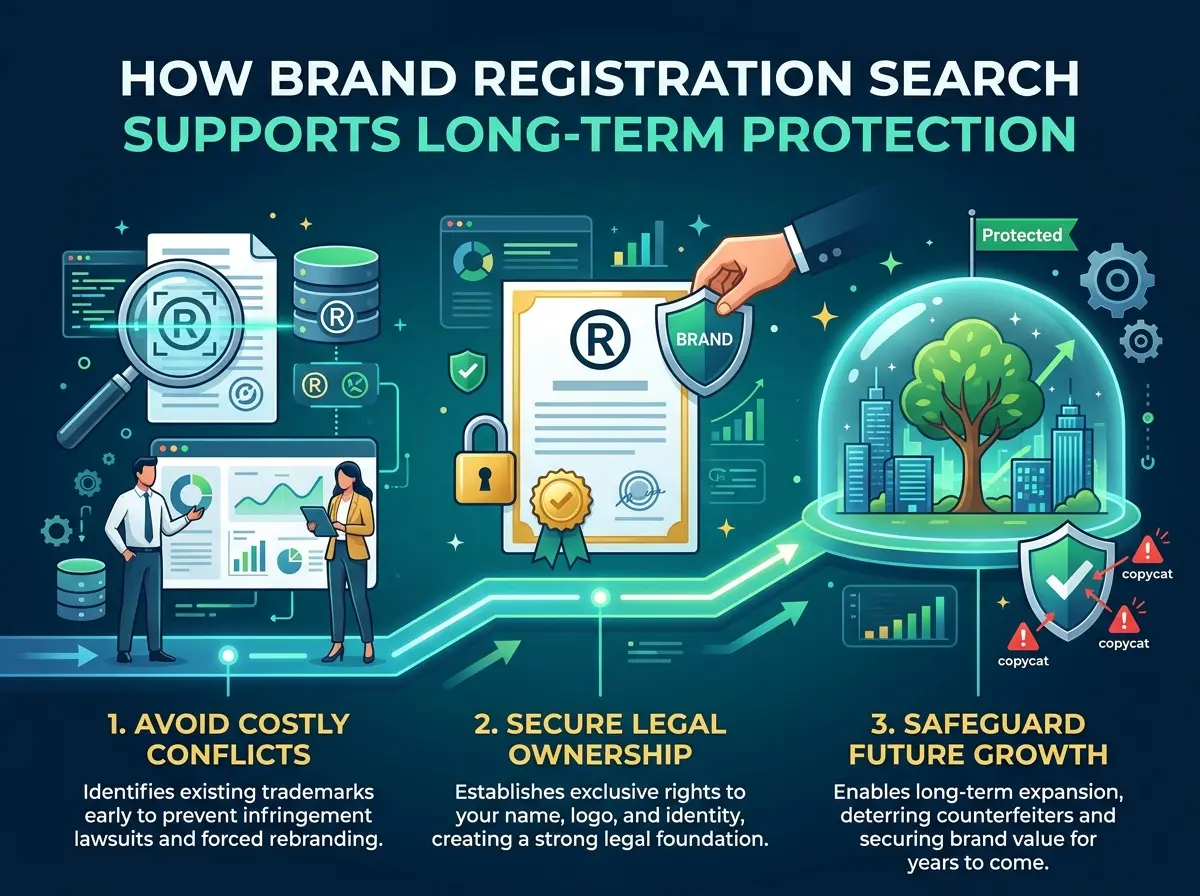
Once a business identifies a promising brand name, a brand registration search can provide further insight into existing applications and registrations. It helps establish whether similar identities have already entered the formal trademark system and whether there are pending applications that deserve attention.
This research is valuable because trademark records may contain information that is not visible through ordinary commercial searches. A competitor might be preparing to launch a product under a particular name, or an organization may have applied to register a mark before making its wider commercial presence obvious.
Reviewing registration records can also help businesses understand the competitive environment surrounding a proposed identity. If a name appears frequently in a relevant industry, it may be difficult to establish a distinctive position even when the exact proposed wording is not registered.
Brand registration research also supports the transition from naming to protection. After evaluating potential conflicts, a business can consider whether to apply for trademark registration in the markets and product or service categories that matter to its operations.
This process should be planned with future growth in mind. A business that expects to expand into additional product lines or countries may need to consider those plans when evaluating the scope of its trademark protection. A brand that is suitable for a small local operation may require a broader strategy when the company begins entering international markets.
Trademark Risk Assessment: Looking Beyond the Search Results
A trademark risk assessment brings the findings of the clearance process together. Rather than simply listing similar names, it evaluates the potential consequences of using the proposed identity.
Several factors can influence this assessment. The similarity between the marks, the relationship between their goods and services, the markets in which they operate, and the strength of existing rights may all be relevant. The business should also consider how widely it intends to use the proposed identity and how much investment will depend on it.
Some findings may indicate relatively limited concerns, while others may require a more detailed legal examination. A close similarity involving competing products, for example, may deserve more attention than a shared word used in unrelated commercial fields.
Risk assessment also encourages businesses to think about the practical consequences of a dispute. These could include changing a brand name, redesigning packaging, revising advertising materials, negotiating with another rights holder, or delaying a market launch.
The purpose is not to eliminate every imaginable risk. That would be unrealistic. Instead, it is to help decision-makers understand significant concerns before making commitments that could be difficult to reverse.
Brand Name Protection Begins With a Distinctive Identity
Brand name protection is easier to approach when businesses understand the importance of distinctiveness. A name that clearly separates a company from competitors can become a valuable commercial asset. By contrast, a highly descriptive or commonly used expression may be harder to distinguish and protect, depending on the relevant trademark laws.
Distinctiveness also contributes to customer recognition. When people can easily associate a name with a particular business, product, or service, the brand has a stronger foundation for consistent communication.
This is where the relationship between clearance and branding becomes especially important. A business should not choose a name only because it is legally available. The name should also communicate the right identity, appeal to its intended audience, and remain suitable as the organization develops.
The distinction between brand marketing and other promotional activities also matters. As explored in Brand Marketing vs Digital Marketing, brand development involves building a recognizable identity, while digital marketing focuses on using online channels to reach and engage audiences. Both can support business growth, but a consistent and properly evaluated brand identity gives these activities a stronger foundation.
The Brand Approval Process and the Role of Business Decisions
The brand approval process connects research findings with the final decision to adopt a proposed identity. It brings together the people responsible for branding, marketing, business operations, and legal review so that the decision reflects more than personal preference.
A creative team may prefer one name because it sounds memorable, while the marketing department may favor another because it fits the target audience. The clearance findings introduce another essential consideration: whether the proposed identity can be used with an acceptable level of risk.
When concerns emerge, the approval process provides an opportunity to reconsider the name or explore alternatives. Sometimes a small change may improve the distinctiveness of an identity, although changing a word does not automatically resolve a trademark conflict. In other situations, choosing an entirely different name may be the more practical decision.
Approval should also consider how the identity will be used across different channels. A name may appear on a website, social media accounts, product packaging, advertising campaigns, partnership materials, and promotional videos. Each use contributes to the brand’s public identity.
For businesses planning creator collaborations or promotional partnerships, these considerations can extend beyond the company’s own marketing channels. The identity should be consistently represented by external partners, which makes Brand Partnerships relevant to the wider process of building recognizable and trusted commercial relationships.
Brand Clearance in a Changing Digital Marketplace
Digital platforms have made it easier for businesses to introduce new brands and reach customers across different regions. A company can establish a website, publish promotional content, create social profiles, and begin selling products without the traditional barriers associated with physical expansion.
However, this accessibility also increases the importance of brand clearance. Businesses compete for attention in crowded online spaces where similar names, logos, and product identities can quickly create confusion.
YouTube channels, social media accounts, ecommerce stores, and influencer collaborations all contribute to brand visibility. A company that plans to build a presence through video promotion, for example, needs to consider whether its name and visual identity are distinctive across those channels. The commercial opportunities associated with How to Get Brand Promotion on YouTube become more useful when the brand being promoted has already been evaluated for potential conflicts.
Digital expansion also makes geographic considerations more important. A name that appears available in one market may create problems in another. Businesses operating internationally should therefore consider their intended markets before committing to a brand identity.
Once a brand is established, organizations should continue monitoring relevant developments. New trademark applications, changes in business activity, and unauthorized use of brand elements may affect the company’s position. Clearance is an important starting point, but ongoing brand management helps preserve the value built after launch.
Building a Stronger Business Identity Through Early Clearance

A successful brand represents more than a name or visual design. It reflects the company’s reputation, customer relationships, market position, and long-term commercial ambitions. Because so much value can become connected to a brand, selecting an identity without examining potential conflicts creates avoidable uncertainty.
Brand clearance helps businesses approach this decision with greater confidence. Through trademark searches, availability checks, intellectual property research, and risk assessment, organizations can better understand the environment surrounding a proposed identity.
The process also encourages better coordination between creative and commercial teams. Instead of treating legal considerations as an obstacle to branding, businesses can use clearance findings to make more informed decisions about distinctiveness, positioning, and future expansion.
No search can guarantee that a brand will never face a dispute. Trademark rights and legal requirements differ across jurisdictions, and complex cases may require advice from a qualified trademark professional. Nevertheless, evaluating a proposed identity before launch can reduce uncertainty and help businesses avoid costly mistakes.
Ultimately, a strong brand should be memorable to customers and practical for the business to develop and protect. Making brand clearance part of the early decision-making process gives that identity a more reliable foundation for long-term growth.
Frequently Asked Questions About Brand Clearance
1. What is brand clearance?
Brand clearance is the process of checking whether a proposed brand name, logo, slogan, or other identity element may conflict with existing trademarks or intellectual property rights. It helps businesses identify potential concerns before launching a brand.
2. Why is trademark clearance important?
Trademark clearance helps businesses identify possible conflicts before investing in branding, packaging, advertising, and other promotional activities. It can reduce the risk of disputes and costly brand changes.
3. What is included in a brand name search?
A brand name search may include trademark databases, business registries, internet searches, domain records, social media platforms, and relevant industry references. The scope depends on the business’s intended markets and activities.
4. Does an available domain mean a brand name is legally available?
No. Domain availability only indicates that a particular web address may be available for registration. It does not establish that the name is free from existing trademark rights or other legal restrictions.
5. What is the difference between trademark clearance and trademark registration?
Trademark clearance evaluates whether a proposed mark may conflict with existing rights. Trademark registration is the formal process of applying to protect a qualifying mark through the relevant trademark authority.
6. Can two businesses use similar brand names?
In some circumstances, businesses may use similar names, particularly when their products, services, markets, or geographic territories are sufficiently different. However, the outcome depends on applicable trademark laws and the specific facts.
7. What does a trademark risk assessment examine?
It examines factors such as name similarity, existing trademark rights, related products and services, geographic markets, and the likelihood of customer confusion. It helps businesses understand potential risks before adopting a brand.
8. When should a business conduct brand clearance?
Ideally, brand clearance should take place before a business commits to a name, logo, packaging, website, or major marketing campaign. Early research makes it easier to explore alternatives if potential conflicts appear.
9. Is brand clearance necessary for small businesses?
Yes. Small businesses can also face trademark conflicts. Evaluating a proposed identity early can help them avoid expensive changes as their customer base, online presence, and commercial activities grow.
10. Does brand clearance guarantee complete trademark protection?
No. Brand clearance reduces uncertainty but does not guarantee that a brand will never face a dispute. Trademark laws vary by jurisdiction, and new applications or commercial uses may emerge after the initial search.