Brand Naming Research: Build Recognition and Trust

Brand naming research helps businesses evaluate potential names for relevance, memorability, originality, availability, and audience appeal. Through competitor analysis, brand name validation, customer testing, and identity research, companies can select names that support their positioning and long-term goals. A well-researched name can improve recognition, reduce confusion, and provide a strong foundation for consistent marketing.
Choosing a brand name is one of the most important decisions in building a business identity. A name introduces a company to its audience, shapes first impressions, and influences how easily people remember and recognize the brand. However, selecting an effective name involves more than creativity or personal preference. Businesses need to understand their target audience, market position, competitors, and long-term goals before making a final decision. This is where brand naming research becomes essential.
Brand naming research is the process of evaluating potential names to determine whether they are relevant, distinctive, memorable, appropriate, and available for use. It helps businesses understand how a name may be perceived, whether it communicates the intended message, and how effectively it can support future marketing activities. A well-researched name can strengthen recognition, differentiate a business from competitors, and create a foundation for consistent brand communication.
Without proper research, companies may choose names that are difficult to pronounce, too similar to existing businesses, unsuitable for their audience, or challenging to protect legally. These problems can create confusion and lead to costly changes later.
A structured research process reduces these risks and helps decision-makers select a name based on meaningful evidence. By combining audience insights, competitor research, availability checks, and practical testing, businesses can create a brand name that supports their identity and remains relevant as they grow.
Understanding Brand Naming Research
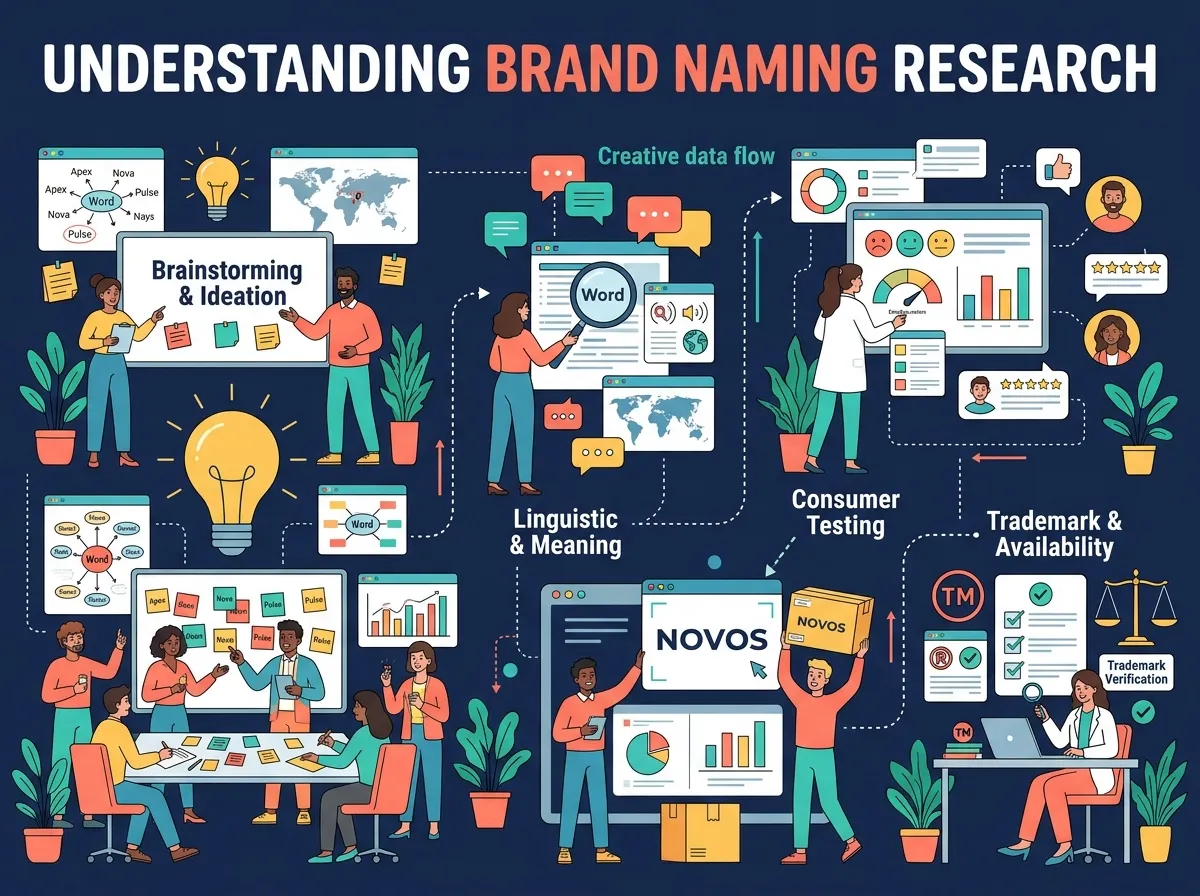
Brand naming research examines the relationship between a proposed name, the business it represents, and the people expected to interact with it. The objective is to identify names that communicate the right meaning while remaining distinctive and practical across different marketing channels.
A name may sound appealing but still create problems when used in the real world. It might be difficult to spell after hearing it, resemble a competitor’s name, carry an unintended meaning in another language, or lack suitable domain and social media availability. Research helps businesses identify these concerns before committing to a name.
The process usually begins with a clear understanding of the company’s purpose, audience, products, values, and competitive position. Researchers then explore naming directions, compare possible options, assess audience reactions, and investigate availability. Each stage contributes information that makes the final decision more reliable.
Brand naming research also connects with wider brand development. A name should fit the company’s intended identity and communicate a consistent impression across its website, advertising, packaging, customer service, and other touchpoints. Understanding customer perception can help businesses consider how audiences interpret names and what associations they may form before engaging with the brand.
Ultimately, effective research helps companies move beyond choosing a name simply because it sounds attractive. It provides a stronger basis for selecting a name that fits the business and makes sense to its intended audience.
Brand Name Analysis and Audience Relevance
Brand name analysis involves evaluating potential names according to their meaning, clarity, pronunciation, memorability, emotional associations, and suitability for the business. It helps organizations understand the strengths and weaknesses of each option before making a final selection.
One important consideration is relevance. A name should connect with the company’s purpose or desired positioning without limiting future growth unnecessarily. A highly descriptive name may communicate the current product clearly, but it could become restrictive if the business expands into additional services. An abstract or invented name may offer greater flexibility, but it might require more marketing effort before customers understand what the company does.
Pronunciation and spelling also influence how easily people remember and share a name. If customers frequently misspell it or struggle to say it, the business may experience difficulties with word-of-mouth referrals, search discovery, and everyday communication. Simple, distinctive names often have practical advantages, although complexity can work when it serves a clear creative purpose.
Emotional associations deserve attention as well. Different words can suggest reliability, innovation, affordability, sophistication, friendliness, or other qualities. Researchers should assess whether those associations match the intended brand personality rather than relying only on what the naming team personally prefers.
A useful brand name analysis compares options against consistent criteria. This makes it easier to identify names that are memorable and meaningful while avoiding decisions based entirely on subjective taste.
Developing a Clear Brand Naming Strategy
A brand naming strategy establishes the direction and criteria for developing a suitable name. Before generating ideas, businesses should clarify what they want the name to communicate, who the name needs to appeal to, and how the brand should differ from alternatives in the market.
The strategy should reflect the company’s positioning, audience expectations, values, and long-term business objectives. For example, a technology company may want a name that suggests innovation and adaptability, while a professional service provider may prioritize credibility and clarity. These are not universal rules, but they illustrate why naming decisions should be connected to the business’s intended identity.
Companies should also decide whether the name should describe the product directly, communicate a broader benefit, suggest a particular feeling, or establish a distinctive identity that can develop over time. Each approach has different advantages, depending on the category and the audience.
A strong naming strategy helps teams avoid generating large numbers of unrelated ideas. It creates a shared understanding of what makes a candidate appropriate and provides a framework for comparing alternatives.
This work can be supported by a broader brand strategy framework that connects naming decisions with positioning, communication, and long-term brand development. Although the framework may need to be adapted to the business’s own industry and objectives, the underlying principle remains useful: a brand name should support a consistent direction rather than operate as an isolated creative choice.
When the strategy is clearly defined, research becomes more focused, discussions become more productive, and the final decision is easier to explain and justify.
Business Name Research and Competitor Name Analysis
Business name research examines the market in which a proposed name will operate. It helps businesses understand existing naming conventions, identify crowded areas of the market, and discover opportunities to create a more distinctive identity.
Competitor name analysis is an important part of this process. By reviewing direct and indirect competitors, companies can identify repeated words, common naming structures, industry-specific expressions, and visual similarities. This information reveals which naming approaches are already widespread and where a new brand could establish a different position.
For instance, if many competitors use similar descriptive terms, a distinctive name may help a business stand apart. However, differentiation should not come at the expense of clarity. A name that is completely disconnected from the audience’s expectations may be memorable but difficult to associate with the relevant product or service.
Research should consider competitors beyond their names alone. Their positioning, audience, tone, visual identity, and public reputation can help explain why certain naming choices work in the market. Businesses can then identify opportunities to communicate a different personality or value proposition without imitating an established brand.
It is also important to examine similar names outside the immediate competitive set. A company in another industry may still create confusion if its name is widely recognized or if the businesses operate in related markets. Search engines, business directories, domain records, and relevant trademark databases can help reveal potential conflicts.
Competitor research should inform originality rather than encourage copying. The goal is to understand the naming environment and identify an identity that customers can distinguish from other businesses.
Brand Name Validation and Availability

Brand name validation determines whether a potential name is suitable for practical use. Even a name that performs well in creative discussions may encounter problems when businesses check legal rights, domain availability, social media handles, and existing commercial use.
Trademark research is particularly important. Companies should investigate whether identical or confusingly similar names are registered or used for related goods and services in the markets where they plan to operate. A name’s availability as a domain does not establish that it is legally safe to use, and a business registration does not automatically provide trademark protection.
For more reliable decisions, businesses should search relevant official trademark databases and consider professional legal advice before committing to a name. Similarity can involve pronunciation, spelling, meaning, and overall commercial impression, so a simple exact-match search may not be sufficient.
Brand name availability also includes practical digital considerations. A suitable domain can make the brand easier to find online, while consistent social media usernames can support recognition across platforms. If the preferred domain or handle is unavailable, businesses should evaluate alternatives carefully rather than adopting a confusing variation that resembles another brand.
International businesses need additional checks. A name that works in one language may have an unintended meaning, pronunciation problem, or cultural association in another. Local language research and audience feedback can help identify these risks.
Validation should happen before major investments in logos, packaging, advertising, or website development. Early checks reduce the chance of expensive rebranding and help businesses move forward with greater confidence.
Brand Name Selection and Decision-Making
Brand name selection brings the research together and identifies the strongest candidate for the business. At this stage, decision-makers should compare shortlisted names using consistent criteria rather than relying on the preferences of the loudest person in the room.
Useful criteria include relevance, memorability, pronunciation, spelling, distinctiveness, audience appeal, flexibility, digital availability, and potential legal conflicts. The relative importance of each criterion will depend on the business. A name intended for a local service company may need to communicate its offering clearly, while a consumer brand with international ambitions may place greater emphasis on linguistic suitability and adaptability.
A scoring system can help organize the comparison, provided it is used as a decision aid rather than an automatic answer. Some factors, such as a significant trademark conflict, may disqualify a candidate regardless of its creative appeal. Others, such as a minor pronunciation concern, may be manageable through branding and communication.
Decision-makers should also consider the name’s future usefulness. A name closely tied to one product or location may become restrictive if the company expands. On the other hand, an overly broad name may provide little immediate information about the business. The best choice balances present clarity with future flexibility.
Final selection should involve the relevant business stakeholders and reflect the evidence gathered throughout the research process. Documenting the reasons behind the decision can help teams maintain consistency as the brand identity develops.
Brand Naming Trends and Long-Term Relevance
Brand naming trends change as industries, technologies, consumer expectations, and cultural influences evolve. Some businesses choose short invented words, while others prefer descriptive names, familiar language, meaningful combinations, or terms that communicate a particular value.
Trends can provide creative inspiration, but they should not determine the entire naming decision. A name that feels fashionable today may become dated as competitors adopt similar approaches. Businesses that follow naming trends too closely may also struggle to distinguish themselves in crowded markets.
The more useful approach is to understand why a trend appeals to a particular audience and determine whether that underlying quality fits the brand. For example, a concise name may be attractive because it is easy to remember, while a descriptive name may be effective because it immediately communicates relevance. Those benefits can be evaluated independently of the trend itself.
Businesses should also consider how the name will work across different contexts. It needs to remain understandable when spoken aloud, displayed in a search result, placed on packaging, used in an advertisement, or shared in a conversation. A name that depends heavily on a temporary cultural reference may not work equally well in every setting.
Long-term relevance does not mean choosing a name that is completely neutral or predictable. Distinctive names can remain effective when they are supported by clear positioning, consistent communication, and meaningful customer experiences.
Researching naming trends alongside audience expectations and competitor activity helps businesses make creative choices without sacrificing originality or long-term usefulness.
Brand Name Testing and Customer Feedback
Brand name testing helps businesses understand how potential customers respond to different naming options. Instead of assuming that internal teams represent the target audience, companies can collect feedback from people who resemble the customers they want to reach.
Testing may explore how easily participants pronounce and recall each name, what qualities they associate with it, and what kind of business they expect it to represent. These responses can reveal unexpected interpretations or highlight differences between the intended message and the impression created by the name.
Qualitative interviews can provide context behind those reactions. Participants may explain why a name feels trustworthy, confusing, modern, ordinary, or unrelated to the product. Surveys can then help compare a larger set of responses, particularly when the questions and candidate presentation are consistent.
It is important to avoid leading questions. Asking people whether they like a name may produce limited information because personal preference does not necessarily predict recognition or commercial effectiveness. More useful questions explore what the name communicates, whether it is easy to remember, and what participants expect from a business using it.
Testing conditions should also be fair. Names should be presented in comparable formats so that one candidate does not benefit from a more attractive logo, stronger description, or additional explanation. If the name is intended for international use, testing should include relevant language and cultural contexts.
Customer feedback should inform the decision without replacing legal validation or business judgment. A name that receives positive reactions may still be unsuitable if it conflicts with an existing trademark or fails to support the company’s long-term direction.
Brand Identity Research and Consistent Positioning
Brand identity research examines how the name fits into the broader identity that a business wants to establish. A name does not operate independently; its meaning develops through the company’s visual design, messaging, products, customer service, and public reputation.
Research can help determine whether a proposed name supports the intended personality and market position. A business that wants to communicate expertise and reliability may need a different naming direction from one that emphasizes playfulness or experimentation. The name should feel consistent with the experience customers are likely to receive.
This is also where the relationship between branding and marketing becomes important. Brand marketing vs digital marketing explores two related but distinct areas: developing a recognizable brand and using digital channels to reach audiences. A strong name can support both by providing a consistent identity that appears across websites, social platforms, advertising, and customer communications.
Brand identity research should consider practical use as well. A name needs to work in a logo, website header, product label, presentation, and other branded materials. Some names look appealing in a written format but become difficult to understand when spoken or displayed at small sizes.
The research should also account for how customers may interpret the name after repeated exposure. Initial reactions matter, but long-term brand associations develop through consistent experiences and communication. A suitable name provides a foundation that the company can strengthen over time.
By evaluating naming decisions within the broader brand identity, businesses can create a more coherent presence and reduce the risk of choosing a name that feels disconnected from their actual positioning.
How Brand Naming Supports Marketing Conversion
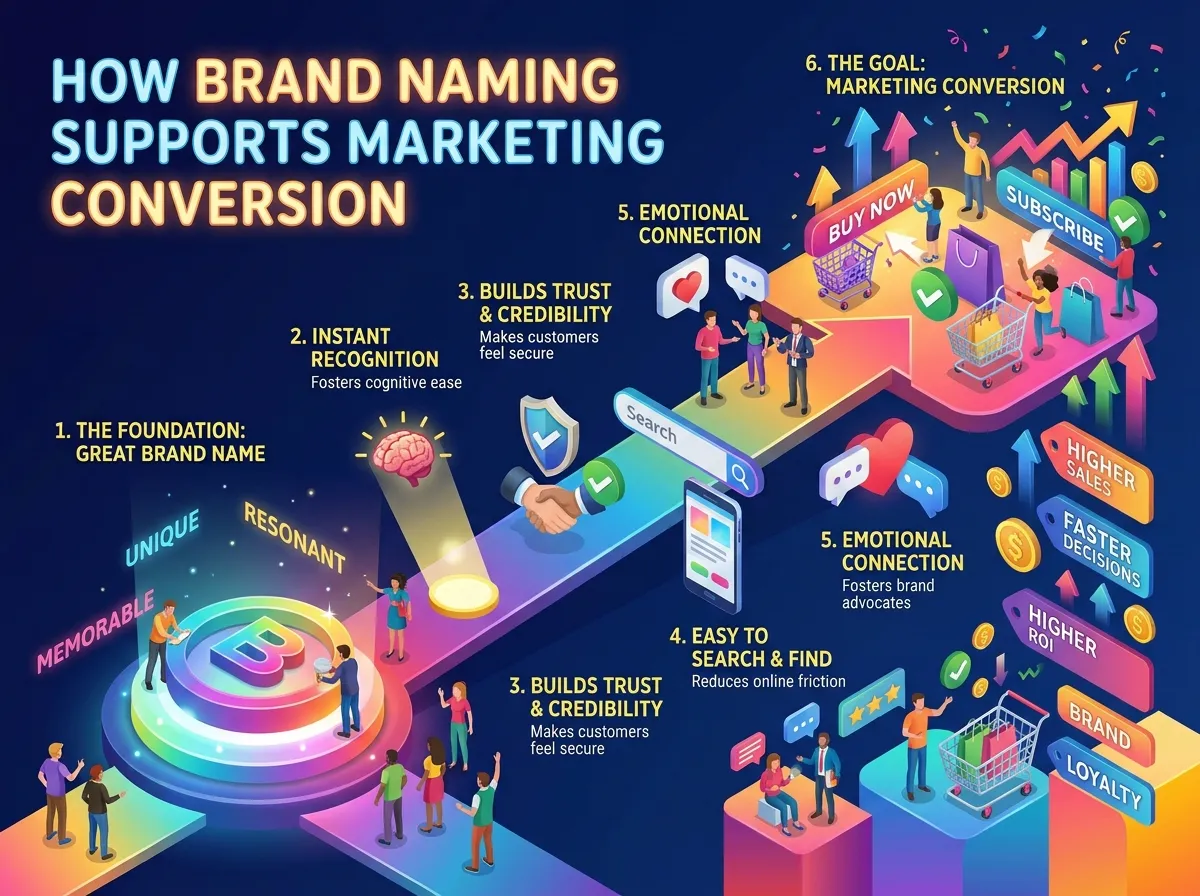
A brand name can influence how easily potential customers recognize, remember, and distinguish a business. Although a name alone cannot guarantee sales, it can contribute to the first impression that shapes whether someone pays attention to a brand or investigates its offering further.
Clear and memorable naming can also support advertising recall. When audiences encounter the same name across search results, social media, websites, and offline communication, consistency helps reinforce recognition. Confusing or highly similar names may make it harder for customers to identify the correct business and return to it later.
The connection between naming and marketing conversion is therefore indirect but meaningful. A relevant name can support brand recognition and reduce confusion, while conversions also depend on factors such as product quality, pricing, trust, user experience, messaging, and the strength of the offer.
Businesses should avoid assuming that an unusual name automatically produces better marketing results. An unfamiliar name may require more explanation, while a descriptive name may communicate value more quickly. The right choice depends on the audience, market, and role the name plays in the customer journey.
Once the name has been selected, companies can strengthen its impact through consistent messaging, relevant content, and reliable customer experiences. Over time, those activities help audiences connect the name with the qualities and benefits the business wants to represent.
Conclusion
Brand naming research helps businesses choose names that are distinctive, relevant, memorable, and suitable for long-term growth. By examining audience expectations, competitor naming patterns, brand identity, availability, and customer feedback, companies can reduce uncertainty and make more informed decisions.
A strong naming process combines creativity with practical evaluation. Brand name analysis clarifies the strengths of potential candidates, a naming strategy establishes direction, validation identifies legal and digital concerns, and testing reveals how real audiences interpret the options. Together, these activities create a more dependable basis for final selection.
The most effective brand name is not necessarily the most unusual or fashionable. It is the name that fits the business, resonates with its intended audience, stands apart from relevant competitors, and can be used consistently across marketing channels.
By treating naming as an important part of brand development rather than a quick brainstorming exercise, businesses can establish a clearer identity, strengthen recognition, and create a foundation for lasting customer relationships.
Frequently Asked Questions
1. What is brand naming research?
Brand naming research is the process of evaluating potential brand names to determine whether they are relevant, memorable, distinctive, appropriate for the target audience, and available for use.
2. Why is brand naming research important?
It helps businesses avoid confusing or unsuitable names, understand competitor naming patterns, identify potential legal issues, and choose a name that supports long-term brand development.
3. What is brand name analysis?
Brand name analysis evaluates potential names based on factors such as meaning, pronunciation, spelling, memorability, emotional associations, and relevance to the business.
4. How does a brand naming strategy help?
A brand naming strategy establishes the business goals, audience expectations, and criteria that guide name development. It helps teams compare options consistently and choose names that fit the intended brand identity.
5. What is business name research?
Business name research examines existing businesses, market conventions, audience expectations, and possible naming conflicts to determine whether a proposed name is suitable for the intended market.
6. How can businesses validate a brand name?
Businesses can validate a name by researching relevant trademarks, checking existing commercial use, reviewing domain and social media availability, testing audience reactions, and assessing linguistic or cultural concerns.
7. What is the difference between brand name availability and trademark availability?
Brand name availability may refer to whether a name can be used for a domain, social media account, or business registration. Trademark availability concerns potential conflicts with protected marks and requires appropriate research in relevant markets.
8. How can businesses test a brand name?
Businesses can test names through customer interviews, surveys, pronunciation and recall exercises, and questions about meaning and brand associations. Testing should involve relevant audiences and avoid leading questions.
9. Should businesses follow brand naming trends?
Naming trends can provide inspiration, but businesses should prioritize audience relevance, distinctiveness, usability, and long-term fit. Following trends too closely can make a name feel generic or dated.
10. How does brand naming research support marketing?
It helps businesses select names that audiences can recognize, remember, and distinguish from competitors. A suitable name can support consistent branding and marketing recall, although commercial results also depend on the product, messaging, customer experience, and overall strategy.