Brand Market Perception: Understanding How Customers See Your Brand

Brand Market Perception describes how customers and market audiences understand, evaluate, and compare a brand. It influences trust, perceived value, reputation, positioning, and purchasing decisions. By analyzing customer feedback, competitive differences, market sentiment, and brand experiences, businesses can identify gaps between their intended identity and actual market opinion. Consistent communication, meaningful customer experiences, and evidence-based brand strategy help create a stronger and more credible market position.
A brand may invest heavily in advertising, product development, customer service, and visual identity, yet still struggle to understand how people actually view it. A company might consider itself innovative, dependable, and customer-focused, while consumers associate it with high prices, outdated products, or inconsistent service.
This difference between what a business intends to communicate and what the market genuinely believes is the foundation of Brand Market Perception.
Market perception is shaped by every interaction people have with a brand. Advertising creates expectations, product experiences influence satisfaction, customer reviews affect credibility, and competitors provide a reference point for comparison. Over time, these experiences form a collective impression that can influence purchasing decisions, loyalty, and business growth.
Understanding this perception is essential for companies that want to build a meaningful market position. It helps businesses recognize whether their message is reaching the right audience, whether their reputation supports their goals, and whether customers see a clear reason to choose them over alternatives.
What Brand Market Perception Really Means
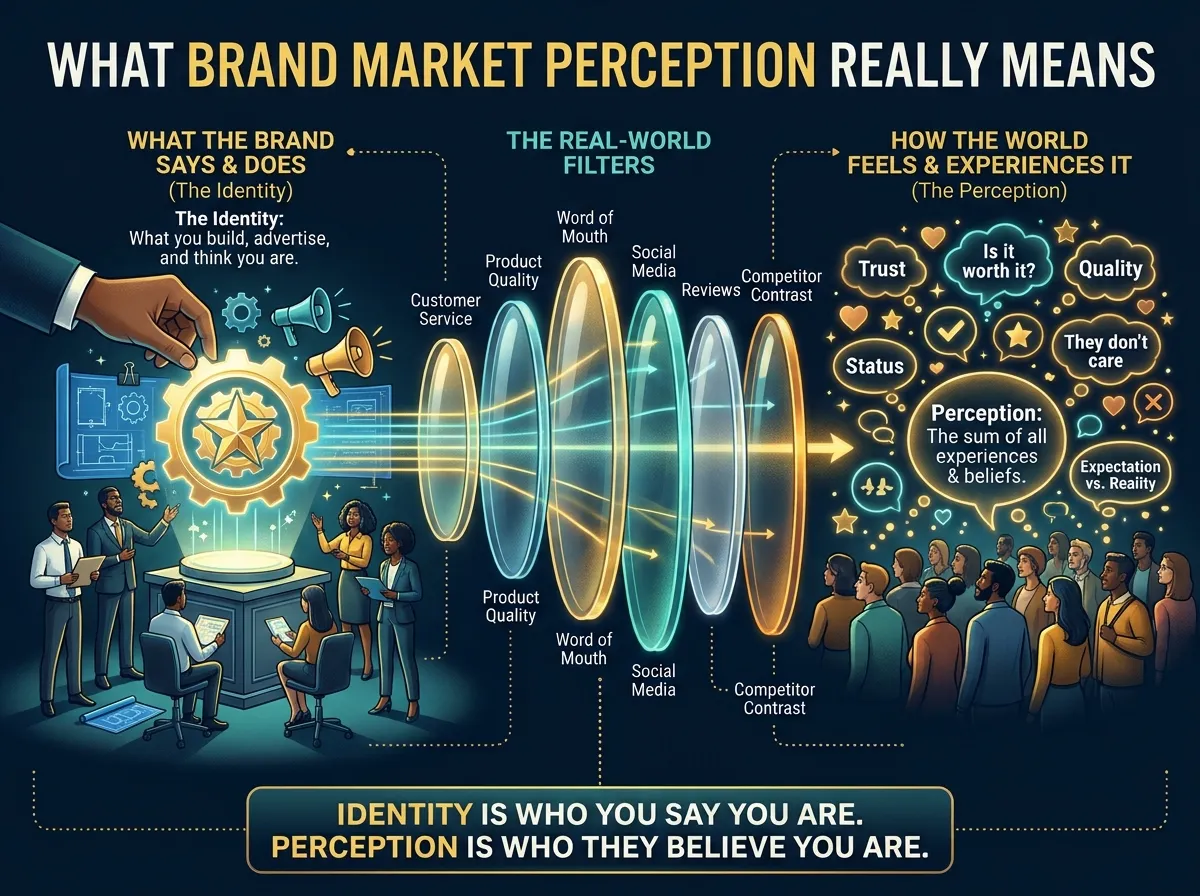
Brand Market Perception refers to the way consumers, prospects, industry professionals, and other market participants understand and evaluate a brand. It includes their beliefs about its quality, value, reliability, personality, and relevance.
Unlike a company’s official brand identity, market perception cannot be fully controlled by internal decisions. Businesses can shape their messaging and customer experiences, but the final impression develops through the audience’s interpretation of those experiences.
For example, a company may promote its products as premium and exclusive. If customers consistently experience poor service or receive products that do not meet expectations, the market may perceive the brand as expensive rather than premium.
This distinction makes Market Perception of a Brand an important business consideration. It reveals whether the company’s intended positioning matches the way people actually understand it.
Perception is also not limited to existing customers. Someone who has never purchased from a brand may develop an opinion through social media, recommendations, news coverage, or competitor comparisons. These impressions can influence whether that person considers the brand in the future.
Why Consumer Opinions Can Become a Competitive Advantage
In crowded markets, products and services often share similar features, prices, and capabilities. When customers struggle to identify meaningful differences, their perception of a brand can become a deciding factor.
Consumer Brand Perception influences whether a business appears trustworthy, innovative, affordable, convenient, or worth paying more for. These associations can make a brand easier to recognize and more attractive to a particular audience.
Consider two companies offering similar software. One is perceived as simple, reliable, and helpful, while the other is viewed as complicated and difficult to support. Even if both products offer comparable functionality, customers may prefer the first company because its reputation reduces uncertainty.
Perception can also influence the amount of effort customers are willing to invest in evaluating a brand. A familiar and respected company may receive more consideration than an unfamiliar competitor, even when the competitor offers a lower price.
However, positive perception must be supported by real performance. A brand that depends entirely on advertising claims may lose credibility when customers encounter experiences that contradict those promises.
The strongest competitive advantage comes from aligning what a brand communicates with what it consistently delivers.
Brand Image in the Marketplace: More Than a Logo
A brand’s marketplace image includes far more than its visual identity. Logos, colors, typography, and packaging help people recognize a company, but they do not fully explain what the company means to its audience.
Brand Image in the Marketplace develops through a combination of practical and emotional associations.
Customers may connect a brand with:
- Product quality and reliability
- Customer service and responsiveness
- Price and perceived value
- Innovation and product development
- Social responsibility and business conduct
- Convenience and ease of use
- The experiences of other customers
These associations can reinforce one another. A company known for reliable products and helpful service may gradually become associated with trust. A business that frequently changes its messaging or delivers inconsistent experiences may create confusion.
Marketplace image also changes as customer expectations evolve. A brand that once represented convenience may lose that association if competitors introduce faster or more flexible services.
This is why brand perception should be treated as an ongoing business reality rather than a fixed outcome of a branding campaign.
The Difference Between Brand Reputation and Market Position
Brand reputation and market position are closely connected, but they describe different aspects of a company’s standing.
Brand Reputation and Market Position involve both how people evaluate a company and how the company competes within its category.
Reputation reflects the beliefs and judgments people hold about a brand. Market position describes the place a brand occupies in the minds of customers relative to competing businesses.
A company may have a strong market position because it is widely recognized, but its reputation could weaken after repeated customer complaints. Similarly, a smaller business may have an excellent reputation among a specialized audience without holding a large share of the overall market.
The relationship between these concepts becomes especially important when a business wants to reposition itself.
A company moving from a low-cost offering toward a premium market needs more than a new advertising campaign. It must create experiences, product quality, service standards, and communication that support the intended position.
If customers continue to associate the brand with low prices and limited features, the new positioning may feel unconvincing.
Successful positioning requires a clear understanding of existing perception and a realistic plan for changing it.
How Customers Decide Whether a Brand Offers Real Value
Price is visible, but value is often perceived.
Customer Perception of Brand Value develops when customers compare what they receive with what they believe they are giving up. This includes money, time, effort, risk, and attention.
A higher-priced product may still be considered valuable if customers believe it offers superior quality, dependable performance, useful features, or a better experience. Conversely, a low-priced product may appear unattractive if buyers expect it to fail or require frequent replacement.
Perceived value also depends on the audience. A feature that matters greatly to one customer group may be unimportant to another.
For example, business buyers may prioritize reliability, integration, and support, while individual consumers may focus more on convenience, design, or affordability.
Brands need to understand these differences before deciding how to communicate their value. A message that emphasizes premium craftsmanship may work for one audience but fail to address the practical concerns of another.
Value perception becomes stronger when marketing promises are supported by evidence. Product demonstrations, transparent pricing, customer experiences, and clear service commitments help people understand what makes a brand worth considering.
Brand Awareness Does Not Always Mean Positive Perception
A brand can be widely recognized without being highly regarded. Awareness tells businesses whether people know or remember a company, while perception reveals what they think about it.
Brand Awareness and Market Perception should therefore be evaluated together, but not treated as interchangeable.
A company may achieve strong awareness through frequent advertising, viral content, or extensive media coverage. Yet if people associate it with poor quality or unreliable service, increased recognition may not produce the desired business results.
On the other hand, a smaller brand may have limited awareness but a strong reputation within a specific market segment. Its customers may trust the company and recommend it to others, even though the broader public knows little about it.
This distinction helps businesses interpret marketing performance more accurately.
Awareness campaigns can introduce a brand to new audiences, but the experience that follows determines whether those audiences develop favorable opinions.
Companies should therefore look beyond reach and impressions. They should also examine customer sentiment, perceived quality, trust, relevance, and the reasons people choose or avoid the brand.
Understanding the Competition Through Perception
Customers rarely evaluate a brand in isolation. They compare it with alternatives, even when they do not consciously conduct a formal comparison.
A brand may be perceived as affordable because its competitors are more expensive. Another may appear innovative because competing products have changed very little. These impressions depend on the wider market context.
Competitive Brand Perception Analysis helps businesses understand how their image differs from that of other companies serving similar audiences.
The purpose is not simply to imitate competitors with favorable reputations. Instead, it is to identify meaningful differences in how customers evaluate the available choices.
For example, research might reveal that several competitors are associated with low prices, while customers believe the category lacks dependable customer support. A company could use that insight to build a stronger position around service quality.
Competitive analysis can also uncover perception gaps. A business may believe its products are more advanced than alternatives, but customers may not recognize those differences. This suggests that the company needs clearer communication, better demonstrations, or more visible proof of its capabilities.
The most useful competitive insights come from understanding why people hold particular opinions, not just measuring which brand receives the highest score.
Brand Positioning Begins With the Customer’s Perspective

Brand positioning is often discussed as a strategic decision made by leadership or marketing teams. In practice, positioning becomes meaningful only when customers understand and recognize it.
Brand Positioning in Consumer Markets involves creating a distinct and relevant place for a brand within the audience’s mind.
A company may want to be known for affordability, expertise, convenience, sustainability, or premium quality. However, the intended position must be credible and relevant to the people the business wants to reach.
The process begins with understanding the audience’s needs and existing expectations. Customers may value benefits that the company has not considered important, or they may misunderstand the brand’s central promise.
This is where perception research becomes useful. It can reveal whether the audience sees the brand as intended and whether its positioning stands apart from competing options.
Emotional connections can also influence positioning. People may choose brands that reflect their values, aspirations, or personal experiences. Businesses exploring Emotional Marketing can use these insights to understand how feelings and associations contribute to customer relationships.
A strong position is not simply a clever slogan. It is a recognizable promise that customers believe the brand can consistently fulfill.
Measuring Market Sentiment Toward Brands
Customer perception is not always expressed through formal surveys. People share opinions in reviews, social conversations, product discussions, customer support interactions, and personal recommendations.
Market Sentiment Toward Brands reflects the overall tone and direction of these opinions. It can provide useful insight into how customers respond to a company’s products, campaigns, decisions, and public reputation.
Positive sentiment may indicate satisfaction, confidence, or enthusiasm. Negative sentiment can reveal frustration, unmet expectations, or concerns about a brand’s conduct.
However, sentiment should be interpreted carefully. A large volume of positive comments does not automatically mean that every customer is satisfied. Likewise, a negative discussion may focus on a temporary issue rather than the brand’s overall reputation.
Businesses should examine the context behind customer opinions. A recurring complaint about delivery, for example, may indicate an operational problem that advertising alone cannot solve.
Combining sentiment analysis with customer feedback, service data, and market research creates a more complete understanding of perception.
The purpose of monitoring sentiment is not to react to every comment. It is to identify meaningful patterns and respond to the issues that influence customer confidence.
Global Markets Can Interpret the Same Brand Differently
A brand that performs well in one market may face different expectations in another. Cultural values, language, purchasing habits, local competition, and economic conditions can influence how people interpret a company’s identity.
A message that communicates prestige in one region may feel distant or impractical elsewhere. A product feature that attracts customers in one market may have little relevance in another.
This makes international perception especially important for businesses expanding beyond their original audience.
Companies must preserve the core elements that make their brand recognizable while adapting communication and experiences to local expectations. This balance is explored through Global Brand Localization, where consistency and cultural relevance work together.
Localization should not create completely different brand identities in every market. Instead, it should make the same underlying promise understandable and meaningful to different audiences.
Understanding local perception helps businesses avoid assumptions and develop stronger relationships with customers across regions.
Turning Perception Insights Into Better Brand Decisions

Market research becomes valuable when businesses use it to make informed decisions.
If customers perceive a brand as difficult to use, the company may need to improve product design or customer support. If buyers believe the brand offers little value, pricing, communication, or product benefits may require closer examination.
When the market sees a company as outdated, innovation and more relevant messaging may help address the gap. If customers question its credibility, transparent communication and consistent service can gradually rebuild trust.
These decisions should be based on evidence rather than assumptions.
The commercial impact of brand strategy can also be evaluated through The ROI of Brand Strategy, which connects brand investment with business outcomes such as customer retention, preference, and growth.
Brand consistency plays an important role in this process. Clear standards help businesses maintain recognizable communication across teams, channels, and customer touchpoints. A strong Brand Governance approach can support this consistency while allowing the brand to adapt thoughtfully.
Ultimately, improving perception requires more than changing the message. It requires identifying the reasons behind customer opinions and addressing them through meaningful business action.
Conclusion: Perception Is the Brand Customers Experience
A company’s identity may begin with its mission, values, and visual presentation, but its reputation develops through the experiences and opinions of the people it serves.
Brand Market Perception provides a valuable perspective on how customers understand a business, compare it with competitors, and decide whether it deserves their trust.
By examining consumer opinions, marketplace image, perceived value, brand positioning, and market sentiment, businesses can identify opportunities to strengthen their reputation and communicate more effectively.
The most successful brands do not rely on the image they want to create alone. They pay attention to the image customers actually experience.
When a brand’s promise, performance, and communication align, perception becomes more than an abstract marketing concept. It becomes a foundation for customer confidence, competitive distinction, and sustainable business growth.
Frequently Asked Questions
1. What is Brand Market Perception?
Brand Market Perception is the way customers, prospects, and other market participants view and evaluate a brand. It includes opinions about quality, value, reputation, reliability, and relevance.
2. Why is brand market perception important?
It influences customer trust, purchasing decisions, loyalty, competitive preference, and the ability of a business to maintain a strong market position.
3. What factors influence consumer brand perception?
Product quality, customer service, pricing, advertising, reviews, social media, brand reputation, and personal experiences all contribute to consumer perception.
4. How is brand perception different from brand identity?
Brand identity is how a company presents itself through its values, messaging, and visual elements. Brand perception is how the audience interprets and evaluates that identity.
5. How can businesses measure brand market perception?
Businesses can use customer surveys, interviews, reviews, social listening, sentiment analysis, competitor research, and brand tracking studies to understand market opinions.
6. Does brand awareness guarantee positive market perception?
No. Awareness measures recognition, while perception measures what people think and feel about a brand. A widely recognized brand may still have a weak reputation.
7. How does competitive brand perception analysis help?
It reveals how customers compare a business with its competitors, identifies market gaps, and helps companies develop more distinctive and relevant positioning.
8. Can brand market perception change over time?
Yes. Customer experiences, product improvements, market trends, public communication, and business decisions can gradually change how people view a brand.
9. What role does customer experience play in brand perception?
Customer experience provides direct evidence of a brand’s promises. Consistent and helpful experiences can strengthen trust, while repeated problems may damage reputation.
10. How can a business improve its brand market perception?
A business can improve perception by understanding customer feedback, addressing service or product problems, communicating clearly, maintaining brand consistency, and delivering experiences that support its intended positioning.